
How geopolitics is driving Japanese energy investments in Scotland
Japanese companies are making strategic investments in Scotland’s energy jigsaw


Drive south from the village of Nigg at the entrance to the Cromarty Firth and a picture unfolds that’s typical of the coastal Highlands: sheep grazing in neatly cropped fields and flocks of geese gathering for winter at the water’s edge.
A little further on, however, the outline emerges of vast, hangar-sized buildings spread across 400,000 square metres and various large quaysides.
This is Port of Nigg, which traces its roots to the North Sea oil and gas industry. The facility is emblematic of a new wave of foreign investment in Scotland’s energy sector since American investment in the Northeast in the 1970s helped turn the UK into a global oil and gas powerhouse in the decades that followed.
Port of Nigg was operated for years by Texas-based Brown and Root as an oil platform construction and maintenance yard until it closed in 2000.

This time, it’s Japan that’s investing. Its companies have been active in Scotland for decades, including a Mitsubishi Electric air conditioning factory that’s operated in Livingston since 1994. But energy is the big new focus, with one of the country’s big industrial conglomerates, Mitsui, buying Port of Nigg from its owner, Roy MacGregor’s Global Energy Group (GEG) in July. Mitsui first invested in GEG in 2012, taking a little over 25 per cent. Now, it will own not only Port of Nigg but its shipping unit, Mitsui Osk Lines (MOL), will also have a stake.
The move is the latest in a series of strategic investments by Japanese companies in Scotland’s energy jigsaw, made up of oil and gas servicing and offshore wind, especially the floating wind farms to be deployed in the North Sea under Crown Estate Scotland’s ScotWind project.
Marubeni, a rival conglomerate, is involved in developing the “Ossian” wind farm with partners SSE and Copenhagen Infrastructure Partners of Denmark.
Tokyo Electric Power Company is part-owner of Green Volt, a planned floating offshore wind farm that’s part of a scheme to decarbonise oil and gas rigs.
Yet another Japanese company, Sumitomo Electric, is building a £350 million factory the size of 21 football fields on land next to Port of Nigg. Next year it starts producing the subsea “interconnector” cables needed to link the UK up with continental Europe. Another type of cable used to link offshore wind farms with each other, and to send the power they generate onshore, will be made later.
Such investments are a sign of the opportunities that stem from the UK’s renewables push – most recently seen in this month’s announcement by Chinese wind turbine manufacturer Ming Yang of plans to invest up to £1.5 billion in a wind turbine parts factory down the road from Nigg at Ardesier Port.
But they also highlight how the fracturing of the world order as a Trump-led US grapples with China, resource nationalism and trade frictions are all prompting like-minded allies to strengthen economic and investment ties.
Julia Longbottom is Britain’s ambassador to Japan. On Monday, she visited Port of Nigg as part of a four-day “roadshow” in the UK designed to strengthen bilateral investment ties. “Japanese investors have been incredibly committed to the UK over time and now they are adapting to the newer strategic industries that we both care about, like offshore wind. So having this connection from almost opposite ends of the globe is a really important play in terms of energy security and national security,” she told me.
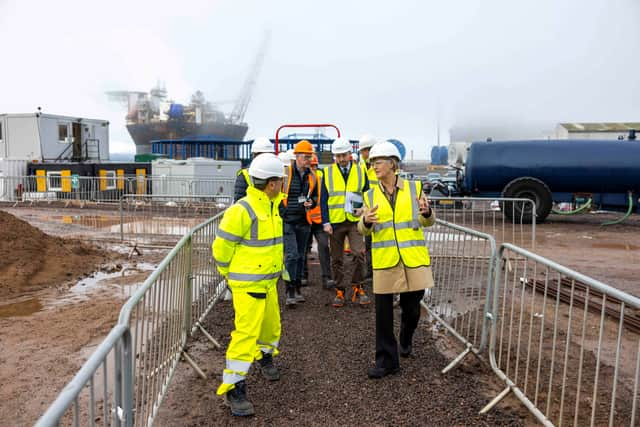
This explains much of what is happening at Port of Nigg. “As these cables are critically important for energy security, we strongly believe our new factory will contribute significantly not only to employment, the economy, and the local supply chain, but also to energy security,” Yasuyuki Shibata, chairman of Sumitomo Electric Europe, said on a tour of the partially built factory. Mitsui’s history with, and ambition for, Port of Nigg highlights why Japanese conglomerates are ideally suited for projects of this scale. It has already invested £120 million in the port since acquiring its minority stake in 2012, turning it from a facility focused mostly on rig maintenance to one that has handled parts fabrication and assembly for four offshore wind farms - book-ended by SSE Renewables’ “Beatrice” project in 2018 and the Moray West wind farm that was switched on by Ocean Winds in April.
Moreover, Japanese conglomerates have global scale across multiple industrial, shipping and trading businesses, giving them significant advantages as they cross-fertilise knowledge and experience across the entire group.
Tokyo-headquartered Mitsui, which is active in over 60 countries, sees Port of Nigg as an asset that can be used to developing the supply chain for offshore wind in the UK and beyond, much in the way Mitsui has done for the automotive supply chain in Japan. At the time of its initial investment in the port, Mitsui was “already thinking about the energy transition,” explains Yoshihiro Hayakawa, a career Mitsui employee who is now Port of Nigg’s chief executive.
This means leveraging the shipping expertise of MOL in maximising the operations side of Port of Nigg, using Mitsui’s global steelmaking and trading business in the manufacture of steel towers for wind turbines, and tapping into the expertise of GRI Renewable Industries, a Spanish wind company that Mitsui also owns.
Yet with the global offshore wind industry facing what it hopes are short-term financial and political headwinds, Mitsui is nonetheless hedging its bets. Hayakawa, who was previously at GRI, explains that while offshore wind will likely make up 70 per cent of the business, oil and gas will still be in the mix: “It depends on the situation. Balance is important. The key is how to diversify the business by looking at the market situation.”
Comments
Want to join the conversation? Please or to comment on this article.