
How a changing climate is impacting business investment in Scotland
“Some businesses told us they don’t have good enough information about the climate risks they face”
COP-31 has put a changing climate back in the spotlight, but, closer to home there’s a much more practical question for businesses here in Scotland: is the weather starting to influence where companies choose to invest?
New Barclays research suggests it is.
Our Business of Adaptation report surveyed 700 medium and large businesses across the UK. It found that 82 per cent now see adapting to the effects of climate change as an immediate priority. Yet only 7 per cent believe they’re fully prepared.

That’s quite a gap. And, for Scotland, one of the most interesting findings is that this is already feeding into real business decisions.
Across the whole of the UK, 36 per cent of businesses surveyed said climate risk had influenced where they chose to put new sites or facilities over the past five years. A similar number said more extreme weather had affected decisions about moving or bringing supply chains closer to home.
However, half of the Scottish companies surveyed for the report stated that in the last five years they have redirected investment away from assets, sites or regions that have a high climate risk.
So why does this matter for Scotland? Because attracting investment is, ultimately, a competition for growth between places.

Think about what goes into a decision to open a factory, expand an office or invest in a major new facility. Businesses look at whether they can find the right people, how good the transport links are, whether the infrastructure works, how much it’ll cost to operate and how easily they can reach customers and suppliers.
Our research suggests they’re increasingly asking another question too: how resilient is this place if something goes wrong? For Scotland, that matters across almost every part of the economy.
Manufacturers need reliable roads, railways, ports and power. Food and drink businesses depend on farmers and suppliers spread across the country. Tourism relies on transport and local infrastructure. And practically every company needs its offices, technology, energy and supply chains to keep working.
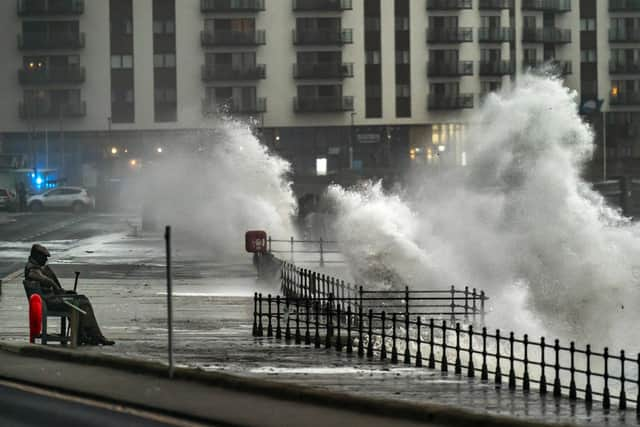
More regular extreme weather turns from a weather story into a business problem if staff can’t get to work, deliveries can’t get through or a site must regularly stop operations or even close.
Of course, that doesn’t mean businesses will simply stop investing in places where there’s a risk of flooding or severe weather. Almost everywhere carries some kind of risk.
The question is how well places understand those risks, and what they’ve done to prepare for them. That could become an increasingly important part of Scotland’s pitch to investors.
When we talk about what different parts of Scotland can offer a business, we tend to talk about skills, universities, areas of industrial expertise, infrastructure and connectivity. All of those things still matter.
But resilience itself is becoming a growth opportunity, with the report finding that Scotland is seen as the third most attractive region from a climate resilience perspective. This is a strength that the country could look to build on. At the same time, this matters because many Scottish businesses are struggling to justify adaptation investments.
In our research, businesses told us there are always other priorities competing for investment. For Scottish businesses, 59 per cent said that competing business priorities were holding back adaptation investment, which is higher than the UK average.
Firms also stated they can struggle to work out what the return would be on investing in measures that protect against a changing climate. Some businesses told us they don’t have good enough information about the climate risks they face. Others don’t yet have the expertise to work out what they should do about them.
You can know that flooding or extreme heat could cause problems for your business without necessarily knowing whether you should spend money protecting a particular site, rethink a supply route or invest somewhere else entirely.
And that, I think, is where this becomes a very real business discussion, rather than an abstract climate one.
Business leaders are used to thinking about risk. They consider what could interrupt production, push up costs, disrupt suppliers or make a planned investment less attractive. Increasingly, severe weather belongs in that conversation too.
A year of more extreme weather events has brought some of these questions back to the fore. But businesses don’t need to wait for international negotiations like COP-31 to play out before asking what they mean for their own operations.
And there’s a bigger consideration for Scottish businesses here. If resilience is starting to influence where companies put their money, then places that can give businesses confidence they’re well prepared may have an advantage when competing for investment.
So, for me, responding to the changing physical impacts of climate is not just a problem to be solved but a potential opportunity for Scotland’s growth and competitiveness.
Scottish businesses are already making decisions about where they invest and what they protect, and weather and climate risks are increasingly part of those decisions.
However, they also need to start seeing adaptation as not simply a cost of responding to climate change but rather recognise that greater resilience can also be an economic asset. The research shows that Scotland is already seen as more resilient than some other parts of the UK. Building on this will further strengthen the attractiveness of Scotland as an investment destination and increase its competitiveness.
For Scotland, being ready for climate change could be about much more than managing risk. It could become part of how we compete for the investment, businesses and jobs of the future.
Jamie Grant, head of Barclays Corporate Banking, Scotland
Comments
Want to join the conversation? Please or to comment on this article.