
Honda Super-N review: a tiny electric city car that delivers
Honda is bidding to reignite its venture into the world of electric cars withthis titchy, titchy ‘Bulldog’, writes Jim McGill
Honda is bidding to reignite its venture into the world of electric cars with the introduction of this titchy, titchy Super-N. But while it may be small in stature, it delivers big time in terms of city range, fun, versatility, and price. It starts at £18,995. Yup, you read that correctly: £18,995. There’s only one trim, and it comes with oodles of kit.
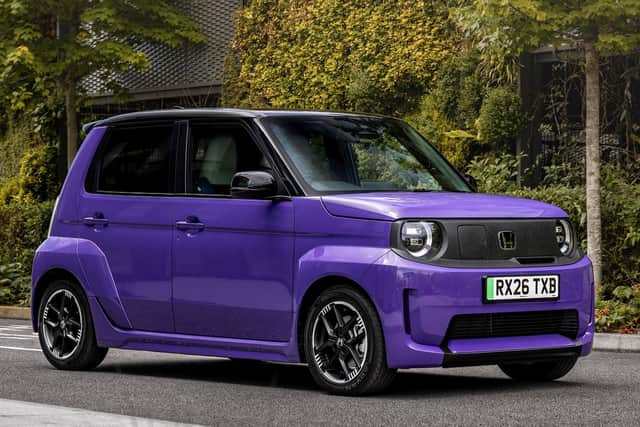

Honda basically pulled the plug from its EV products after it stopped sales of the excellent Honda e, and the disappointing e:Ny1 was discontinued. But after significant multi-billion pounds losses in 2025, the Japanese car giant has realised it desperately needs to increase its EV sales. And it believes this city runabout will prove to be a significant return to the EV world. Initially the company had promised so much when, back in the summer of 2020, it introduced the retro-futuristic Honda e. It was a hoot to drive and was beautifully designed inside and out. But it was expensive, at a smidge under £30,000, and had a range of only 136 miles. In January 2024, Honda officially pulled the e from sale in the UK due to slow sales. As for the e:Ny1, well enough said really. So now, Honda is putting all its electric faith in the little Super-N. Can it punch above its size and deliver? Only one way to find out.
Ok, tell me more about the Super-N The Super-N is based on Honda’s Japanese market N-Series kei car platform. Right, first things first: what’s a kei car? Just after World War II, Japan introduced the kei-jidosha – which translates to ‘light vehicle’ – in an effort to get the market back on its feet. The kei car market is still going strong in Japan today, and the teeny Honda N-Box has been the best-selling car in Japan for the past four years. In Japan you can only buy a new car if you can prove you have a personal, dedicated parking spot. Space, as we know, is at a premium in any of Japan’s cities and towns, so the kei cars were always designed small. But the dimensions have developed. The most recent major update to the kei cars regulations was introduced in 1998. As a result of crash safety regs, the maximum dimensions were increased to 3.4m in length and 1.48m in width. The 2m height limit has remained in placed since it was first introduced in 1949.
So, this is a kei car for the UK? Well, not exactly. Based on the N-One currently sold in Japan, the Super-N is larger, being 1573mm wide. Honda has also fitted a wider track, chunky arches, uprated brakes, bespoke alloys, a proper little spoiler and protruding bumpers. Oh, and there’s a cute F1 rain-type light at the rear of the car. Design-wise it has been inspired by the brilliant City Turbo II of the 1980s. It received the nickname, Bulldog. One look at the Super-N and you can clearly see the resemblance. And the newcomer has something of a bite. Kei cars are restricted to a maximum power output of 63bhp. That’s ideal for everyday pootling about the town in your Super-N. But when you want to put a big smile on your face, press the ‘Boost’ button on the steering wheel and the front-drive electric motor unleashes a whopping 94bhp. Just stay canny. That power can arrive with a bit of a whoosh.
What’s it like to drive? Let’s start with it in ‘Standard’, 63bhp mode. In town it’s perfectly acceptable. It’s sprightly enough to deal with everyday traffic and naturally is a dawdle to place in traffic and parking. Dare I say it: it’s the perfect city car. And it’s fun. Boosted by the fact it tips the scales at a paltry 1097kg, one of the lowest weights in the sector. Plus, with the car’s compact, thin battery being stored below the floor it has a low centre of gravity. But the real excitement starts when you press the Boost button. Importantly, it’s not one of these boost additions you can only use for a limited time. You can run the Super-N on Boost all the time if you prefer. The problem is, having used it once I defy you to switch back to the 63bhp standard output next time you get into the car. It’s fun with 63bhp and 40kW, but with 94 and 70kW? Well, you won’t stop smiling. The 0-62mph time plummets from 14.5secs to 10secs. There’s a greater urgency off the line when you take off from standstill, and that acceleration is supported audibly by a four-cylinder soundtrack which apparently was inspired by both the City Turbo II and the Integra Type R. The standard default is to the simulated seven-speed automatic ‘box, but you can further enhance the enjoyment of the 119lb/ft of torque by activating the manual mode by holding the left-hand paddle for three seconds. Miss a shift, and yes you will hit the limiter, but boy it’s fun. Oh, and you also get ‘engine braking’. Yes it’s simulated by using different levels of regen, but it just adds to the fun.
Are there different modes on the Super-N There are. We know Boost is available via the button. But there’s also Sport, which has a 30 per cent lower red line but retains the fake gearshifts; and City which, not surprisingly, activates one-pedal driving. Switch into Normal mode and you can use the paddles to change the regen level, and finally there’s Eco which will maximise driving range.
What about range and charging? Honda quotes the Super-N will cover 128-miles of range from its 29.6kWh battery, based on the WLTP cycle which, as we know, includes mixed driving conditions. According to Honda, restrict the city car to town driving and you should be able to cover 199 miles. That said, my test route did include A-roads and a section of motorway where it sat comfortably at 70mph, so don’t think it can’t do the business out of town. As for charging, using a 50kW charger will see you replenish from 10 per cent to 80 per cent in around 30mins. Plug in with a Type 2 AC charger with a 7.4kW supply and it will tale around four-and-a-half hours.
What’s it like inside? In a word: brilliant. Given its tiny footprint, the internal packaging of the Super-N instantly gives you the feeling of a much bigger car. My 5ft 9in frame, along with my slightly shorter colleague, had acres of space. I spoke with a 6ft-plus colleague, and he equally had more than enough headroom in the front; plus he could comfortably sit behind himself in the rear. And joy of joy: the Super-N has been fitted with Honda’s ‘Magic Seats’. They first appeared in the original Jazz and were an instant hit. The very clever system first allows the rear seats to be folded completely flat. Put them back into position, then you can flip the actual seat base up to rest against the seatback and you have a floor-to-ceiling storage space immediately behind the front seats. And that floor is completely flat. It’s genius, and makes then Super-N one of, if not THE most practical small EVs on the market. Upfront there are two very sporty, heated seats with a smart asymmetric design and chunky bolsters. They hugged me perfectly, but some larger hips might find it a tad tight. And not only is the steering wheel leather, but it’s trimmed with some funky blue stitching. The driver gets a 7.0in display in front of them with all the necessary info, and depending on what driving mode you’re in it changes colour. Centrally there’s also a 9.0in touchscreen which is easy to use and very responsive. It’s also supplemented by a clutch of proper, physical buttons for the other major controls. Well done Honda. Satnav isn’t included, but such is the tech that Honda has worked on the basis most people will use the system on their smartphone linked through the standard-fit Apple CarPlay and Android Auto. It’s the system I used and it worked seamlessly. Interestingly, Honda went to great measures to highlight some of the interior fabrics have been made using recycled plastic bottles blended with old Honda work uniforms. Looking round the cabin, and being picky, sure there are some materials that look a bit plasticky, but remember the £18,995 price. This is a cheap car. And despite that, technically it’s it punches way above its pay grade. Elsewhere in the cabin there’s good-sized glovebox, spaces for water bottles and plenty of cupholders. There’s also, as standard, an impressive Bose eight-speaker sound system with a large subwoofer mounted under the floor of the boot.
Prices, trim and packs As I mentioned, Honda has kept things brilliantly simple. There’s only one trim and one price: £18,995. First cars are due to arrive in August, and early adopters can bag their Super-N from £199/month over four years with a £2999 deposit. As you would expect, there’s an option for customisation. While the Boost Violet Pearl is the free colour, you can opt for alternative colours – including Platinum Pearl White, Crystal Black Pearl, Mono Grey Pearl or Seabed Blue Pearl — for an extra £675. A contrasting black roof is yours for £300. There’s a £305 ‘Black emblem kit’ which includes the front H-mark and rear Honda logo finished in black chrome. Next up is the ’Super-N Style Pack Decals’ which includes the centre stripe decals in matte grey (for the bonnet, proof and tailgate spoiler) and the right & left side strip decals in Starry Silver. That’s set you back £455. The ’Super-N Style Pack Full’ includes the decals pack and adds ‘unique’ floor mats. Yours for £695.
Warranty Honda’s three-year warranty is standard, but this stretches to eight years if you have the car serviced at an official Honda dealer.
Verdict From the outside the Honda Super-N looks small, slow, a bit strange and rather compromised. The reality is it’s terrific to drive, brilliantly packaged, super-efficient and great fun to drive. Whether you’re on the school run – the kids will love it – just skooting around town or doing the weekly shop, even heading on to an A-road or motorway, the Super-N delivers. Essentially it’s a gentle everyday mode of transport and a nippy, speedy little go-kart all thrown into one. Honda has introduced what could, and should be a game changer in the evolution of the electric city car. If a car ever deserves to succeed, the Super-N is it.
The facts Honda Super-N Price: £18,995 Powertrain: 29.6kWh battery, 1x e-motor Power: 94bhp Torque: 162Nm Transmission: Single-speed automatic, front-wheel drive Top speed / 0-62mph: 83mph / 10.0sec Range: 128-miles (WLTP Max Charging: 50kW (10-80% in 30 mins) Dimensions (length/width/height in mm): 3599 / 1573 / 1608mm On sale: Now
Comments
Want to join the conversation? Please or to comment on this article.