
Helping Scotland’s brightest young companies could help you escape inheritance tax grab - Moray Martin
Escape Rachel Reeves’ clutches by putting money into Scotland’s brightest young companies, writes Moray Martin
After delivering one of the biggest tax-raising budgets in the history of the UK, the Chancellor has found herself embattledon multiple fronts.
The decision to raise employers’ national insurance contributions has caused uproar, with many sectors warning they will result in drastic job losses and closures.
Even more unpopular has been her decision to push more families into paying inheritance tax. Her significant reforms, including tighter inheritance tax (IHT) measures and freezes on existing thresholds, will reshape financial planning in the UK next year.

And from April 2026, it gets worse, when IHT relief for agricultural and business property will apply at 100 per cent only on the first £1 million of qualifying assets. For assets over this threshold, the relief will be reduced to 50 per cent, effectively applying a 20 per cent IHT on values above £1m.
But there is an escape route through this increasingly complex estate planning labyrinth; one which can help you and support Scotland’s best young companies.
Investing via the Enterprise Investment Scheme (EIS) and the Seed Enterprise Investment Scheme (SEIS) offers a strategic way to mitigate or circumvent IHT in the UK, while also providing other attractive tax reliefs to encourage entrepreneurs.
The Enterprise Investment Scheme (EIS) is a UK government-backed incentive designed to encourage investments in small and innovative companies carrying out a qualifying trade in the United Kingdom, while its little sister, the Seed Enterprise Investment scheme (SEIS), focuses on seed-stage start-ups.
The tax benefits of both are not widely known, but for many they are extremely useful.
Eligible investors will receive income tax relief based on the amount invested of 30 per cent through EIS and 50 per cent through SEIS. And any gains made on shares are Capital Gains Tax (CGT) exempt if the shares are held for at least three years.
Not only that, if shares are disposed of at a loss, the investor can elect that the amount of the loss, less Income Tax relief given, can be set against income of the year.
Crucially, with the inheritance tax changes coming over the horizon, these schemes can be a highly-efficient tool for estate planning.
After holding shares in qualifying EIS or SEIS companies for two years, EIS shares qualify for Business Relief. This means they can be left to beneficiaries free from inheritance tax.
A gain made on the sale of other assets can also be reinvested in EIS shares and deferred over the life of the investment.
Even before last month’s changes, more people have been waking up to these benefits, largely because the government has been raising increasing amounts from IHT. The latest HMRC statistics show that the Treasury raised £4.3 billion from IHT in the first half of this financial year – up by 10.3 per cent compared to the same period the year before.
As a result, a growing number of people are looking to angel investing as part of their tax management strategy
And while I am not suggesting that paying tax isn’t fun, many find that putting their money to work for the next generation of businesses is a little more exhilarating...and, of course, there is the potential of an upside.
In recent months, TRICAPITAL Angels Limited has supported a wide range of companies, and our investors – who all invest in a personal capacity – have backed some truly trailblazing entrepreneurs.
Among our recent deals is Aberdeen-based HonuWorx, which is advancing the subsea robotics industry with autonomous, all-electric submarines aimed at the renewable energy and oil and gas sectors.
We have also supported Trademylux, which seeks to create a transparent and accessible platform for art resale, ensuring secure transactions for buyers and sellers, and Kaly, a seaweed farming and biotech company creating new jobs on Skye.
And we’ve invested in Beta Bugs, a biotechnology company based in Edinburgh that specialises in breeding high-performance insect strains, particularly black soldier flies, for sustainable animal feed.
The money we invest is often matched by Scottish Enterprise, which supports our strategy of fostering high-potential, innovative Scottish companies across diverse sectors.
So, even if it was entirely by accident, the Chancellor’s IHT changes have made it more appealing to invest in our early-stage companies.
But angel investing isn’t just about reducing your tax bill; it’s about directing your money where it matters, supporting the entrepreneurs and innovators who are shaping the future.
And in the process, you might do it with the full approval of the taxman, leaving a legacy that doesn’t come with a 40 per cent deduction at the end.
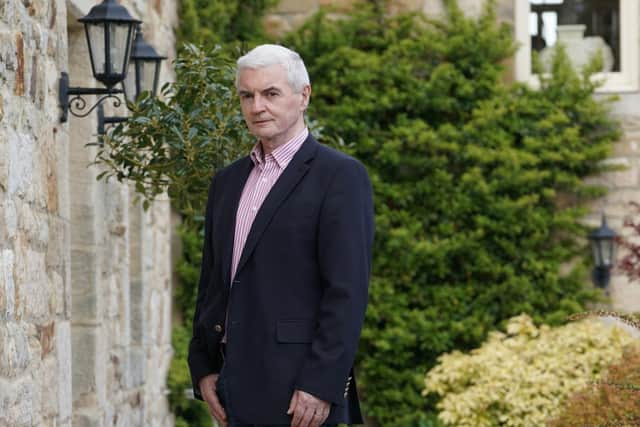
Moray Martin is the Chief Executive Officer of TRICAPITAL Angels Limited, one of Scotland’s most active angel investment groups.
Comments
Want to join the conversation? Please or to comment on this article.