
How Scottish firm Balmoral Comtec manages to straddle offshore wind and oil markets globally
Jeremy Grant reports on a firm which is showing how Scotland's subsea engineering sector can be resilient


The ocean is an unforgiving environment, as anyone working offshore knows. Tides, currents and storms mean that sand and sediment around the foundation of a fixed-bottom wind farm, embedded in the seabed, are eroded by the motion of the sea. It’s similar to what happens when the sand around your feet is washed away by wavelets as you’re standing on a beach.
This so-called “scour erosion” can reduce the foundation’s strength, potentially leading to instability of the turbine that sits on top of it.
For a wind farm operator, the consequences are counted in money. The solution involves backfilling each foundation with tonnes of rocks, hiring specialist vessels for the purpose. That’s expensive, considering the size of some wind farms. Seagreen, a wind farm off the Angus coast, has 114 turbines. Scottish subsea engineering company Balmoral Comtec thinks it has a better solution. It has developed a concrete collar placed around the base of the foundation with hexagonal shapes to disperse currents.
The device, which the company calls “HexDefence”, has been developed at a specially built testing facility at its Aberdeen headquarters.
“For a subsea geek, this is really cool stuff. We think it’s a game changer,” says Ian Milne, head of sales and business development for renewables, as he gives a tour.
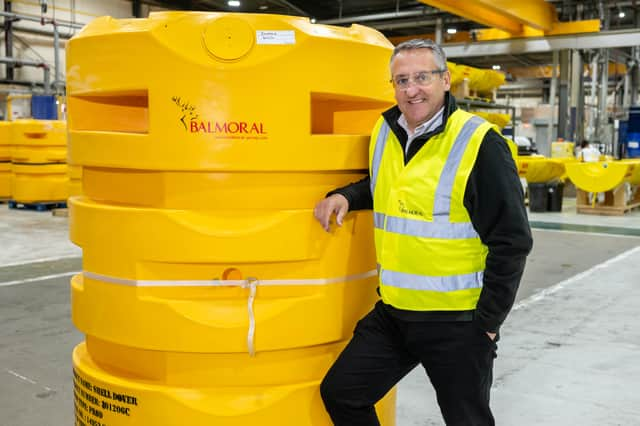
Balmoral Comtec is part of the Balmoral Group, owned by the family of founder Sir James Milne. Set up in 1980 and with about 400 employees, the company is one of the most prominent examples of the subsea engineering businesses that are the backbone of the economy of the Northeast.
There are as many as 700 such companies in Scotland generating a cumulative £7.5 billion in annual revenues, according to Scottish Development International (SDI). Some trace their roots to the oil and gas boom of the late 1970s and include Rotech, an Aberdeen business in underwater excavation.
One of its products is the “Orange Peel Grab”, shaped like a peeled orange, for clawing giant boulders off the seabed ahead of wind farm installation.
Remarkably, as much as half the sector relies on work outside the UK. Indeed, 90 per cent of Balmoral Comtec’s sales come from projects overseas.
It’s this aspect of Scotland’s offshore energy expertise that deserves more attention even as debate rages over the exploitation of more hydrocarbons in the North Sea and as domestic offshore wind, chiefly ScotWind, faces headwinds.
That’s because businesses like Balmoral Comtec are demonstrating a degree of resilience by making a virtue of straddling oil and gas and renewables as they tap further into global markets.
One such market is Japan, with which the UK in February signed an agreement to accelerate offshore wind. Last month, SDI organised for 14 Scottish companies to attend the Wind Expo conference in Tokyo, among them Rotech, moorings business First Marine Solutions, and Balmoral Comtec.
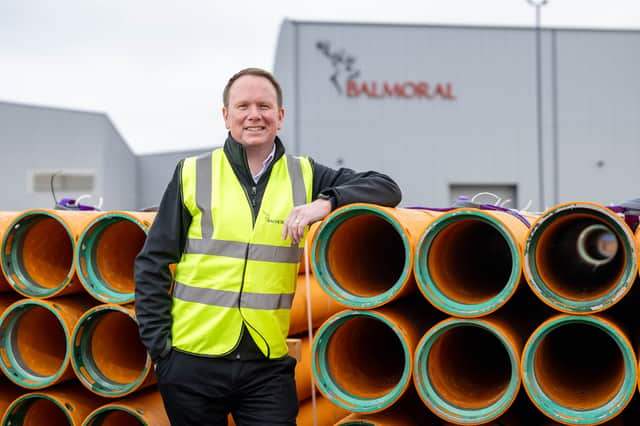
Balmoral Comtec got its start making products essential to oil and gas developers: buoyancy devices that wrap around the pipes connecting subsea wells to oil and gas storage vessels on the surface, keeping them steady, as well as polymer “bend restrictors” used to prevent undersea pipes and cables from suffering fatigue.
By 2017, when a series of fixed-bottom wind farms were being developed in UK waters, management spotted the opportunity to diversify into renewables after deciding that its core products could be used in offshore wind, especially the nascent floating variant where wind farms require long power cables to be protected. A year later, Balmoral Comtec acquired Norwegian cable protection company Seaproof, which owned some technology that plugged a gap in the Aberdeen company’s capabilities.
“Our view was we needed to get technology to gain a foothold in the industry, build a reputation and then move to the bigger picture, which was floating wind,” explains Gary Yeoman, sales director. “The technology for floating is almost identical to that of oil and gas, so we now have tried and tested technology with a 45-year track record in the market.”
In the UK, the company’s cable protection systems are installed at the Moray West fixed-bottom wind farm, which started operating a year ago in the Moray Firth. The same kit is being supplied to the Hornsea 3 project, located off the Norfolk coast, under a contract awarded in 2024 by Danish developer Ørsted.
Yet while half of Balmoral Comtec’s offshore wind business comes from the UK, its overall home market represents less than 10 per cent of group revenues. Most of the rest comes from oil and gas customers in places such as Guyana and off the coast of west Africa, where new discoveries have created work.
This drove a fourfold increase in operating profit to £34 million in the year to March 2025 on an 85 per cent rise in sales. Offshore wind’s share of group sales was seven per cent and remains at roughly that level - even as that business has also grown - because oil and gas has grown faster.
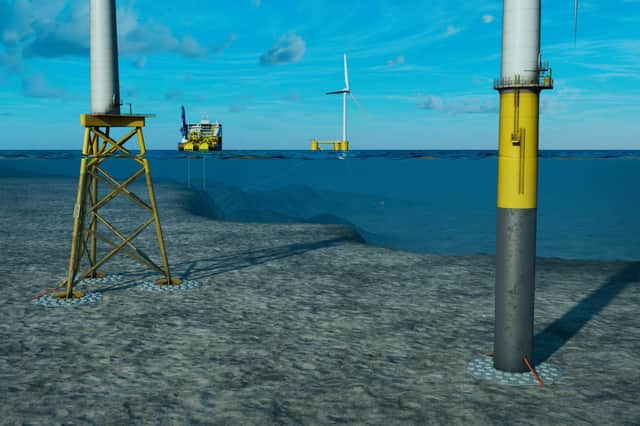
Yet Balmoral Comtec’s attendance at Wind Expo – its fourth appearance – is a sign that Asia holds particular promise over the long term, including for HexDefence. Last year, the company signed an agreement with LS Cable & System of South Korea for collaboration on developing a system for floating offshore wind cables.
Such markets are maturing faster than in Scotland, Yeoman says. “A lot of these countries are more advanced than Scotland in terms of the infrastructure to support these projects like fabrication yards and ports.
“Being international, we’ve obviously been building up our customer base globally, and we’re trying to capitalise in other areas of the world.”
Comments
Want to join the conversation? Please or to comment on this article.