
Why are so many plays about Scottish history being made and what does that say about our national identity?
‘I think we’re in a place in Scotland now where we're trying to grapple with who we are right now’

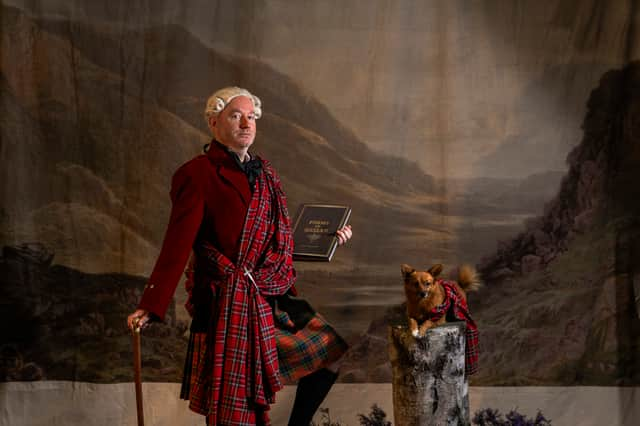
Poet Martin O’Connor stands on a stage littered with larger-than-life Scottish tropes: giant props of a stag; a piece of shortbread; a sporran.
Performing in Scots throughout his one-man play, Through the Shortbread Tin and accompanied by Gaelic songs, O’Connor himself wears elements of Highland dress, taking them on and off again as he speaks.
“Imagine if your culture was taken, was bundled up, deconstructed, marketed and sold back at you at a premium price,” he says to the audience. “And imagine if you started asking questions.”
Billed as “the story of the greatest literary hoax of all time”, Through the Shortbread Tin, created with the National Theatre of Scotland (NTS), aims to debunk the Scottish fantasy. It explores Scottish culture, myths, history and identity through the “tartan-trimmed” works by James Macpherson on third century bard, Ossian, while asking whether the “gift shop fantasy” beloved by tourists holds the nation back.
The work - which started life in 2025 touring small venues across Scotland and is in 2026 set to embark on a touring programme that includes the Edinburgh Festival Fringe, as well as venues in Glasgow, Stirling and Inverness - is one of a number of new plays being made in Scotland which tackle well-known aspects of Scottish history, but through a different, modern lens.
Jackie Wylie, artistic director and chief executive of NTS, says the production “celebrates the Scottish experience”.
She says: “I think we’re in a place in Scotland now where we're trying to grapple with who we are right now, in our own terms, in a reckoning with who we have been in the past, in order that we can go forward. We had the referendum and you can see it with our grappling with the difficult parts of difficult parts of our history as well now.
“Through the Shortbread Tin touched people so deeply, because on one level, it was a story about masculinity, a story about being a man in Scotland. But on another level, it was about the whole search for who gets to tell your story.”
She adds: “Theatre is part of how we understand ourselves, how we how we figure out who we are, in order that we can move on with confidence.”
Ms Wylie references a 2021 NTS walking tour production, Ghosts, written and directed by Adura Onashile, that explored the legacies of Scotland's slave trade past.
She says: “We're looking at our past in order that we can go into the future with confidence. I think as Scottish people, we think of ourselves as being the colonised, that we were subjected to rule. But actually now we're grappling with this duality of being the colonisers and the colonised.

“Scotland is grappling with finding its own sense of confidence and self, about telling its own stories, but also about moving into the future and not being scared about the difficult parts of our past as well.”
Another production hoping to change the public perception of a well-known Scottish tale is hip hop musical Wallace. The show began life as a scratch work performed at The Arches in Glasgow during the Scottish independence campaign and this year was resurrected in a collaboration between playwright Rob Drummond and acclaimed rapper Dave Hook as an hour-long contribution to A Play, A Pie and A Pint.
Now, it has been reworked into a full length show and is to be part of the new season’s programme at the King’s Theatre, Edinburgh, which is reopening after a three year refurbishment.
The work asks whether William Wallace was a hero, a rebel, or simply a myth.
“His [Drummond’s] take on Scottish history is really interesting, he's trying to debunk the Braveheart fantasy,” says Gillian Garrity, cofounder of Raw Material, the Glasgow-based production company behind the piece.
"What I love about that is how he's trying to question the history."
The first version was shown in a raw, early form, as part of a referendum festival held in Glasgow's Arches in 2014, as the country prepared to vote on independence. Yet, artists have to be aware of a changing political landscape into which they are performing their work.
"Rob was sitting there with a Saltire painted on his face that day, I don't think you would see that now," says Ms Garrity, referencing a recent trend for the Saltire - among other national flags - to be adopted by the right wing.
"I think we have to be more careful in terms of that and consider how we as an arts community respond to it."
Among other projects by Raw Material in 2026 are an upscaled re-staging of history musical Scots - which has previously been performed at the Fringe - and the final instalment of the James Plays, James V1: First and Last.
Raw Material’s other co-founder, Margaret-Anne O’Donnell, says artists find it easier to deal with contemporary issues through the lens of history, rather than tackling them head-on.
"Scottish theatre has always looked at history as a way to unpick a view of who we are today,” she says.
"I think if you do anything too contemporary, dealing with these issues, it could be too much in people's faces."

Meanwhile, Flora, a new musical which explores the life of “reluctant Jacobite heroine” Flora MacDonald in the years after she famously helped Bonnie Prince Charlie escape after his defeat at the Battle of Culloden in 1746, is to hold its premiere at Eden Court in Inverness, before touring to Pavilion Theatre, Glasgow in March.
Writer Belle Jones compares Flora’s personal lack of agency with that of Scotland within the UK.
She says: “I had some really interesting conversations when I was writing the play about the element of independence, and how Flora's lack of independence could possibly reflect the relationship between contemporary Scotland and the Westminster Government, in terms of lack of choices, lack of autonomy and so on.
“My main theory is that potentially the reason for so many historical plays being made, is our way of remembering where we came from and analysing our past in order to understand the present a bit better.”
However, she believes it could also be in response to a desire to learn more about the past in a factual way.
“I think it can be a different way of being reminded of what you maybe forgot about in school,” she says. “A different way of consuming our cultural history is by going to see it in a play, as opposed to reading it in a book or answering questions about it on a paper.”
Comments
Want to join the conversation? Please or to comment on this article.