
Theatre reviews: Small Acts of Love | The Invaders' Fear of Memories
Small Acts of Love rises in every way to the challenges posed by the story of the Lockerbie bombing, writes Joyce McMillan
Small Acts Of Love, Citizens’ Theatre, Glasgow ★★★★
The Invaders’ Fear of Memories, Scottish Storytelling Centre, Edinburgh ★★★★
We know – in the words of the Czech poet Milan Kundera – that the struggle of humanity against power is the struggle of memory against forgetting. It’s therefore tremendously moving, at this bleak moment in history, to see the gloriously restored Citizens’ Theatre of Glasgow reopen its doors – after a mighty seven-year rebuilding project – with Small Acts Of Love, a collective act of memory about the aftermath of the 1988 Lockerbie bombing of Pan Am flight 103, based by writer Frances Poet and composer-songwriter Ricky Ross on years of meticulous and loving research, and dozens of interviews with Lockerbie people and bereaved families.


Faced with real-life disaster and horror on a scale they could never have imagined, the people of Lockerbie reacted at first with shock, stoicism, and a kind of numb practicality. Soon, though, there came an upwelling of deep empathy for the families of those who died that led them not only to send the bodies home accompanied by little, precious signs of care and respect, but to wash, smooth, repair and restore all the thousands of recovered belongings for return to the families, painstakingly matching every object to the right person.

It’s this slow, healing process that forms the substance of the show, focused on the stories of five or six of the victims; and it’s wonderful to see Dominic Hill’s quietly brilliant production rise in every way to the challenges posed by the story. Frances Poet’s play is striking, even by her high standards, for its absolute integrity and painful truthfulness; Ross’s songs and music – played by a superb five-piece onstage band – are not only beautiful and melodic, but also unafraid of the darker emotions unleashed by such a horrific act of violence.
In the end, though, this is show that belongs to the audience, and to the tremendous 11-strong acting company who offer it to them as if they had created every word themselves; a mighty ensemble and choir led by Barrie Hunter as local policeman George White, Robert Jack as the troubled Catholic priest Father Keegan, and Blythe Duff as a whole range of formidable women.
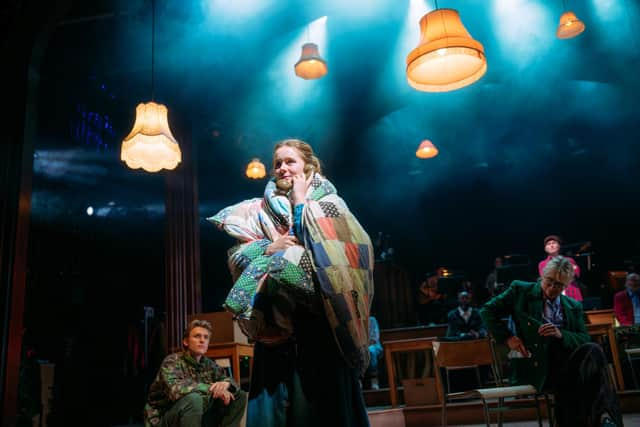
The Lockerbie people portrayed here are not, heaven knows, among the wretched of the earth. They are, though, exactly the kind of people – living lives shaped by love, decency and community, rather than hatred and division – whose priorities are often marginalised and ignored, in violent and divisive times. Here we see them centre stage, singing out their truth to the city and the world; and that, as the much-loved Citizens Theatre reopens, is exactly as it should be.
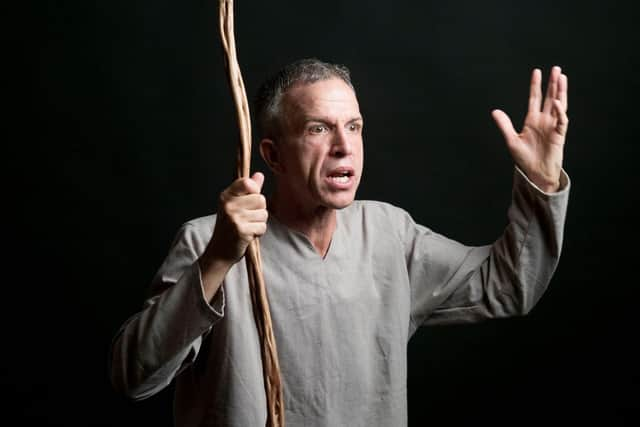
In Edinburgh, the new Palestine Museum in Dundas Street moved briefly into the world of theatre this weekend, sponsoring two performances at the Scottish Storytelling Centre of Benjamin Rivers’s powerful monologue The Invaders’ Fear of Memories, along with the mighty poem by Palestinian writer Mahmoud Darwish that gives the show its title, performed in Edinburgh by Tam Dean Burn.
Rivers’s play focuses not on a Palestinian story but on a Jewish one, set mainly in late 1940s Palestine, where the surviving children of Russian pogroms and the Nazi holocaust themselves carried out a ruthless killing and expulsion of Palestinians in order to found the state of Israel. Over a heartbreaking hour, River plays half a dozen characters on all sides, breaking into mighty sung laments from the Hebrew, Yiddish and Arabic traditions.
Darwish’s words ring out loud and clear, in love and mourning for Palestine; and Rivers tells with rage and sorrow of a hollow victory, haunted by that dehumanisation and erasure of those defined as “other” that Jewish history itself teaches us to recognise, only too well.
The Scotsman’s arts newsletter is now sent twice a week - subscribe today
Comments
Want to join the conversation? Please or to comment on this article.