
Theatre reviews: Dementia The Musical | Murder on the Orient Express
Dementia The Musical is a quietly tremendous celebration of activism, writes Joyce McMillan
Dementia The Musical, The Studio, Edinburgh ****
Murder on the Orient Express, King’s, Glasgow ***
In a time of stress, it’s good to see contemporary Scottish theatre returning to its strong roots in the barnstorming agitprop theatre of the 1970s, pioneered by 7:84 Scotland and Wildcat. After a packed-out runs in Edinburgh and Glasgow, Sleeping Warrior’s musical To Save The Sea – about the Greenpeace occupation of Brent Spar in 1995 – heads off on a Scotland-wide tour; and now, straight out of left field, comes new touring show Dementia The Musical, a quietly tremendous celebration of activism in the face of a condition that affects around 90,000 people in Scotland, and also has huge impacts on all their families and friends.

Written by Ronnie Coleman, himself diagnosed with a form of dementia, Dementia The Musical is a 70-minute play with songs (eight fine ones, by composer Sophie Bancroft) that celebrates the real-life stories of three great Scottish dementia activists – James McKillop, Nancy McAdam and Agnes Houston – who have not allowed their dementia diagnoses stop them fighting, living, laughing, and campaigning for their basic rights.
The play imagines that James, Nancy and Agnes – brilliantly played by Ross Allan, Fiona Wood and Kirsty Malone – have been detained as troublemakers by the dementia authorities, and forced to live in a care facility where they are put on trial for the sin of creating “chaos and confusion” through their activism.
That Rigid System appears in the small but frighteningly overbearing person of actor Pauline Lockhart, who interrogates them about their “crimes”, while appointing the audience as a jury absolutely required – “for their own good” – to find them guilty. And while a television reporter ably played by a fourth dementia activist, Willy Gilder, reports on screen, each interrogation offers space for powerful dialogue and songsexpressing the mighty spirit and individuality of each of the three accused.
All these elements are beautifully and forcefully co-ordinated by director Magdalena Schamberger; so when, towards the end, the actors step back to allow us to meet the real-life John, Nancy and Agnes on screen, the effect is almost overwhelmingly moving. Yet it’s also profoundly life-affirming, in the face of one one of the most difficult diagnoses life has to offer; and of an overstretched care system all too inclined towards the the kind of hyper-managerial attitudes so perfectly captured, in Ron Coleman’s memorable play.
If pure escapism is what you need this autumn, though, then you could do worse than head along to the Festival Theatre in Edinburgh to catch the current UK touring production of Ken Ludwig’s stage version of Murder On The Orient Express, one of the most famous of all Agatha Christie’s Hercule Poirot mysteries.
Agatha Christie was a wise woman, of course, and her image of a train travelling across Europe in the winter of 1934, stuck in a snowdrift somewhere in the Balkans while horrible violence is discovered on board, is not innocent of a sense of the politics of the time, and a darkening global scene.
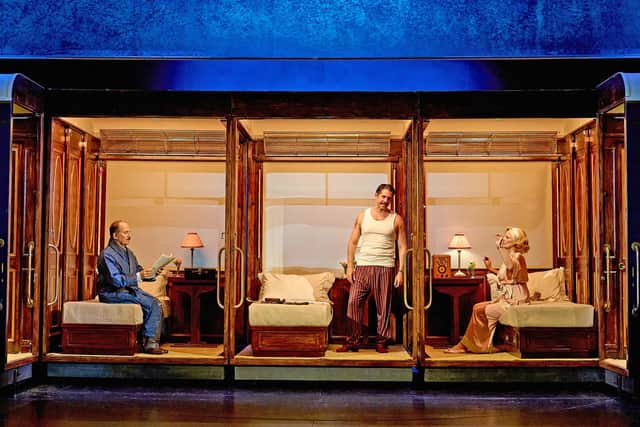
For the most part, though – and despite the tormenting dilemma Poirot faces when he discovers the truth of the murder – Murder On The Orient Express is a thoroughly enjoyable shock-horror whodunnit. Only first-class passengers get to play a full part in the story, of course; but Michael Maloney’s thoughtful Poirot offers tantalising glimpses of a more complex world beyond the gorgeous wood-panelled compartments of Mike Britton’s set, in a show that offers a couple of hours of old-school entertainment, but also just a little food for thought.
Dementia The Musical on tour until 9 November; for details see www.deepnessdementiaarts.co.uk/theatre/dementia-the-musical. Murder On The Orient Express is at the Festival Theatre, Edinburgh until 26 October, and His Majesty’s Theatre, Aberdeen, 11-15 February 2025.