
Songbird Frances discovers a new voice
Theatre star Frances Ruffelle tells Joyce McMillan about her new take on Cocteau
Frances Ruffelle had already done a fair bit of living, when a friend gave her a copy of Jean Cocteau’s 1930 monologue The Human Voice to read. She had known early West End fame in the 1980’s as the first ever Eponine in Les Miserables, had built a career as a singer and songwriter as well as a successful stage and screen actress, had been married and divorced, had two children, even represented the UK in the 1994 Eurovision Song Contest.
She had also - in a 2013 production of Pam Gems’s Piaf - given an award-nominated performance as the legendary singer who was one of Cocteau’s closest friends; it’s said that when an ailing Cocteau heard of Edith Piaf’s death, in 1963, he said “Now I can die too”, and passed away the next day.
Yet for all that, Frances Ruffelle found that Cocteau’s most famous play - a one-hour monologue for a woman facing the devastating end of a long love affair, told through a series of telephone calls to and from her Paris flat - was not really speaking to her, as a 21st-century woman.

“I thought that the woman was portrayed in too emotional a way,” says Ruffelle. “She whinged too much. So I said to my friend that I would only ever do The Human Voice if I could keep stopping the play, and telling everyone what I thought about it; and that’s how the idea for this play was born.”
Ruffelle had never written a play before, although she was used to working collaboratively on songs and music albums, and had written vignettes for her own solo shows. She received plenty of encouragement though, from friends in show business; and one of them was Alan Cumming, who began to co-write the script with Ruffelle, arranged a New York workshop session on it in 2019, and has now commissioned a full production for Pitlochry Festival Theatre.

“Alan and I were born the same year, and we share a lot of reference points, particularly about becoming a teenager in the late 1970’s; and when we started work on this idea, it just immediately felt as if we had been writing together for years. Then later, I also worked on the script with my actress friend Sally George. She thought she couldn’t write a play, either; but I just said to her what Alan said to me - yes you can!”
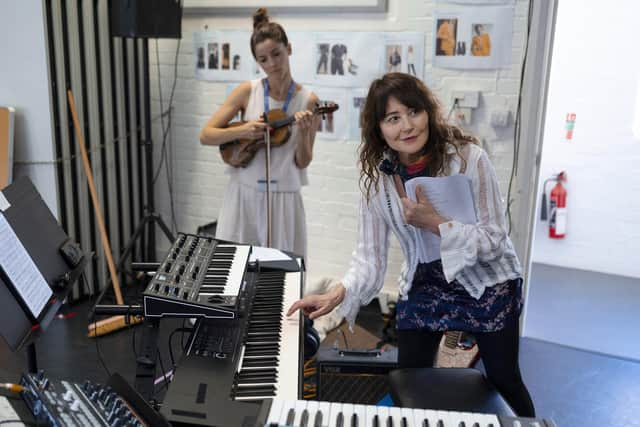
The result is I Can Die Too, a 100-minute multi-layered play with songs set during the tech rehearsal of a play inspired by The Human Voice, in which an actress not unlike Ruffelle - “not me, but a bit too like me!” - is struggling with the play, and with her life.
“There are so many layers to this,” says Ruffelle, “it’s like a kind of fever-dream of a tech rehearsal. There’s the Cocteau play. There’s the play within the play, in which the performer is struggling to critique the Cocteau play. Then there’s this play, I Can Die Too, in which I stand back from that struggle, and take my own view of it; and the show has nine songs, which mostly cut through those layers, and belong to all of them.
“There are four performers on stage apart from me, all of them brilliant actor-musicians; they play the dresser, the stage manager, the director and the musical director, and they also form a band. And so far, it’s all going better than I could possibly have hoped.
“When I’m writing or creating a show,” adds Ruffelle, “I always want it to be entertaining, above all. I want it to give the audience a good time, a good laugh, a good cry - I love a good cry. And it’s not about sending a particular message - I’m much more free than that, in the way I work. Except that it is a woman’s story, about a woman struggling in a theatre world shaped by men. I hope that’s changing, now; but yes, there is still that.”
I Can Die Too at Pitlochry Festival Theatre, 11 July-2 August.
The Scotsman’s arts newsletter is now sent twice a week - subscribe today
Want the latest Scottish headlines sent directly to your phone? Sign up to our new WhatsApp channel here
Comments
Want to join the conversation? Please or to comment on this article.