
The forgotten Edinburgh film believed to be the world's first 'talkie' - filmed a year before The Jazz Singer

The film was premiered a full year before The Jazz Singer
It is widely accepted that the first-ever “talkie” feature film is critically acclaimed US hit The Jazz Singer, premiered to much fanfare at Warner Brother’s own cinema in New York in October 1927.
But now, new evidence has emerged that the first ever feature-length film with sound was actually made and screened at an Edinburgh cinema a full year earlier.
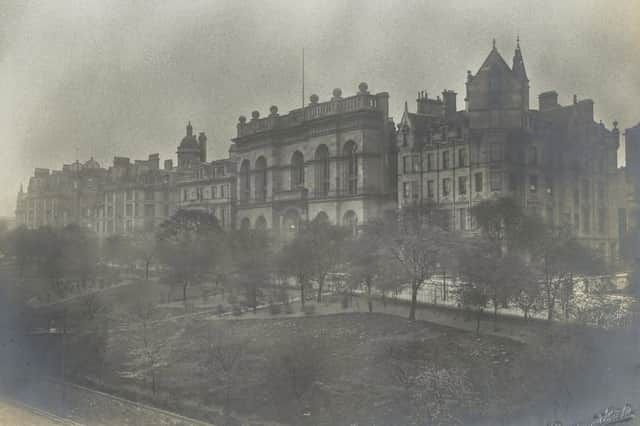
Till the Bells Ring, by Glasgow writer and actor Graham Moffat, premiered on October 11, 1926 - 100 years ago this week - at Poole's Synod Hall, a cinema on the site of the current Traverse Theatre on the city’s Castle Terrace.
Reviewed by The Scotsman, it used Phonofilm technology to sync picture and sound in a 44-minute drama written and directed by Moffat and starring his suffragette and actress wife Margaret and daughter Winifred among the six-strong cast - as well as their family dog.
However, a cataloguing error meant it has been listed in national archives as having been made in 1933, when the concept of films with sound was well underway.


The only known nitrate print of the film sits in the British Film Institute National Archive - unscreened since 1933 - but discovered by writer and film enthusiast Marc David Jacobs, who unearthed documentary evidence that it was actually made and screened seven years earlier. Mr Jacobs came across the film while researching a book about the forgotten people behind the first wave of British sound films.
Mr Jacobs said: “I’ve always had an interest in British film history and particularly this period which was the first decade where sound started to come in. There are only about 2,000 films made in the 1930s in this country. When I saw this one in a British Film Archive catalogue, I was living in Glasgow and I was fascinated that this had a Scottish connection, but that very little seemed to be known about it.”
He found an original play bill and reviews from newspapers at the time which proved it had been screened in 1926.
“I realised gradually that it was this really big thing,” he said. “It was a film that nobody had really talked about in its full significance, in terms of being the first modern film. Film had been around for three decades by then, which was why there was a cinema to screen this in, but when people now say ‘what films have you seen lately’ they’re talking about a feature-length film of sound and that’s what this is.”
He added: “It’s kind if this perfect storm, if you could imagine all the ways to make a film be forgotten. All of these things happen: the first is that things were incorrectly written about it and that ties in with ignorance around British film history, which has not been taken as seriously as American film history. If this was an American film, we would have known about it, but this just existed in a book and you can’t even watch the film.
“And the fact that it was only ever shown properly once in one cinema - and it’s not in London, so it’s only really the Scottish press which writes about it.”
The film is currently not able to be viewed due to concerns over the fragility of the print. Comprising just over half its original length, the remaining footage crucially includes the film's opening and closing reels and appears to date from its original 1926 exhibition. It has never been shown privately or publicly since being acquired by the BFI over half a century ago.
“I hope that other film archives around the world may now come forward and find they have a copy of the film which may be in better condition,” said Mr Jacobs, who hopes the film could be restored and ultimately given another screening.
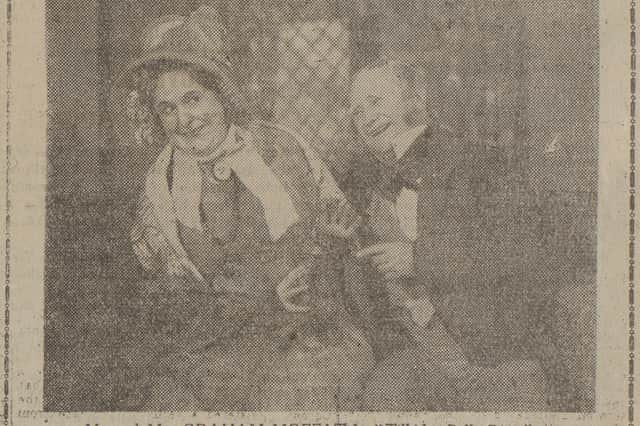
Based on a 1908 stage play by Moffat which had toured to London and Australia, Till The Bells Ring, which lasts 44 minutes, was written in what Moffat described as “Lowland braid Scots”.
Moffat, whose 1908 play, Bunty Pulls the Strings, had been a hit in London’s West End and on Broadway, hired De Forest Phonofilms to make an adaptation of the work. Film sound technology was then widely seen as a novelty best suited to lectures and short comedies, but Moffat’s ambitious project featured his entire touring company performing with synchronised dialogue throughout its full length.
After a disastrous private demonstration with faulty equipment in London, the film was finally premiered as the main feature at Poole's Synod Hall. Billed as “A Super Talking Picture of Victorian Scottish Life”, audiences accustomed to walking in and out of silent films had to accept the unprecedented request that they “refrain from entering the Auditorium within 45 minutes after the [film's start] times, as the disturbance will inconvenience others and interrupt the dialogue as in an actual play”.
The Scotsman wrote: “Movement and sound are perfectly synchronised, and after the listener becomes accustomed to the phenomenon of screen figures appearing to talk and the ear attunes itself to the sounds, there is no difficulty in catching the spoken words.”
Sister paper The Edinburgh Evening News praised the “perfect synchronisation” of the film.
It said: “Even America has never attempted such a work. So perfect was the synchronisation between the image on the screen and the broad Scots dialogue spoken by the image, that one might quite well have been listening to a legitimate stage version of the comedy. Even the opening and shutting of doors are noticed, and the confidential whisperings between several of the characters is remarkably well reproduced.”

The film then disappeared for several years until re-released in 1933 as a tax dodge by an exhibitor who marketed it as a new film - leading in later decades to its being mislabelled as a 1930s production. Moffat sued the exhibitor, winning his case in 1935, after which all copies and negatives were ordered to be returned to him, and the film was apparently never shown again.
The writer and performer died in Cape Town in December 1951, aged 85. He made no further films after Till the Bells Ring, and the Moffat family's landmark contribution to world cinema has gone completely unrecognised and uncelebrated.
Mr Jacobs added: “For the past 99 years, if you asked any critic what the first talkie was, they'd have told you The Jazz Singer - despite the fact that it's mostly a silent film with only two minutes of genuine dialogue.
“Now, nearly a century after it was last seen, the time has finally come for the world to recognise Graham and Maggie Moffat’s world-beating achievement.”
Comments
Want to join the conversation? Please or to comment on this article.