
The 'feisty' woman who graduated from cleaner to head of lighting at Scottish theatre 100 years ago
Bethia Cassie, also known as Bertha, held an ‘unusual job for a woman’

She began her career working as a cleaner at an Edinburgh theatre.
Yet almost two decades years later, Bethia Cassie was featured in a national magazine as someone with an “unusual job for a woman”: as head of lighting at the same venue, which was built in 1906.
Her story has been uncovered as part of the People’s Archive at the King’s Theatre, which is currently undergoing a major refurbishment and is due to reopen next year.
A team of volunteers have trawled the theatre’s archives - as well as material donated by individuals who have performed, worked or attended productions on the King’s Theatre stage over decades - for stories of people who worked there in the early part of the 20th century.
Volunteer Ruth Bowman, who investigated Ms Cassie’s life, said she had generated a strong impression of her during her research, which also included looking at census records to uncover where she lived during her time working at the King’s - mainly in the Old Town area of Edinburgh in the tenement Gladstone’s Land.
Details of Ms Cassie’s career at the King’s were documented in an article published by the People’s Journal, on 2 October, 1937, with the headline “Bertha, the lady who lights the stage” - written in first person by Ms Cassie herself. She started work at the theatre as a cleaner in 1917, aged 30.
Ms Bowman said: “She was obviously a bit feisty, very hard working. And from the stories she tells in the article, she was obviously quick to react to things and respond appropriately. This kind of job wasn't something women did, all these pullies and levers and everything, but somebody at the theatre obviously persuaded her to do it and she was so good, she became well known.”
In the People’s Journal story, Ms Cassie wrote: “With due modesty, I think I can say that my name is something of a by-word in the theatrical profession. As switchboard operator at the King’s Theatre, Edinburgh, for close to 20 years, I can claim to occupy a position which is unusual for a woman.
“Hence the reason why the name Bertha, as everyone calls me, is known to all artistes who have ever visited the King’s and who, when they return to the city after an absence of years, invariably voice the query, ‘Is Bertha still here?’.”
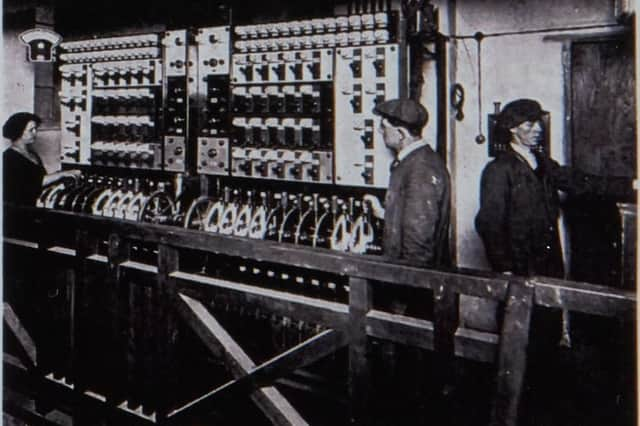

In the article, Ms Cassie recounts anecdotes during her time operating the switchboard, including one time when she forgot to lower the house lights at the end of a production during her early days at the helm of the lighting switchboard - and incidents including a burst pipe supplying an on-stage “bathing pool”.
She also told of an accident, when she was hit on the head by a wooden stand during a performance of pantomime Dick Whittington - but remained at the lighting switchboard until the end of the show, when she fainted into the arms of the leading man. She was given first aid and sent home in a taxi, before returning to work the next day.
Ms Bowman added: “The fact that she was virtually knocked unconscious during a show and was back at work the next day. I mean, that's some woman.”
Ms Cassie started work in the King’s as a cleaner in 1917, but shortly afterwards the chief electrician, known only as “Mr Taylor”, told her he was promoting her to operate the spotlight, with her promotion coinciding with a performance by a famous Russian ballerina.

In the People’s Journal article, Ms Cassie remembers her first show being a performance by Anna Pavlova, however, Ms Bowman can find no record of Ms Pavlova having performed on the stage at the King’s in that year.
“The article was written 20 years later, so she may have forgotten which ballerina it was - and Anna Pavlova was at the King’s in 1921, so she might have got mixed up,” she said.
When Mr Taylor was going on holiday, he asked her to cover for him, operating the switchboard. She did it successfully – so much so that when he died after an accident, she was given the job permanently.
The dates of her promotions are not known, but she mentions working on the play Mr Wu, which this was performed at the King’s in September 1918, suggesting she had taken up the role by then.
Quickly, she became well-known within the industry, recalling in her People’s Journal article that she could “walk into nearly any theatre in London” and “be greeted as an old friend”.
Ms Bowman added: “The musical director of the King’s Theatre, who described her as being ‘as good as any man in the job’, said she was always just known as Bertha, rather than Mrs Cassie, which would have been unusual.”
With no staff records available for the period, it is not clear when Ms Cassie stopped working at the theatre. A ledger uncovered for 1948 had no records of her having worked any shifts that year, suggesting she could have retired before then.
Her husband, with whom she had three children, died in the late 1930s.
“She maybe felt as well that she wanted to keep working after he died,” said Ms Bowman.
“I'm only guessing that she would have probably continued to work through the Second World War, because the men would be away, and that she might have retired at 60 in 1947 because by then, she would get an old age pension.”
While Ms Bowman has managed to trace some descendants of Ms Cassie, she has not connected with anyone from her direct line. It is believed Ms Cassie had a comprehensive autograph book, in which she collected the names of many stars who performed at the theatre.
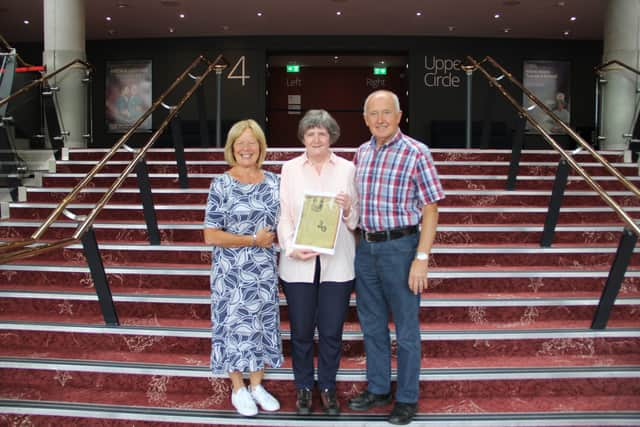
“I would love to if we could, hear from any of her direct descendants, and especially if they have her autograph book, if they would allow us to see it, that would be fascinating,” she said.
Janette Maclaughlin, from Coatbridge, whose husband, Phil, is Ms Cassie’s great nephew, knew her name through having conducted family history research, but did not know about her theatrical links until she was contacted by Ms Bowman through a genealogy website.
She said: “We were absolutely mind blown, because then women didn't get jobs like that.
“Phil’s grandpa lived in Coatbridge and that’s where his family was and of course, Edinburgh was miles away to keep in touch with relatives. There was no internet then.”
The pair later visited the King’s, where they saw the lighting switchboard which Ms Cassie operated.
Mr Maclaughlin added: “To hear she used to go to London quite often, it would have been a big thing then. She must have been quite exceptional.”
Ms Cassie’s story will be brought to life as part of the King’s Playwrights project.
The initiative supports a group of ten playwrights aged 60 to 95, developing character stories about people who worked at the King’s Theatre. The stories will be developed into site specific performances that will be performed in and around the King’s after it reopens.
Comments
Want to join the conversation? Please or to comment on this article.