
'Regret is not a word I have ever used' - Malala Yusafzai on love, uni life and activism

Malala Yousafzai is to speak in Edinburgh as part of her book tour
When I speak to Malala Yousafzai for the first time, I feel like she is one of my closest friends.
I have just turned the final page on her latest book, Finding My Way, and I am still in her world, 22 again, transported back to a blissful time when friends, crushes and university essays were the only things on my mind.
I know I am speaking to a Nobel Prize winner; a global ambassador; someone who has met numerous US presidents, the late Queen and Michelle Obama. Yet, the girl in the raw, honest and entertaining coming-of-age book I have just read appears to be none of those things: she is an ordinary young woman with boy troubles, a love of trashy TV and parties and a self-confessed dose of imposter syndrome as she describes her academic “struggles” through Oxford University.
She is on the phone, travelling by car between Portland and Seattle on the final leg of her US book tour. Soon, she will return to the UK, when she will begin another round of engagements, including one at Edinburgh’s Assembly Rooms tomorrow.


Yousafzai is a self-confessed fan of best-selling author Dolly Alderton and her new book has more of a style of women’s contemporary fiction than a serious, political tome. In fact, politics is barely mentioned at all.
“I love reading books and I don't like reading boring books,” she explains. “So when I'm thinking about my own book, I wanted to make sure that people enjoy reading it.
“I chose not to make it a political book or a book about my opinions, because that's how I have been known in the public eye for a long time: just known by what happened to me at age 15. I have grown so much in the past years and especially it was my experience at college, making friends, finding love, that has helped me now transform into this young woman that I am today.”
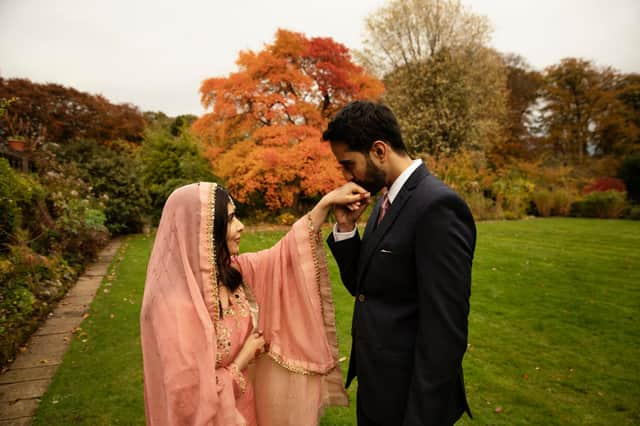
She adds: “I think it's important for people to get to know the real me, who is not all perfect, who doesn't have an answer to every issue and was going through similar challenges that people go through at different times in their life: feeling lonely, anxious or feeling like they don't belong.”
While the majority of the book is upbeat, charting a largely happy time at university - she refers to it as “college”, presumably for the American audience - it also recounts some severe mental health struggles, when she is forced to come face to face for the first time with the realities of what happened to her at the hands of the Taliban.
Working with her father, an educational activist himself, Yousafzai had already put her head above the parapet during the Taliban’s closure of schools for girls in the Swat region of her home country of Pakistan four years earlier. Among other appearances, she spoke out at a press club in local capital Peshawar and wrote an anonymous blog for the BBC. By 2012, she had been named by the Taliban as a target and received other death threats both at home and online.
In October that year, Ms Yousafzai was travelling home from a school exam on a bus, when a Taliban fighter boarded. “Who is Malala?” he asked.
She was shot, a bullet travelling from her left eye, through her neck and into her shoulder.
Before her experience at Oxford University, she remembered nothing of that day, waking up to find herself in a hospital ward in Birmingham, where she had undergone lifesaving surgery.

She quickly became a household name and spent the next few years travelling the world, where she spoke out about her experiences and advocated for girls’ education, before becoming the youngest Nobel Prize laureate in history in 2014, aged just 17. Her first book, I Am Malala, was published in October 2013, less than a year after her attack.
Despite her extensive physical injuries - she skirts briefly over three summers of facial reconstruction surgeries in Finding My Way - she has always appeared to be something of a miracle, who somehow managed to get through an unimaginably traumatic experience mentally unscathed.
While she was at university, however, this changed.
At Oxford, she smoked marijuana - not for the first time, she admits - but on this occasion, using a bong. The stronger hit of the drug triggered a PTSD experience of her shooting which she struggled to come to terms with.
At the time, she put off seeing a doctor or counsellor, worried that she has broken the law, but in the book - and in person - she is very open about the experience.
“I wanted to share about my friendships, love, life and mental health,” she says. “So there are tough topics, but there are also some funny elements in it as well. But that's who I am.”
The entire book is disarmingly honest. Her choice of language often makes her sound younger than her years and even gauche at times - but always likeable.
She talks about sneaking western style outfits into her suitcase when she leaves home and recounts tales of her first parties and nightclub experiences, which she admits she later exaggerates to try to “sound cool”.
She replicates cringeworthy phone messages she sent to boys she liked - the kind that, if as her friend, you’d jump in and try to stop her sending. We’ve all done it.
Even after meeting Asser Malik, now her husband, the pair married in 2021, she is guilelessly frank: “So ridiculously hot,” she writes in the book of seeing Malik again after some months apart.
To me, she tries to explain.
“I felt like I was reconnecting with that whole part of myself that I had lost,” she says. She is referring to not only the period spent in hospital recovering from her injuries and of her teenage years spent working as a global ambassador - but as a displaced teen in a new school in a foreign country, where she admits, she found it hard to make friends. After a disappointing high school experience in Birmingham, Oxford was a second chance at having a normal social life.
“Sometimes I feel like I was living my teenage years in my 20s.”

In the book, she recounts an incident when, with a new friend, she attends the university’s Freshers’ Fair. The pair approach the Oxford Union table, which is adorned with a banner emblazoned with photographs of previous speakers. She spots Albert Einstein, Malcolm X, Queen Elizabeth II, Ronald Reagan - and herself. She spoke at the union in 2013 - four years earlier.
She laughs, remembering her embarrassment.
“It's strange when you see a photo like that of yourself, because you assume that there's an expectation and you have to live up to that. So when I looked at that photo, I'm wondering, what do my friends think?
“Do they have a fixed image in their mind that this is who [I’m] supposed to be? She can't laugh, she can't crack a joke, she can't talk about boys and crushes and astrology. And I think part of the reason why my friends, thought it so funny when I would talk about anything else [her work], was because in their head, this just was a very different version of the student Malala that they were seeing.”
Finding My Way feels very much like a public call for Yousafzai to be allowed to regain herself from her public image. She is happy to continue her work in advocacy, admitting she feels a responsibility to dedicate herself to it. She still runs the Malala Fund, as well as new venture Recess, with Malik, which supports girls’ participation in sport. There is no doubt she still feels passionately about it. Yet, she also wants to be a friend, a daughter, a sister and a partner - and most of all, to be able to live her own life without being accountable for every movement and decision.
“I feel like I have to dedicate my whole life to girls education to prove I deserved even a bit of the support that I have received,” she says. “But I also felt I had to be a serious person, that I couldn't have friends, I couldn't have a normal life, that that's what the life of an activist is supposed to be. And this is how we are taught as well about activists, we are never told about their personal life - their life is shown as that of a superhero.”
I wonder if she is referring to Greta Thunberg. She has often been compared to the climate activist, who at six years her junior, once described Yousafzai as her “role model”.
“Greta is younger than me, and I see her as a little sister,” she says. “Of course, she has such a powerful platform, and she has mobilised young people on climate justice, social justice. I think we need more young activists. And I also think that people need to see how the activism of every person is just so unique, depending on where we come from, what our story is. For me, it was the circumstances I found myself in that made me become an activist. I had no choice but to speak out for my right to be in school.”
Unfortunately, not all of the comparisons have been entirely complimentary. Thunberg has been celebrated for holding those in power to account, while Yousafzai is criticised for, to a certain extent, working with the system. She and Malik are often pictured on the red carpet at events such as the Oscars.

She says: “I think sometimes people are compared so much that people want them to be exactly the same, to mimic each other and that’s not the point. We all have our own way of doing the work.
“The message of Greta’s and mine, or any other activist, is that we are not here to tear each other down. We are here to support each other, we stand together as sisters and if we are truly committed to the issues, we need to stay focused on that, because it's never about us, and it's never about an individual.”
Yousafzai writes openly about her academic issues at Oxford, and the times she felt she suffered from “imposter syndrome”. She recognises the irony of a woman who has dedicated her life to promoting girls’ education having to consider dropping out of one of the world’s most famous academic institutions. She ultimately graduated with a 2:1 degree in Politics, Philosophy and Economics.
“Of course, there was a lot of pressure,” she says. “But I also knew that I would not be helping myself if I limited myself so much to the academic side of my experience at college, if I limited myself to libraries only, I knew that this would not be a real learning experience for me.”
She admits there were evenings she spent time partying or relaxing when she should have been studying. But she has no regrets, saying she met the “people who gave me a sense of comfort to be myself”.
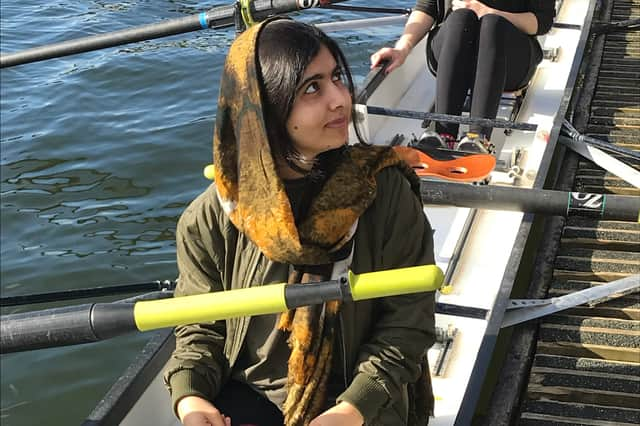
“I am so grateful that I found those friends,” she says. “I also feel that we need to have a conversation around what true education is and I think it's learning, not just from your textbooks, but from the people around you. That helped me learn and grow emotionally as well. So I felt that I received the best education that way.
“I personally needed help with my studies and I'm so grateful that I received the academic support in the end. I know how many other people would be feeling the same way, where they feel like they are imposters and they don't deserve to be at college. I had the exact same thoughts, but I'm glad that I received that academic support, so I hope it raises awareness about these things, that these are normal experiences that any college student can go through.”
She says she began with “the story of a girl who was shot by the Taliban”, which she changed “into a story of every girl who is fighting for her right to be in school”.
She says: “So many things that have happened in my life were completely unexpected. We could not imagine that the Taliban would ever take over our valley. It was known as a place of tourism, and suddenly it became a place of terrorism. I never thought schools would be banned and women would be punished if they dared to speak out.
“Getting attacked by the Taliban, even though it was a big shock in life, we had experienced these unforeseen circumstances already.”
In the future, she wants her fund to move her focus away from only funding specific educational projects, to empowering more local female activists to carry out their own work, especially in Afghanistan, where the Taliban is in power and women and girls’ rights are hugely restricted - which Yousafzai calls the “most extreme form of oppression against women”. She speaks passionately about underground schools in the country, where she recounts one girl telling her that reading a book is an “act of resistance”.
“Afghan women activists are leading a campaign to call it a gender apartheid,” she says. “They're asking leaders to hold Taliban accountable, and I am supporting them in their activism through the Malala Fund.”
She calls for world leaders to “take the voices of Afghan women more seriously”, pointing to the exclusion of Afghan women from the most recent Taliban peace talks with the United Nations. She also supports projects in Gaza, where she added her voice to those calling for a ceasefire.
“I do think that more people are talking about it, but we know that condemnation and words are not enough,” she says. “How can we call ourselves feminist leaders and have feminist foreign policies or, how do we say that we care about gender equality when we have not seen any progress for women and girls in Afghanistan?”
Two other girls who were travelling on her bus, Kainat Riaz and Shazia Ramzan, were also shot and brought to the UK for treatment. They ultimately went on to study nursing in Edinburgh and still live and work in Scotland.
“I am looking forward to seeing my friends,” she says, adding that she has visited Scotland many times, both to see Riaz and Ramzan and on holidays to Skye and Islay with Malik, who enjoys hiking.
Their relationship is, like many of her generation, charted on social media, with both their Instagram pages showing candid shots of the couple socialising and on holidays, as well as at public events.
The book is again, in a characteristically Yousafzai-like way, extremely honest about their relationship and her fears about marriage.
“In my culture, everything revolves around the man,” she writes. “In my ideal world, my relationship with Asser could go on forever, free of expectations, existing without context or formal commitment.”
His disappointments and her ultimate realisation that due to cultural restraints, if they did not get married, they could not continue their relationship, are charted in detail.
To mark the publication of his wife’s book, Malik posted a tongue-in-cheek reel on social media with the words “When you are happy about the book coming out, but realise she’s written abut you in it”.
“I didn't show this book to anybody [before publication], not my friends, not even my parents,” Yousafzai admits, adding that Malik had seen a first draft. “But it was only that, a draft, not the final copy.
“I kept it that way because, of course people will always have an opinion about something, and they even might remember something differently, but I wanted this to be true to how I felt and what I saw and what I remember.
“So far, everyone is happy.”
The last chapter mentions how she is often asked if she would give up her current life to go back to a time before the shooting.
“It’s an odd question,” she writes. After reading it, I quickly cross out the question already scribbled in my notebook. Instead, I ask her what she thinks she would be doing now, if she had not been shot.
“I don't look back. Regret is not a word I have ever used,” she says.
Then she pauses. “But it's like...I will be honest. It's not that this question hasn't been there on my mind. Of course, I sometimes imagine what life would have looked like, but I just focus on the journey that is ahead of me.”
Malala Yousafzai - Finding My Way is on at the Assembly Rooms, Edinburgh, tomorrow (30 November).
Comments
Want to join the conversation? Please or to comment on this article.