
Ballet class for Parkinson's gives new power to patients - and hopes culture could deliver for the NHS

Arts and movement programmes for people with illnesses including dementia and Parkinson’s could boost the NHS
At Perth Theatre, a ten-strong group of people with Parkinson’s disease are finishing their weekly ballet class.
Dance artist Niamh O’Loughlin asks them to sit in a circle and create a “dance of thanks” to the person next to them, based on the movement of an animal of their choice. The results are outstanding. Everyone embraces the idea with enthusiasm, executing the dance within their range of movement.
Even Peter, who is new to the class and supporting his wife, Anna, is happy to join in, imitating a cat. Musician Dave MacFarlane, who accompanies the class every week on his fiddle, guitar and keyboard, improvises to reflect the style of each dance.
Some dancers are able to perform the exercises, based on classical ballet moves, standing up and using a chair as a barre, while others sit. Part of the session is given over to a seated port des bras - balletic arm movements.
“Doing the class makes an insane difference - to both physical symptoms and everything else,” says Ms O’Loughlin, who has been teaching the group for five years.
“The wife of one member of the class said her husband’s silliness had come back and that was something she hadn’t seen for a very long time.
“Another said she comes shaky and unsteady and then she just feels like everything starts flowing.”
She adds: “We try to keep the class going all year round and don’t take a long summer break, because it really makes a difference to people’s symptoms if they can keep moving.”
Dance for Parkinson’s is a Scotland-wide initiative established in 2016 in partnership with Edinburgh centre Dance Base, which, alongside other similar projects for people living with illnesses such as dementia, is regarded as a key example of the benefit of culture being embedded into Scottish culture.
Backed by research into the impact of movement and creativity on people living with Parkinson’s, it is inspired by an initiative in the US and funded by private companies, trusts, foundations, and arts patrons.
Calls for a Culture Act for Scotland point to money which could be saved in the NHS if more people are given access to arts and cultural activities which could benefit their health. A recent report in Wales found that every pound invested in cultural organisations delivered an £11 return in terms of health, wellbeing, and productivity benefits.
In Perth, the community of the dance class is so strong that Veda Stewart, who came to the class for years as carer for her husband Ian, who had Parkinson’s, continues to attend after his death.
When the class is not on due to holidays, the group often meet for coffee.
“I don’t have Parkinson’s but I keep coming,” Ms Stewart says. “It was such an inclusive class that I just felt I had to keep coming along even after he died 18 months ago, because it’s just a lovely start to your week on a Monday morning.
“You don’t think you’ll get to meet new friends in your 80s.”
Class member Sylvia Dewar, 85 - who is now caring for her husband who has dementia, as well as living with her own illness - was one of the original members of the class when it started in 2019.
“My Parkinson’s nurse told me about it, so I could meet other people with the illness,” she says. “I don’t know anyone with Parkinson’s outside of the class. We don’t all talk about having Parkinson’s, but it’s nice to know everybody is in the same boat - I understand how they feel and they understand how I feel.
“It’s not obvious to look at me that I have Parkinson’s, so to other people, it doesn’t always make sense why I can’t do certain things.
“Today, in class, I didn’t feel like I could stand up so I didn’t, I did everything seated and that’s fine. You can choose to do whatever you want to do.”
Ms Dewar and Ms Stewart have become best friends.
“We text each other every night, don’t we Sylvia?” says Ms Stewart.
“Yes, we say ‘How has your day been?’ And depending on what it’s been like, we might say ‘good’ or we might say ‘bad’, but we always check in with each other.”
Perth is not alone in embracing the power of culture as a way to wellbeing.
At Edinburgh’s Festival Theatre, an award-winning dementia programme features performances, workshops and creative activities for people living with the disease.
In 2015, theatre workers realised that a significant number of people who had been regular attendees of the theatre had stopped going.
They contacted them to find out why and discovered that many had received a diagnosis of dementia and no longer felt comfortable going to regular performances.
“We thought, ‘there’s something we could do here,’” says Claire Swanson, head of creative engagement at Capital Theatres.
“We have been developing a programme since then that is about us encouraging people to be able to connect with the things they care about for as long as possible and as long as they want to and also to combat stigma around dementia to celebrate what people living with dementia can do.”
The theatre made significant changes across the building, adding nosing to the edge of carpets to reduce trip hazard risk and changing the colour of toilet seats to make them more dementia friendly.
Now, access performances, held in association with visiting companies such as Scottish Ballet and Scottish Opera allow people with dementia to safely continue to attend shows, while five regular participatory events are held to celebrate creativity and reduce social isolation. Small scale performances of theatre shows are also held in workshop spaces to accommodate people who may be overwhelmed by a large auditorium, while work is also taken into care homes.
Together in Song is a a musical concert held in conjunction with The Forget Me Notes choir and often features guest appearances from visiting performers, while Relaxing Rhymes is a dementia-friendly event led by Xa Shaw Stewart, who shares both modern and classic poems.
Meanwhile, Brew and Blether is a social gathering held in the theatre, while Tea and Jam is “a big rock and roll tea party” and Comfy Ceilidh does a seated dance session with poetry and storytelling.
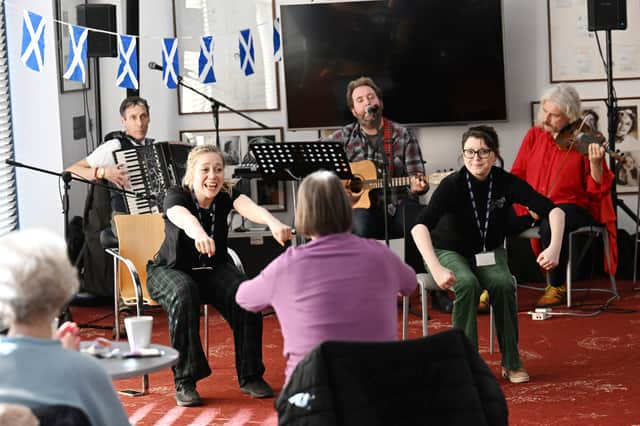

“We know connecting with music can help people living with dementia to access memories or connect with emotions or the environment they’re in in a completely different way,” says Ms Swanson.
“The ceilidh is about not only movement, but encouraging people with dementia to keep on connecting with dance that’s been important through their life.”
She adds: “We know that social isolation can increase the risk factor for dementia by up to 26 per cent. And if someone is living with a diagnosis of dementia, particularly when they’ve just received that diagnosis, the risk factor of them becoming socially isolated is so strong.”
The theatre also works with people who have had a specific arts interest throughout their lives.
“A lot of people who come to our community find their way to us because the arts have been important in their lives, maybe they’ve been dancers, or they make music or they write,” says Ms Swanson.
“Where we know someone has a specific interest or talent, we do what we can to support them to amplify that talent and keep on exploring it.
“It’s helps keep people connected with who they are and what matters to them and what do they like.”

One example of this is a six part podcast series hosted by former BBC journalist Willie Gilder, who, after his dementia diagnosis, looked at different experiences within the theatre and the dementia community.
Meanwhile, in 2024, Scottish poet Ron Coleman, who had vascular dementia, wrote a musical, called Dementia the Musical, telling the story of dementia activists who campaigned for changes to dementia policy. It was directed and acted by professional performers and shown in the Festival Theatre’s Studio Theatre.
The Scottish Government's Rethink Dementia campaign aims to encourage people with dementia to keep doing daily activities and socialise for as long as possible.
Ms Swanson says: “The idea of social prescribing is such an interesting one because in the arts, it has been anecdotally understood for decades that participating in artistic activity that helps you build confidence and build self esteem and combat social isolation and connect within your community, all has massive benefits from a mental health and aging well and community cohesion perspective.

“This all has impacts on healthcare in many different directions. I think what is interesting is seeing the shift in that being evidenced in research over and over again.
“I’m not a medic, but my understand is that when people are able to feel they have somewhere to go, are not socially isolated, there’s something to look forward to and they can make a difference in their community, all these wellbeing factors are so intrinsically linked with their physical health outcomes.”
Kathryn Welch, co-director of Culture Counts, which is made up of arts, heritage and creative industries organisations and is leading the charge for a Scottish Culture Act, describes Perth’s Dance for Parkinson’s programme as a “brilliant example” of how cultural participation can improve health and deliver savings and efficiencies for the stretched NHS.
She says: “As a nation, we regularly discuss the need to maximise the value of our NHS spend. Cultural participation is a critical part of realising this ambition, and it is backed up by extensive research outlining the impact culture has on physical and mental health and dementia.
“We are calling for the introduction of a Culture Act for Scotland, which would integrate culture into all areas of public life. This would provide a statutory framework for scaling the cross-portfolio benefits of the culture sector, making it easier for national and local governments to make informed, long-term decisions that drive efficiencies for the public sector and health benefits for individuals."
Comments
Want to join the conversation? Please or to comment on this article.