
Trumpeter Wynton Marsalis says his wife Nicola Benedetti 'made me a better composer' as he opens EIF
As he prepares to open the Edinburgh International Festival with All Rise, a 12-movement jazz symphony, the acclaimed trumpeter and composer talks about collaboration and hope, his connection to Scotland, not least through his wife, violinist and EIF director Nicola Benedetti, and the fun of working with 200 musicians and singers for the Usher Hall concert


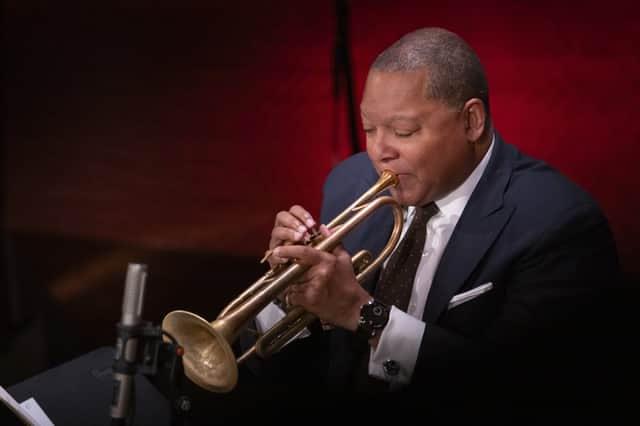
When he steps on the stage for the opening concert of Edinburgh International Festival, leading 200 performers in a rendition of his symphony All Rise, it will be a coming together of a lifetime’s influences, musical and personal, for world-renowned US trumpeter, bandleader and composer Wynton Marsalis.
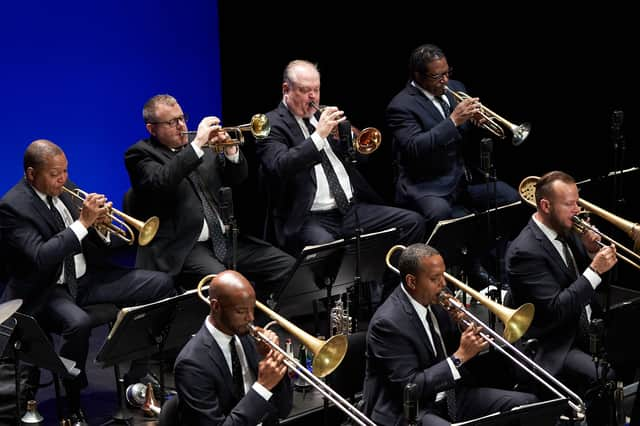
The New Orleans raised, New York based musician is at the top of his game, and will be joined by his Jazz at Lincoln Center Orchestra alongside the Royal Scottish National Orchestra, the Edinburgh Festival Chorus and Jason Max Ferdinand Singers – all under the baton of James Gaffigan. Anticipating the performance of his massive jazz composition next weekend, he sums the experience up in a word - fun.
“When it comes together it's fun,” he laughs, no stranger to large orchestras and audiences as musical director of Jazz at Lincoln Center In New York, with 130 albums - from jazz to classical - and numerous awards under his belt, and he’s unfazed by big undertakings.
It’s also significant for Marsalis to be performing All Rise in Edinburgh, as his wife, Scottish violinist Nicola Benedetti is Festival Director, and All Rise inspired this year’s theme in a rallying cry for collaboration, resilience, and ascendance. The Festival also marks the 250th anniversary of American independence by examining the country’s culture, creativity, tensions and complex impact.

Marsalis’ 12-movement symphony, built on the 12-bar blues structure, mixes influences such as a New Orleans parade, gospel, juba, blues, jazz, classical, Latin, and embraces a world of energies, from playful and dark and challenging to uplifting, embodying the human condition and embracing the togetherness of humanity.
Another huge link to Scotland for Marsalis is the late Scottish baritone saxophonist Joe Temperley, who played with the Jazz at Lincoln Center Orchestra and was such a massive influence on him over the years.
Marsalis wrote All Rise as a commission for the New York Philharmonic in 1999 to welcome the millennium after he was challenged by its then musical director Kurt Masur.
“I had met him 10 years before when I was in my 20s and he challenged me to write a piece for the New York Philharmonic. I thought he was crazy, because I hadn't even written a piece for a jazz orchestra,” says Marsalis.
“Over the next 10 years every time I saw him at the Lincoln Center he would introduce me and say, ‘this is Wynton Marsalis, he's afraid to write for the New York Philharmonic’, so it became a joke. He goaded me to do it. So at the end of the 1990s, I developed enough technology to write for all the instruments.
“Kurt told me he had been a Nazi soldier. I had never met anyone who said that. And he said, ‘I was a Nazi soldier, Friend. And a member of Hitler Youth.’ He said ‘of course, if you were in Germany at that time you would be that, or I wouldn't be here talking to you.’ He said, ‘you have a misconception about what happened because you think it was because people were poor. That's not why.’ He said, ‘there was a lot of cheering, Friend, so I want you to write a piece that brings people together, because I notice that the New York Philharmonic does not do anything that deals with an integration of peoples, no collaboration with jazz, nothing that brings communities together in New York’. He said, ‘don't think what happened there could not happen here.’ So I wrote this piece called All Rise, in response.”
“Anybody who studies human history understands the tremendous effort required to maintain civilisation, let alone forward it. Then to develop and try to bring people closer together with a worldview that includes people who are not like yourself, and overcome the darker side of things that are more titillating and provocative is difficult. It's always been difficult. So I embraced his vision and was honoured for the opportunity to write the piece.”
Was it a challenge for Marsalis to blend all of the musical styles that All Rise embraces together?
“It's a challenge, but they all are already blended. Like human beings. It would be a challenge to speak six languages, but they're all saying basically the same things. A kid I met, from The Hood, was teaching me to play chess and he said he spoke Russian, and I said, how did you learn, and he said ‘well, I knew how to speak Japanese first and in a strange way they're very similar languages’. I wouldn't have put that together, Japanese and Russian, but he told me when you know what something is, you recognise its similarities with other things.”

What would like the audience to come away feeling at the end?
“All Rise is about how you can only rise through collective creativity and the recognition of the magic of other people, the astonishing creativity and beauty of others and your small part in it. When you realise there are no real others, the power is exponential. You can only rise through each other. I can't rise alone. I can only rise if you're rising, you know? So it's cathartic, I hope.”
He goes on to explain the movements of the symphony as ‘a 12 step progression through life that we've all experienced.’
“It's fundamental things, like the first movement we're born in joy, then play as kids, fall in love for the first time, then experience love that grows until we're mature. We become arrogant and filled with ourselves and we fall, we struggle enough that forgiveness is granted, experience spiritual transformation, restudy and relearn, then we come back and we begin to rise.
“So we go through the same first four movements now reborn. Whereas in the first one we’re born, now we dance, we find romance, and come back to ourselves. Where we played with toy trains as kids, now the train takes us places and we have more global understanding, and where we fell in love, the most mature form of love is the blues which is where we have an optimism that's not naive. The last movement is where we transcend and reach ‘I Am’ consciousness, which is, I am, all of us, we all are.”

“So, it's a very basic kind of spiritual progression we all know, and if we have not gone through, our parents or our friends have. We end with a New Orleans march. We end in the beginning, like life.”
Where would he say he is now, on this 12-step progression through life?
“Well, I was always in all of them, because I always had many friends much older than me. I knew the great jazz musicians and they were 40 or 50 years older than me, Dizzy Gillespie, Gerry Mulligan, Art Blakey, Ralph Ellison, Elvin Jones, the list goes on and on of people I really knew and was really close with and their passing hit me in my early thirties and was able to reflect on these things.”
With such huge themes and 200 performers on stage, how does that all work?
“The most difficult thing is just to listen to each other across the stage and figure out who am I playing with? When you have large ensembles, it means a lot of people are playing the same part, so, who am I playing with across this expense of space and time? It's fun to do it.”

It’s also significant for Marsalis to be performing All Rise in Edinburgh, because the late Scottish baritone saxophonist Joe Temperley, who played with the Jazz at Lincoln Center Orchestra was such a huge influence on him.
“To have the opportunity to do it in Scotland is special for us in the Jazz at Lincoln Center Orchestra, because our orchestra was anchored by Joe Temperley [originally from Cowdenbeath] for many years. He's another example of people who’ve passed away. So it's always special for us to come to Scotland and play because we loved him with such depth.
“And of course, for me, with Nicola being the director, it has great, great meaning.”
What are the advantages of being married to another musician?
“Well, I think with Nicola, even though we have a large age difference [Marsalis is 64, Benedetti 39] we have a strange commonality of understanding and experience. Like hours of practising when young, being accomplished at a young age, both being left handed, having a similar interest in education from a young age. It's not so much that she's a musician, we just have other strange similarities in common.”
Marsalis and Benedetti confirmed their marriage in 2025, and celebrated the birth of their daughter in 2024, of whom he says, “Yeah, she’s a whip!” who keeps him on his toes. Frequent musical collaborators, the musicians also partnered on Marsalis's GRAMMY-winning Violin Concerto. Back in 2015 Marsalis wrote Concerto in D for Violin and Orchestra for Benedetti, a 45-minute piece that blends classical violin traditions with American blues, jazz and folk elements.
Was it difficult to write something so personal or is it easier if you know somebody so well?
“For me it's easier, but, even though I had written pieces like All Rise long before, it wasn't until I wrote her concerto - she actually taught me a lot about how specific I have to be on the score. And that's what made me really love her, the depth of the critique she would have of stuff was so specific.
“It'd be like, ‘you should put the violas on beat one of this section because it's going to save us 20 minutes’ or ‘the bass drum should have a sforzando on the downbeat of three’. I wish I kept the notes she sent me! When I read through those notes, they were so specific and not gratuitous.
“Because sometimes soloists or people can feel like they should know music better, so they become critics but they don't really know what they're critiquing, whereas with her, her critiques were specific and accurate and it made me a better composer, especially the attention to detail. So I learned a lot, from her.”

Prior to this, Marsalis had been introduced to Scotland by Temperley and developed a love of all things Scottish, including its music.
“I love Celtic music. I love Scottish music. Joe Temperley was everything Scotland. Rabbie Burns, golf and the proper way to drink whisky. We were on the road with this man, an old guy from Fife, for a number of years, and our entire orchestra, the love we have for the man is not something I can explain in words. He indoctrinated us all into Scottish ways. So I knew him before I knew Nicola, and he was a walking advertisement for Scotland. But he was also a certain type of person, a salty old dog, a jazz musician, you know? You never had a person who loved their country as much as Joe loved Scotland.”
What did he say was the proper way to drink whisky?
“Well, that was detailed. The peaty whiskys and the whiskys that come from this part of the Highlands and whether you should chase it or should you have it on the rocks - never - there was a whole masterclass,” he laughs
“He was just great. What a loss. His playing was unbelievable, the depth of his soul and sound, and the integrity of the man. He was 34, 35 years older than me. And now I'm the oldest in the band. He had an unbelievable sound but could get that big sound on anything, it was so huge. His final concert with us, he played My Love is Like a Red Red Rose, alone, and we’d never heard him play it before. So we played it for a whole year when we would open our hall.”
“So yeah Scotland, Edinburgh, the castle. And the Festival I love too, how the city incorporates everything, the egalitarian way that the festival was formed after World War II, the history and traditions of it and the people that ensure it happens, how inviting it is, it's a big thing.”
What about his home city? Did growing up in New Orleans shape him musically and as a human?
“Unquestionably. It's such a great city with so many different types of people. It was French, it was Spanish for 50 years, and became American after Louisiana purchased it. It had a fantastic influx of people, though they were not there of their own volition and will, from different parts of Western Africa and the Caribbean.”
“It was an unbelievable experience, and a blessing to grow up in a city with all these traditions and be fortunate to have parents that were cultural minded, and to participate in everything, always be in the streets.
“And because we didn't have that much, you weren't segregated, you were with everybody and it was a great education and experience.”
Raised in a musical family Marsalis started playing the trumpet at the age of six, a LeBlanc, a Christmas gift from his parents, Ellis Marsalis Jun, a renowned modern jazz pianist and music educator and mother Dolores, one of six sons that also included musicians Branford, Delfeayo, and Jason.
He’s been playing the trumpet ever since, but had he been given a different instrument would he have taken it up in the same way or is there something special about the trumpet?
“You know, I don't really know. I think sometimes people's personalities align with their instrument. So I think my personality went with the trumpet.”
Made specially for him by Monette, he always carries his trumpet when he travels.
“My father told me when I was a kid - my mama was carrying my trumpet, I might have been seven years old - and he looked at me and said, ‘Man, don't have your Mama carry your instrument.’ They called it an axe, right, musicians of his time and he said, ‘always, always keep your axe wit’ you and you carry it.’ So since that time, I always carry it, keep my horn, yeah.”
After Edinburgh, Marsalis will be heading to Ireland with the Lincoln Center Orchestra then back to New York to finish a symphony, while Benedetti’s first solo tour in ten years will see her perform in Edinburgh’s Usher Hall in October.
“It's called Liberty Symphony and it's about the quest of freedom. I missed my earlier deadline but it’s scheduled for September,” he says. “Writing a symphony is time consuming if you're also on tours at the same time. I generally get in a state where I don't really sleep, just stay up around the clock for two or three months. But most of the time I'm working, I'm playing concerts at the same time.”
But busy or not, the Edinburgh Festival is a labour of love and something Marsalis would never miss.
“I love it. I mean, I love the values of the Festival, how it was born. And it's important to keep that alive, especially when people start to go back to the more titillating behavior of disrespecting other people. There’s always excitement with disrespect, but there's a much greater excitement with mutual achievement.”
As each generation embarks on their journey from birth through self-discovery and struggle to maturity and joy, Marsalis acknowledges that to maintain civilisation will always be a struggle - “youngsters, you know, they're gonna have to do it” - but that ultimately music can unite us to All Rise.
“As my mama used to say, ‘Well, you have to do something down here’.”
Edinburgh International Festival Opening Concert: Wynton Marsalis’s All Rise, Usher Hall, Edinburgh, Saturday, 8 August 2026, 6:30pm, from £22.50, www.eif.co.uk
The Scotsman’s arts newsletter is now sent twice a week - subscribe today
Enjoying the Arts & Culture journalism on scotsman.com? Make it easier to find by selecting us as a preferred Google source
Want the latest Scottish headlines sent directly to your phone? Sign up to our new WhatsApp channel here
Comments
Want to join the conversation? Please or to comment on this article.