
SCO & Lorenza Borrani, Edinburgh review: 'deeply cathartic'
This was a concert of contrasts and discoveries, with visiting violinist/director Lorenza Borrani a perceptive, persuasive presence throughout, writes David Kettle
Scottish Chamber Orchestra & Lorenza Borrani, Queen’s Hall, Edinburgh ★★★★
Full marks to the Scottish Chamber Orchestra and incisive visiting violinist/director Lorenza Borrani for smuggling half an hour of existential angst into an otherwise easy-going afternoon concert. Not that the audience seemed to mind. Schnittke’s Concerto grosso No. 1 might have been unfamiliar to many – judging by interval conversations – but the focus and attention it drew spoke of fascination and deep involvement.
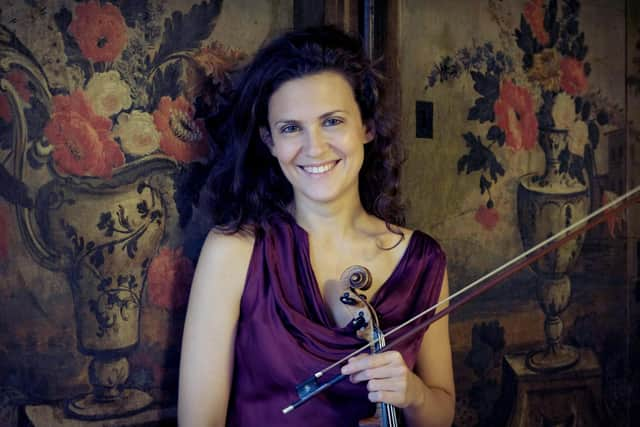

The fearsomely committed account from Borrani and SCO principal second violin Marcus Barcham Stevens – plus Jan Waterfield on harpsichord and synthesised prepared piano – played a huge role in that. When Soviet composer Schnittke burst into Western musical consciousness in the 1980s, it was with his madcap collisions of musical styles. All that was still present and correct, as faux-Vivaldi morphed into acerbic tango and on into wailing dissonance. But Borrani and Barcham Stevens peered deeply into the piece, rediscovering its unremitting intensity and – yes – its often unforgiving bleakness, and conveying them with unflinching honesty. Hardly fun, maybe, but it was a deeply cathartic experience.
And it was all the more striking coming as it did between two such elegant, impeccably well-turned-out performances of often sublime beauty. But there was far more to Borrani’s Haydn and Schubert than mere prettiness. Directing from the leader’s chair, she delivered a Haydn Symphony No. 56 that was almost a lesson in musical construction, a performance that demonstrated as much how the piece worked as it did deliver it with bracing freshness. It was vivid, committed, dramatic and joyfully forthright.
Borrani set about solving the enigma of Schubert’s “Unfinished” Symphony by turning its two extant movements into virtual mirrors of each other. The opening was surprisingly leisurely and intimate – though never lacking in power – while the lyrical second movement ended up surprisingly stormy, as though it was forever about to crack open and reveal deep tragedy. It was a concert of contrasts and discoveries, with Borrani a perceptive, persuasive presence throughout.
The Scotsman’s arts newsletter is now sent twice a week - subscribe today
Want the latest Scottish headlines sent directly to your phone? Sign up to our new WhatsApp channel here
Comments
Want to join the conversation? Please or to comment on this article.