
Ones to watch in 2026: Lisa Robertson, composer
Composer Lisa Robertson has multiple projects planned for 2026, of them all rooted creatively in the Highlands, writes David Kettle
I’d struggle not to be here – it’s a big part of my life and work.” Composer and violinist Lisa Robertson is talking about the Morvern Peninsula, on the Sound of Mull. “I was born and raised here, and I still live here. It’s definitely a huge part of my identity.”
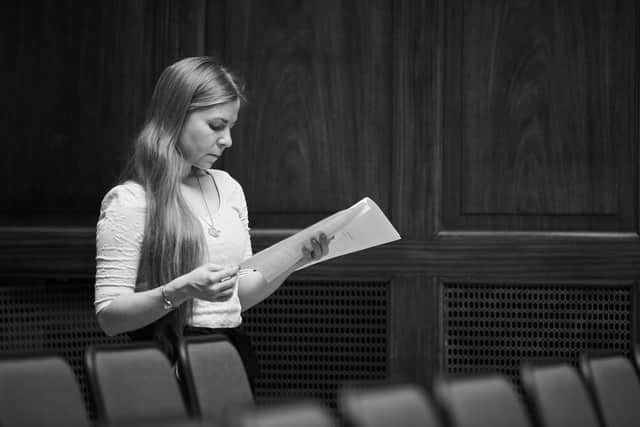

Not only are her Highland location, her identity and her music all intimately interwoven, those deep connections are immediately apparent in her lyrical but sometimes hard-edged music, which can be lush and evocative, or sparse, focused and direct. Hers is a particularly distinctive voice. “As soon as I started composing,” Robertson continues, “I wanted to find ways to embed my music in this place, and reflect it as best I can – in the sound world of the pieces I write, or the themes I’m looking at.”
Those themes include a particular focus on nature, and humankind’s impact on it. “Environmental issues are one of my central concerns,” Robertson explains. “I’m looking at things that are happening where I am, and using them as case studies for more global issues.” She wrote her soaring, swooping am fìor-eun, for example, in 2022 for the Royal Scottish National Orchestra (you can listen to it online), blending a distinctively Scottish sense of space and light with far grittier, rawer sounds. “It was to do with the eagle population in my home area,” she says, “there’s been a decline, because of things like a loss of prey, which is down to climate change.”
As that piece’s title perhaps suggests, another central theme in her work is Robertson’s immersion in Gaelic culture. She’s a Gaelic speaker herself, and the language – and broader Gaelic cultural ideas – have featured increasingly prominently in her music. There are strong connections, she feels, between these environmental and cultural interests. “If you look at Gaelic poetry, for example, there’s a wealth of rich descriptions of nature, and traditional lifestyles were very in tune with nature too. There’s a wealth of vocabulary in Gaelic to describe different kinds of mountain or streams or weather conditions. In my music, I quite often use that intentionally as a way of representing a traditional eco-consciousness that we should maybe be thinking about trying to develop.”
Robertson’s works are far from finger-wagging sermons on ecological sin, however. “It’s more about raising awareness,” she explains. “I think music and art provide a good place where people can experience some of those issues collectively, and maybe explore their feelings around them.”
London listeners will have the chance to do just that on 10 January, at a concert that Robertson has curated as part of her participation in the London Symphony Orchestra’s Jerwood Composer+ scheme, which connects young composers with other musicians and industry professionals as well as offering opportunities for them to present their own projects. Robertson has curated an entire Gaelic and nature-themed concert: “I’m hoping to transport listeners to the wild, West Highland coastal environment,” she says. The concert will include a brand new piece by her, to be premiered by LSO musicians. “It’s called Sluaisreadh, which is a kind of onomatopoeic word for the sound of the sea.”
Prior to the LSO relationship, Robertson was one of eight composers selected to take part in the Royal Philharmonic Society’s Composers programme, which resulted in the new piece, an sgaireag: she screams, for genre-defying quartet the Hermes Experiment. “These schemes are great for helping you feel you’re part of a community,” she says. “We’ve still got quite a bond among the RPS composers, so we can bounce ideas off each other.”
Indeed, community is particularly important to Robertson, both personally and professionally: “I like to be able to share things, and see if I can start conversations.” She connected closely with the RSNO’s community orchestra All Together Now, for example, in writing her new piece We Gather in the Shadow of the Storm for them, to be premiered in February. “I chatted to some of the musicians about the things they’d be interested in looking at in the piece, and a large theme was fear of climate change, and fear of wider issues happening in the world. A large part of what players enjoyed about the orchestra was the feeling of community. I wanted to reflect that in the piece’s feeling of coming together and finding solidarity, even if things can seem insurmountable.”
Robertson went through a similar process in a new song cycle, Quines, to be premiered by Glasgow’s Bubblyjock Collective to mark International Women’s Day in March 2026. “It’s based on poems by Gerda Stevenson, focused on historical Scottish women. It was a very tricky job working with Gerda and the ensemble to pick five out of the amazing women in this book, but I’ve set those to music, exploring women from very different walks of life.”
Looking even further ahead, also in the pipeline are a new song cycle for Scottish mezzo Katie Coventry on the theme of Scottish witch trials, and a film project with Scotica Film and director Gregor Sinclair. And Robertson is still active as a violinist, too: “I really value both composing and playing. And it’s really helpful as a composer to actually be performing with musicians, to learn repertoire and remember what it’s like to be in a rehearsal.” As well as teaching at the University of Edinburgh, she’s also recently taken on co-directorship of the Loch Shiel Festival: her first co-directed event happens in May 2026.
It’s already a rich and diverse portfolio of musical activities, but behind them all lies Robertson’s deeply considered individual perspective. Though she manages to capture enormous variety in her music, her distinctive works remain deeply rooted in the nature and culture of the Highlands.
The RSNO’s All Together Now community orchestra premieres Robertson’s We Gather in the Shadow of the Storm at Glasgow Royal Concert Hall on 28 February. The Bubblyjock Collective premieres her song cycle Quines at the Royal Conservatoire of Scotland, Glasgow on 5 March.
The Scotsman’s arts newsletter is now sent twice a week - subscribe today
Want the latest Scottish headlines sent directly to your phone? Sign up to our new WhatsApp channel here
Comments
Want to join the conversation? Please or to comment on this article.