
Luis Schmidt on launching a new Edinburgh orchestra: 'I want it to represent the city'


In founding Capella Edina, conductor Luis Schmidt hopes to bring a broader audience to classical music. Interview by David Kettle
How do you go about launching a new orchestra? If you’re anything like Munich-born conductor Luis Schmidt – founder, director and chairman of recently established Capella Edina – it’s with apparently endless enthusiasm, quiet determination, and no shortage of charisma. And, it has to be said, with a winning mix of naivety and audacity that is somehow blind to the immense challenges of a venture like this.
Indeed, what Schmidt and Capella Edina have achieved since their inaugural concert in January 2025 is quite remarkable. The orchestra enters a new season of concerts in September, and has found a regular home in Edinburgh’s Usher Hall. Its ranks of musicians are gradually coalescing into a more structured and more permanent ensemble, and it even got to perform the official concert celebration of the city’s 900 years of existence, back in June last year. But an orchestral newcomer in Scotland’s rich but intimate classical music scene also raises inevitable questions – about what and who an orchestra is for, and what role it might play within a community and a country.
If Capella Edina’s achievements are remarkable, then Schmidt’s own journey to establishing the orchestra is even more so. “My family is anything but musical,” he laughs, and admits he only took up his first instrument – the trumpet – so that he could stick with his mates when they moved up from primary into a musical senior school. Ironically, Schmidt got in, but the others didn’t. “Then another important moment was seeing Trooping the Colour on TV,” he continues. It kicked off what’s clearly Schmidt’s profound Britanophilia, a love for British culture that continues to this day, and which prompted him to enquire about becoming a British army musician. “They told me I’d need to be 16, and a British citizen,” he explains. Study in Newcastle would contribute to his citizenship application (“and it was the only university still offering scholarships to EU students in the aftermath of Brexit,” Schmit explains), and it was from northern England that he made his first trip to the Scottish capital.
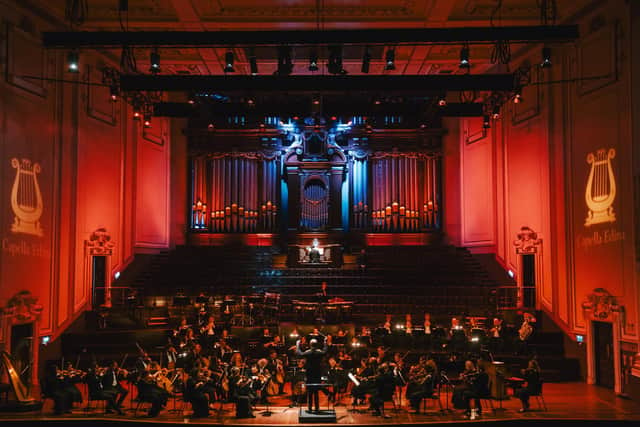
Running concurrently was Schmidt’s burgeoning interest in conducting. He managed to bag himself private lessons with eminent German conductor Bruno Weil, though he admits he’d had limited conducting experience: “At school I started off with brass ensembles, as I was a brass player myself, and then I conducted a string group, a woodwind ensemble and the symphony orchestra at university.”
It was his teacher Weil and fellow conductor Robert Ames – a regular collaborator with Newcastle’s Royal Northern Sinfonia – who suggested he should found his own orchestra. Ames had done that himself with his successful London Contemporary Orchestra, but he also makes regular appearances with other, more established ensembles. And though Schmidt has focused almost exclusively on Capella Edina in its early years (alongside researching a PhD on Bruckner and Wagner), he’s also currently talking with UK artists’ agencies about relationships with other orchestras.
Indeed, Schmidt is clearly a man who’s able to make connections. He enlisted Ames and King’s Singers member Christopher Bruerton as trustees for his new orchestra, and the Duke of Hamilton – who’d been in the audience at one of Capella Edina’s early concerts – became the ensemble’s patron. He’s forged fruitful relationships with Edinburgh’s Lord Provost and Scotland’s German Consul General, and even got a thumbs-up from veteran opera singer Sir Thomas Allen, who became Honorary President. More importantly, Schmidt has also gained practical and financial support from an impressive roster of individuals, trusts and foundations to develop Capella Edina’s work.
But what is Schmidt hoping to achieve with the new ensemble? “It struck me as very odd that Edinburgh didn’t have its own orchestra,” he explains. “Some people point to the Scottish Chamber Orchestra, which is based in Edinburgh, but it’s still a Scottish orchestra rather than an Edinburgh orchestra. I don’t understand why the Royal Scottish National Orchestra isn’t based in Scotland’s capital. It never made sense to me.” What does he feel would make the ensemble into a specifically Edinburgh orchestra? “I want it to represent the city and mainly play in Edinburgh. We had the honour of performing the 900th anniversary concert, for example, and we’re also planning a tour of all-Scottish music to Germany, Switzerland and Austria in 2028.”
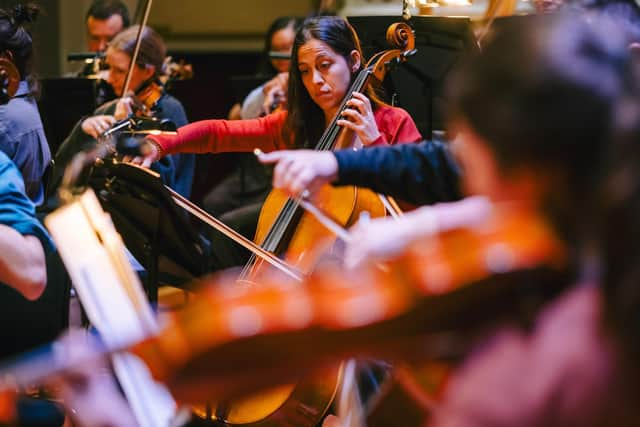
“Some people might say we’re in competition with the existing orchestras,” Schmidt continues. It’s not an unreasonable observation, given what can sometimes feel like a struggle to fill concert halls. “But I feel it’s providing people with a refuge, because the world is getting so dreadful, in my opinion. Music is so special in its ability to bring people together, to connect people with different backgrounds and cultures with each other.” Capella Edina is becoming more structured, too, in terms of its players: Schmidt liaised with the Musicians’ Union about appropriate pay and conditions, and what may have begun life as a collection of freelancers is now crystallising into a structure of regular roles. “We used to hire musicians separately for every concert,” Schmidt explains, “but we’ve moved to a season-long contract, because it allows for better planning, and I know who I enjoy working with and who works well in the orchestra – I want those people back.”
Capella Edina’s is a remarkable story, and the ensemble’s aims of bringing broader Scottish audiences to classical music are undeniably laudable. But it also raises questions about the role and purpose of classical music in Scotland. Better-established ensembles receive direct Scottish Government funding in return for offering performances right across the country, as well as education and community work, ensuring access and inclusion, and acting as cultural ambassadors. Capella Edina might currently be freer to forge its own path, with fewer obligations or expectations, but its relationship with its home city, and with the country in which it resides, is clearly one that’s still being defined and refined.
Capella Edina is a fascinating project, and one that clearly comes from Schmidt’s strongly held beliefs and a deep enthusiasm to share music, entertain and inform. But if launching the orchestra was a towering challenge in itself, perhaps Schmidt’s bigger challenge is to establish the ensemble in the longer term, sustain its activities, and define what it’s for. Watch this space.
Luis Schmidt conducts Capella Edina in a concert of Arnold, MacMillan, Richter and Bruch at the Usher Hall, Edinburgh, 15 September. This feature was produced in association with Capella Edina
The Scotsman’s arts newsletter is now sent twice a week - subscribe today
Want the latest Scottish headlines sent directly to your phone? Sign up to our new WhatsApp channel here