
Gnarly Buttons: Maximiliano Martín on performing the music of John Adams with the SCO
With a “rodeo ride” of a second movement, featuring cow noises and jangling banjo, to a deeply emotional finale, there’s never a dull moment in John Adams’s Gnarly Buttons, Maximiliano Martín tells David Kettle
“I had a teacher in Spain who used to tell me every lesson: ‘You have to play as if you’re singing.’” Anyone who’s been to a Scottish Chamber Orchestra concert is likely to have noticed principal clarinettist Maximiliano Martín. In among an ensemble of already characterful musicians, he’s often a strongly expressive focus. “I try to go to another level,” he continues. “I’m always trying to sing with the clarinet, and to put emotions into the music – emotions that hopefully also travel to the audience.”
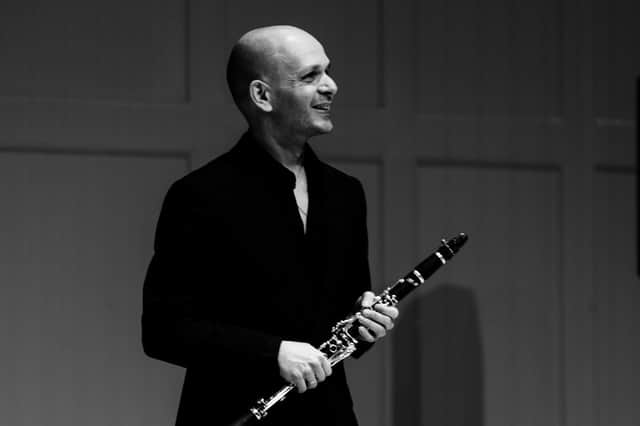

It's true that Martín is a sometimes astonishingly expressive, direct, deeply communicative player, a musician who often seems to live and breathe the music when he’s playing it. And if that’s already evident when he’s performing within the SCO, it’s even clearer when he steps out from among the Orchestra’s ranks as a concerto soloist. It’s something he’s done on many occasions in the past, and he’ll do it again this month with a relatively new departure: US composer John Adams’s quirky but ultimately very moving clarinet concerto Gnarly Buttons.
Indeed, for Tenerife-born Martín, the SCO and the opportunities it offers have become a crucial element in his identity. He’s one of its longest-serving principal players – “it’s coming up to 24 years in February,” he admits with some surprise – and he first joined the orchestra fresh from studies at London’s Royal College of Music. “My original idea was to continue my studies in America, and I had a couple of opportunities here and there, but then this role came along, and since the very beginning, I’ve felt at home.”
That’s even if, as a young clarinettist, he faced some tough choices about career direction. “I was with one particular agency early on, and I was trying to work in my SCO role and as a soloist too. After six or seven months, they said to me: ‘We know you love your orchestral playing, but if you want to be a soloist, you’re going to have to stop. People won’t take you seriously as a soloist.’ I told them: ‘Sorry – the orchestra is part of who I am.’”
Reputation and perception can be brutal questions in the classical music world. But in the SCO, Martín found an ensemble where he was able to combine orchestral, chamber and solo work. And he’s kept one foot firmly in his Canarian birthplace, too – specifically in the village of La Villa de la Orotava, where he grew up, and where he now runs a summer music festival.
“We started it 20 years ago,” Martín explains. “The idea was basically to use the spaces we have in the village, which are some historically very renowned churches. I know all the places where we play, and I know what they mean to the people who play there too.”
As a festival director, Martín adds another, broader perspective to the more detailed musical considerations he employs when on stage. “We came to the conclusion, for example, that people preferred to be completely concentrated on a concert for an hour, maybe 75 minutes. They’re excited about that and they love it – and then they can go off to have a drink or dinner. This is Tenerife in the summer, after all, and you want to be outside.”
They’re ideas he’d gladly carry over into Scottish concerts too – he particularly applauds the SCO, for example, for embracing matinee concerts over the past few seasons. “Things need to evolve,” he says. “Why do you always need to leave the concert hall at ten o’clock at night, when you could sometimes leave around 4pm? For some people in the audience, that’s much better – and for the players too, because we get to spend time with our families.”
Indeed, those kind of developments feed into Martín’s feeling that the SCO is in a particularly strong place. “I think it was a big hit to us when Charles Mackerras passed away. But we’re very lucky with our current principal conductor, Maxim Emelyanychev. He’s just a genius. It’s his understanding of music – when he conducts us, he does everything for the music, and there are no egos. He makes it funny, approachable, but he pushes the orchestra to our limits too.”
That desire to be a soloist, however, has never gone away. “I love playing in the orchestra, but what I like most is to play concertos – to deliver a message to the audience, to have something to say. It involves a whole different rapport with the orchestral players and with conductors too, but I feel really comfortable with it.” And despite his continuing international concerto appearances, he feels particularly comfortable performing concertos with his home orchestra. “I love the camaraderie I have with the players – they’re all there for you. What really makes the difference for me is the trust – everyone trusts each other, and everyone listens.”

Adams’s Gnarly Buttons, however, poses its own particular challenges. Martín learnt it as a self-imposed challenge during the Covid pandemic – “I was chatting with a Spanish friend on WhatsApp and he told me the piece would suit me really well” – and took the plunge to give his first performances of it in Estonia and in Tenerife. It’s a remarkable piece – and one that showcases its clarinet soloist virtually uninterrupted from start to finish. But it’s also quite a strange piece, and one that might take a bit of working out at first listen. Gnarly Buttons is a far cry from the euphoric waves of repetitions that characterised Adams's early minimalism, although those obsessive pattern-making instincts are alive and well in its first movement. The second is a rodeo romp, complete with jangling banjo and cow noises, but its finale is a slow, deeply emotional song, heartfelt and intensely beautiful. “I think that final movement is where people can relax after the hectic earlier music,” Martín explains. “I’m always thinking about the shape of the piece, and heading towards the calmness and serenity of that final movement.”
It’s also a piece that brings Adams and Martín quite closely together through their shared love of the clarinet, Adams’s own first instrument. “I don’t think he really plays any more,” Martín says, “but his father was also a clarinettist, and they used to play together in a wind band. He never composed for the instrument until he was 50, but the clarinet had a huge impact on his life.”
Adams himself remembers his father’s clarinets becoming an obsession for the older man as he slowly fell victim to encroaching Alzheimer’s disease. It’s just the kind of profound emotional resonance that will no doubt find a powerful vehicle in Martín’s deeply expressive playing.
Maximiliano Martín performs John Adams’s Gnarly Buttons with the SCO at the Queen’s Hall, Edinburgh, 11 December and the City Halls, Glasgow, 12 December, see www.sco.org.uk
The Scotsman is the official media partner of the SCO’s 2025-26 Season, and as part of the partnership we're offering 20 per cent off tickets. All you need to do is quote the code TSMSCO20 when booking – for venue contact details visit www.sco.org.uk.
The Scotsman’s arts newsletter is now sent twice a week - subscribe today
Want the latest Scottish headlines sent directly to your phone? Sign up to our new WhatsApp channel here.
Comments
Want to join the conversation? Please or to comment on this article.