
Composer Jay Capperauld on taking centre stage for the SCO's new digital season
All three of the concerts in the Scottish Chamber Orchestra’s 2025/26 Digital Season will showcase music by their composer-in-residence Jay Capperauld. It’s the stuff of dreams, he tells David Kettle
“After one of our performances of Jay’s music, we often hear audience members say: ‘I don’t really like contemporary music – but I like that.’” Scottish Chamber Orchestra Chief Executive Gavin Reid is talking about the powerful, provocative, often immediately appealing, sometimes attention-grabbing music of the orchestra’s associate composer, Jay Capperauld. The 35-year-old has been a growing presence on the Scottish new music scene for quite a while. “But it was absolutely the right time for him to get better known elsewhere too,” Reid continues.
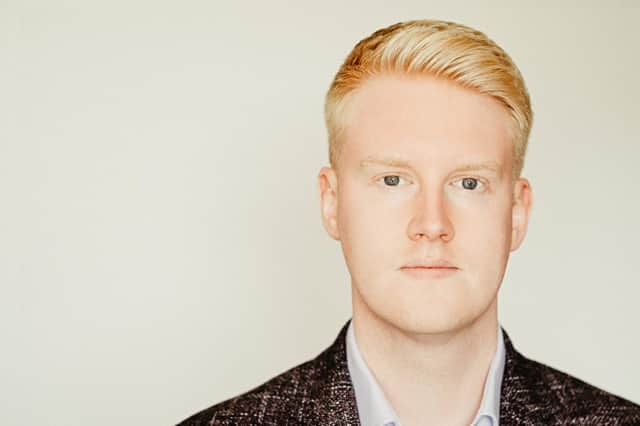

The SCO are making sure of that. Since Capperauld’s appointment to the SCO role in 2022, his output, his breadth of activities and his prominence have all skyrocketed. The orchestra has played his music throughout Scotland, on international tours and at the BBC Proms. And in the current season, it’s devoting all three of its digital season online films – performances specially recorded in the Leith Theatre and available via the SCO website – to his music. “It’s the stuff of dreams,” Capperauld laughs.
But it’s not hard to see where the interest comes from. Capperauld has a thoroughly distinctive musical language – accessible and immediate, expertly crafted, often uncompromising – and the subjects he chooses for his musical creations demonstrate an uncanny knack for unusual, sometimes even thought-provokingly bizarre inspirations. Recent works, for example, have mulled over real-life doll’s-house-sized murder scene recreations (in Death in a Nutshell), or even brain plasticity following trauma (in the saxophone concerto Rewired).
In real life, Capperauld is just as engaging, enthusiastic and eclectically interested as his music might suggest. Mention a resident or associate composer, and many people might imagine a lonely figure locked away, furiously scribbling dots on manuscript. For certain ensembles’ resident composers, that’s pretty accurate. Not Capperauld and the SCO, however, whose connections are far broader and deeper. “My interpretation of what a career as a composer should be,” Capperauld explains, “is far more multifaceted. I think we should be trying to be much more engaged in working with living musicians, in community settings, and also trying to help the next generation of composers and young musicians who are coming through.”
Capperauld practices what he preaches. Alongside the several new pieces he’s written for the SCO, he’s also led a strand of the orchestra’s five-year project embedded within Edinburgh’s Craigmillar community, as well as mentoring emerging composers as part of the SCO’s inaugural Soundbox scheme. And crucially, he’s got to know the SCO musicians intimately. “As a composer, you’ve got to try to make connections with people. But that’s always felt very natural at the SCO. I’ve got to know the musicians’ playing styles so well, from the inside out, so that I can now shape the music for them.”
Reid agrees: “He’s now not only writing for specific instruments, but also specific musicians.” Appropriately enough, Capperauld feels he has the SCO itself to thank for those feelings of connection. Back as a schoolboy in Ayrshire, he was one of many youngsters involved in a composition project with three SCO musicians, a scheme he now counts as formative in his decision to become a composer. “I just remember it was a really satisfying experience. It was that spark of working with live musicians that I’ve retained right up to the present day. It’s like a piece isn’t fully formed until you can sit down with a musician and work it out.” His SCO position, he says, “brought things full circle”, and also came at a pivotal moment: “We were just emerging from the Covid pandemic, and I really wasn’t at all sure what a career as a composer might look like in the future, or even whether I’d be able to have one. It felt like a genuine lifeline.”

That was in 2022. Jump forward to today, however, and Capperauld has written music to celebrate the orchestra’s 50th anniversary, and his music has also been a centrepiece of the SCO’s most recent BBC Proms concert. Those two works, in fact, form the digital season’s opening offerings. The appropriately brightly hued The Origin of Colour is an unapologetic orchestral showpiece, while Bruckner’s Skull – premiered in Scotland last spring, and unveiled to the London Proms audience in August – is a far darker, more macabre creation. Capperauld sees his own diverse interests reflected in the SCO’s versatility. “It comes down to their ability to shapeshift,” he explains. “One minute they’ll be playing something like The Origin of Colour, which is very tonal, very accessible in its language, then they’ll move on to something like Bruckner’s Skull, which has a much starker, more sombre mode of expression.”
Indeed, Bruckner’s Skull has arguably become Capperauld’s musical calling card. Its inspiration comes from a (possibly apocryphal) story of composer Anton Bruckner arranging to be present when the bones of Schubert and Beethoven were being moved from one Vienna cemetery to another, and daring to cradle their skulls in reverence. Rather than dwelling on the shock of the grim tale, however, Capperauld uses its ideas as a springboard to explore musical obsession, in what almost amounts to a psychological exploration of Bruckner’s anxieties and neuroses. “It’s about finding a way of telling stories to audiences,” he explains, “but also inviting the audience members to become more curious listeners. It’s not just about what they’re hearing, but also why they're hearing it.”
Completing the digital season trilogy of works is the far brighter, more optimistic choral piece The Night Watch, which sets a poignant poem by South Uist-born Niall Campbell on the joy and wonder of parenthood. “For that piece I was working with the SCO Chorus,” Capperauld explains, “who are just phenomenal. It’s a deceptive challenge – on the surface it looks quite straightforward, but underneath there’s a lot of nuance. But the SCO Chorus really got their teeth stuck into it.”
For Reid, the SCO’s digital season serves the purpose of reaching new audiences, and thereby raising the orchestra’s profile nationally and internationally. This year’s films, however, feel particularly special. “It’s a great opportunity,” smiles Capperauld, “for audience members who’ve told me they’d love to hear something again, or for people who want to rewind and hear their favourite bits all over again. I love that more investigative way of listening.”
Reid is clear, however, about the digital season’s particular function this year. “It’s another very effective way that we’ve got to amplify the brilliance of this guy, and to get him known on a wider, bigger stage.”
The SCO’s digital season opens with Capperauld’s The Origin of Colour on 16 October, and continues with Bruckner’s Skull, available from 12 February 2026, and The Night Watch, available from 2 April 2026. This feature was produced in association with the Scottish Chamber Orchestra.
READER OFFER: As part of our ongoing media partnership with the Scottish Chamber Orchestra, we're offering 20 per cent off tickets to concerts in the SCO's 2025/26 season. All you need to do is quote the code TSMSCO20 when booking – for venue contact details visit www.sco.org.uk.
The Scotsman’s arts newsletter is now sent twice a week - subscribe today
Comments
Want to join the conversation? Please or to comment on this article.