
Aaron Azunda Akugbo and Steven Osborne on tackling Shostakovich's 'conundrum' with the SCO
A madcap, heart-on-sleeve creation, Shostakovich’s First Piano Concerto offers its two soloists a whole host of challenges, writes David Kettle
“It’s slightly random, a kind of conundrum,” says pianist Steven Osborne. “It’s not a piece that really holds together as a single organism, somehow. You just have to accept that all its twists and turns are wonderful in their own way.”
Osborne is talking about Dmitri Shostakovich’s First Piano Concerto, which goes by the alternative title of Concerto for Piano, Trumpet and Strings. Alongside its musical unpredictabilities, even the piece itself seems to be having a quiet identity crisis. And if you think Shostakovich is all about dark, brooding symphonies that rage against Soviet repression, then this concerto might surprise you: it’s a madcap, heart-on-sleeve creation from Shostakovich’s youth, written to show off his compositional prowess and his own keyboard dexterity.


For the Scottish Chamber Orchestra’s end-of-season celebration concerts, this dazzling, breathlessly entertaining music will be performed alongside the somewhat more serious, tune-filled “New World” Symphony by Dvořák, which Principal Conductor Maxim Emelyanychev directs after the interval.
Osborne’s partner in crime in the concert is trumpeter Aaron Azunda Akugbo, who has his own views on the concerto. “It’s exciting that Shostakovich even wrote something like this,” he says. “I mean, we’re used to trumpets in his symphonies, and often they play the kind of stereotypical loud fanfares you’d associate with the instrument. There’s lots of that in the Concerto, too, but there are also gorgeous moments like the long melodies in the slow movement.”
It’s a piece that demands a unique relationship between its two soloists, and they’re definitely both soloists: you couldn’t claim that the trumpet ever shrinks into the orchestral backdrop. The piece began life as a trumpet concerto, and when Shostakovich came to reconfigure his music for the piano, he couldn’t face ditching the trumpet entirely. “It’s another aspect of the piece’s odd construction,” Osborne continues. “In his earlier music, Shostakovich wasn’t too concerned about tying everything up in a bow. He seems quite happy to leave these kinds of loose ends hanging.”
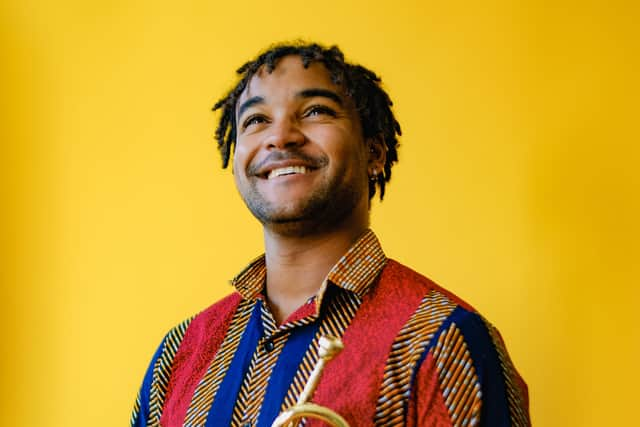
That unconventional scoring also makes for a striking imbalance between the two soloists: while the piano might take the lion’s share of the limelight, the trumpet is no shrinking violet. “When it comes in, it almost overshadows the piano,” Osborne laughs, “but then it just kind of stops again. That’s nice though – it’s good to share the load.” For his part, even with a somewhat unusual, stop-start role in proceedings, Akugbo agrees: “I’m not precious. I don’t need to be front and centre. I’m just happy to be there.”
Though the concerts visit Perth, Edinburgh and Glasgow, they’ll be, in fact, very Edinburgh-focused affairs. Akugbo was born in the city, Osborne lives there, and Edinburgh is also home to the SCO. “It’s my local orchestra,” Osborne smiles. “They’re about ten minutes down the road from me.” And there are more connections: both Akugbo and Osborne studied at the city’s specialist music academy, St Mary’s Music School. “I remember Steven coming into school all the time,” Akugbo explains. “He’d often do lunchtime concerts and introduce us to new repertoire.” There’s quite an age difference between the two men: how does Akugbo feel about soloing with a musician he used to encounter as a teenager? “Perhaps I’ve become way too casual about, but it’s actually quite a big deal.”
Both Osborne and Akugbo have relationships with the SCO stretching back many years – for the former as a soloist, while for the latter it’s more as a listener. “I remember going along to SCO concerts while I was at school,” explains Akugbo, “and if they had a particular soloist performing with them, often they’d come into the school for a masterclass or something like that. I’m trying to think back to whether I ever thought I’d be getting to play with these people, or whether that was even the goal. But it’s great to be able to do it.”
He’s no stranger to high-profile concerto appearances himself: Akugbo made his BBC Proms debut in 2023, and has appeared at London’s Royal Festival Hall and Wigmore Hall. Nonetheless, the Shostakovich performances will mark a particularly special occasion: “It’s actually my first concerto in Edinburgh, and in the Usher Hall, which was the big venue I used to go to when I was growing up. That’s going to be amazing.”
Akugbo moved to London to study at the Royal Academy of Music, and he’s lived and worked there ever since. When we speak, he’s about to memorise Stravinsky’s The Rite of Spring for performances with the Aurora Orchestra, he plays regularly with several London orchestras, and has a strong relationship with the Chineke! Orchestra. “For a trumpet player, in London there’s simply more stuff to do,” he admits. “But I realised the first time I went back to Scotland to perform – it was a trumpet and organ recital with John Kitchen – that it’s really nice being here. It feels like home.” Will he have an entourage coming to his first Scottish concertos? “I hope my family’s going to come,” he smiles. “I’m not going to count on my brothers being there, but they might be. I’ve not done messages to people yet – I end up leaving that to my mum.”
When we speak, Akugbo and Osborne have yet to discuss their joint approach to the Concerto. “But there’s a lot to be said,” Akugbo adds, “for learning to trust yourself a bit more in terms of preparation.” For his part, Osborne has an ongoing lecture project called “What does music mean?”, which he delivers at the Aldeburgh Festival not long after the Shostakovich performances. Does that offer any insights into this unusual piece? “The lecture is actually more about what happens when you get entranced by music, the feeling of meaning you get when you hear a really good performance,” Osborne explains. “My dad was an engineer, so I always like to understand the mechanisms behind things.”
As a performer, knowing about Shostakovich’s life and world plays a large part in conjuring that feeling of meaning, Osborne accepts. But in the end, he feels, it comes down to the music. “It’s about a succession of feelings, trying to get at the underlying emotional drama, which you might not even be able to put into words. But you still develop an instinctive sense of what kind of emotions they are.”
Steven Osborne and Aaron Azunda Akugbo perform Shostakovich’s Piano Concerto No. 1 with the Scottish Chamber Orchestra and conductor Maxim Emelyanychev at Perth Concert Hall, 13 May; the Usher Hall, Edinburgh, 14 May; and the City Halls, Glasgow, 15 May. This feature was produced in association with the SCO.
The Scotsman’s arts newsletter is now sent twice a week - subscribe today
Want the latest Scottish headlines sent directly to your phone? Sign up to our new WhatsApp channel here
Comments
Want to join the conversation? Please or to comment on this article.