
'It feels like the Fringe is back': is this year's festival really the biggest and best ever?
This year’s festival has the biggest ever number of shows

In 2020, organisers of the Edinburgh Festival Fringe had to do something that had never been done before in the event’s 70 year history: cancel the festival.
The Covid pandemic hit and Scotland went into lockdown on March 26. Six days later, on 1 April, the Fringe was scrapped, along with other August festivals including the Edinburgh International Festival and the Edinburgh International Book Festival.
“People initially were very worried about the impact on the future of the festivals,” says veteran Fringe PR Michelle Mangan, who worked at the Edinburgh Festival Fringe Society until weeks before the pandemic.
“It was the unknown of what was about to happen and how people were then going to be able to make a living in the arts.”
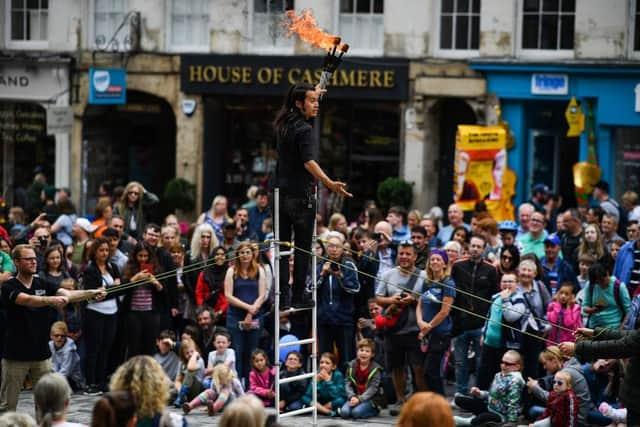
Now, six years later, venues have proclaimed the Fringe is “finally back”, with a record number of shows and an audience appetite for performances that they say has not been seen since before the pandemic.
New figures released by the Edinburgh Festival Fringe Society this week have revealed this year’s festival is the biggest yet. A total of 4,202 shows have been registered with the organisation, larger even than 2019, when there were just 4,105.
Meanwhile, venues have boasted of strong sales in the weeks leading up to the launch of the festival, with one saying it had sold 63 per cent more tickets than at this time last year.
At Underbelly, which is celebrating 20 years of its iconic upside down purple cow, Violet, this summer, ticket sales are up by almost a third, while at its Cowgate site - the original home of the venue operator - the number of seats sold has more than doubled.
“We’re seeing a really strong advance for this year’s festival and this weekend looks like it will be a humdinger, with the highest ticket sales since before the pandemic,” said founders Ed Bartlem and Charlie Wood.
There is one caveat to the Fringe Society’s figures: while the number of different shows is at a record level, the number of performances is actually significantly lower than in 2019 - at 57,000 this year compared to 61,088 seven years ago.
This is mainly due to a rising trend for performers to undertake shorter runs, mainly due to the rocketing price of accommodation in Edinburgh. The shift prompted Mr Wood to warn earlier this summer that Edinburgh was in danger of becoming “just another date on a tour schedule”.
Meanwhile, audiences are also cutting short their visits, with the vast majority of tickets sold to locals, as people living further afield are deterred from spending hundreds of pounds a night on an Edinburgh festival-time hotel room.
“The largest audience share by far is from Edinburgh and Scotland, with no appreciable difference in the number of ticket buyers from the rest of the UK, which we think this is a response to the cost of accommodation,” add Mr Wood and Mr Bartlem.
“But on the flip-side, it’s wonderful to see Edinburgh and Scotland respond so brilliantly to all that we have to offer.”


For Sam Gough, chief executive of venue Summerhall, it “feels like the Fringe is back”.
Ticket sales at the venue are up 63 per cent on the same time last year with 29,334 tickets sold by opening day, compared to 17,958 in 2025, both from around 80 shows.
Mr Gough believes the increase is due to a number of factors, ranging from an audience finally returning after the Covid pandemic, to a boost from a fallow year at Glastonbury sending festival-goers north and an increase in both artists and audience members from the US, looking for an escape from political turmoil back home.
He says: “It’s my 34th Fringe and the last few years, it has felt like Fringe has been there, but we’ve had to drag it there. Now, it feels like the Fringe is back to what it should feel like. The city is really buzzing. There’s a really great atmosphere, we’re not relying on getting the momentum going, we’ve hit the ground running.”
He said the years after the pandemic had resulted in a “fallow” time when artists were not producing as much new work - but believes that period has passed.

“It feels like people are really back to wanting to see a lot of live work and it is fabulous,” he says.
Summerhall last year implemented a new strategy, cutting its number of shows from around 115 to 80. It sold a similar number of tickets and had a string of sold-out shows. This year has already seen three shows sell out their runs: Roleplay, Bigfoot Ripped My Dog In Half I Saw It and Adam Riches: The Captain, with a number of other, smaller shows already close to being sell-outs.
“What we realised last year with all of these changes is it doesn’t have to get bigger to be better,” says Mr Gough. “We don’t have to have a mad dash to fill every minute of every day to make a festival successful.”
Across the main venues, a similar picture is forming.
“I think finally we are getting to a point similar to pre-Covid and people are once again discovering the joy and wonder of live performance,” says William Burdett-Coutts, founder and director of Assembly Festival.
“Sales at this point are off to a good start and we even had some sold out shows in the first few days.”
Anthony Alderson, director of the Pleasance, said it is “particularly heartening” to see audiences taking chances on new artists this year.
“We’re delighted with the start of this year’s festival,” he says. “Audiences have embraced an exceptionally strong and diverse programme, with encouraging ticket sales.
“The Edinburgh Festival Fringe remains one of the few places where audiences come with a spirit of discovery, and that appetite for fresh ideas and bright new ideas is what makes the Festival so special.”
This festival has not been without controversy, with debate over the existence of one performance rocking the event before it had even started.
A petition was launched to scrap Amanda Knox’s stand-up show, backed by the sister of Meredith Kercher, the student killed in Italy in 2007, who said the show turns her sister’s rape and murder into "entertainment". Knox was accused of her murder, and then later acquitted.
Gilded Balloon, one of the most established venues at the Fringe, has defended its right to host the show , saying it was “in line with the Fringe’s long-standing commitment to freedom of expression”.
Stephanie Kercher, however, has said the show being comedic “normalises and trivialises violence against women”.
The Fringe Society has backed the venue’s right to host the show, with chief executive Tony Lankester saying in an interview that the organisation is “not afraid of controversy”, adding the decision whether to run the show “lies with Amanda herself and it lies with the venue”.
“Those are conversations that they can have, but as far as I’m concerned, I believe that if you are opening up a stage and calling it an open access festival and inviting people in to tell their stories, you have to be prepared for some controversy – it’s going to happen,” he says.
The run is sold out, while 11 other shows across Gilded Balloon’s offerings this year have also sold out. The venue has reopened its flagship Teviot hub, which was closed for two summers due to a major refurbishment.
Katy and Karen Koren have described the first days of this year’s festival as “incredible”.
“Lots of our shows are filling up fast and it’s fabulous to see our newer artists benefitting from audiences taking a chance seeing something new. I hope it continues for the rest of this wonderful festival.”
Comments
Want to join the conversation? Please or to comment on this article.