
I was the first visitor to Queen Elizabeth's Palace of Holyroodhouse apartments and this is what I saw
The apartments are open to the public for 100 days

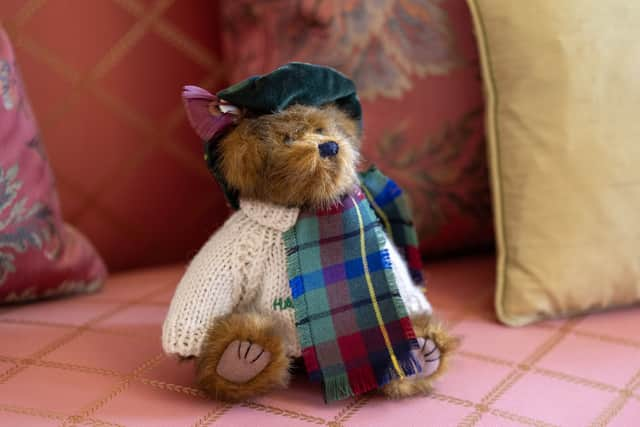
Perched in the centre of a dark pink sofa in the late Queen Elizabeth II’s private sitting room is a small teddy bear.
“He was a gift and she asked that every time she arrived here, that he be placed in that exact position on the sofa awaiting her arrival,” says Emma Stead, curator at the Palace of Holyrood House. “He’s called Haddington Bear.”
The provenance of the teddy is the matter of some debate among royal experts at the palace. Some believe it was given to the Queen when she opened the Scottish Parliament building in 2004, due to its Scottish Parliament tartan outfit, while others ascertain it was gifted on a trip to Haddington itself three years later.
The bear, along with a tartan pin cushion adorned with pin badges from the 1986 Commonwealth Games in Edinburgh - another favourite personal effect of the late Queen - is now on display to visitors to what were the Queen’s private apartments in the royal Edinburgh residence.


The apartments are a suite of private rooms on the east side of the palace, being opened to the public for the first time, allowing access for 100 days to small groups of ticket holders who will be taken behind the scenes to discover the history of the rooms and learn how they were used by the royal couple during the Queen’s 70-year reign.
“You’re the first people we’ve had in here,” says the warden who opens a wooden door off the main quadrangle of the palace to let us inside. It is the first day of the limited tour season and members of the public have already begun to gather at the Abbey Strand gate in hope of catching a glimpse inside.

The sitting room, as well as an equivalent room used by the Duke of Edinburgh; the Queen’s dressing room, the breakfast room and a reception area used by the Duke’s pages are all to be made public. Bedrooms and bathrooms are off-limits as they are still being used by visiting members of the Royal Family.
The sitting room writing desk overlooking the palace gardens holds the iconic red Government dispatch boxes delivered to the monarch every day, as well as headed notepaper and a Royal Telegram template. The Queen famously only took off two days a year - one at Christmas and another at Easter - earning her the moniker of the hardest working monarch.
“All we can say is the Queen was very particular,” adds learning curator Richard Williams, who describes the late monarch and her husband as a “modern couple”.
“I know from staff colleagues in Windsor that if they were going to redecorate her private rooms, they would take photos of everything so that they could put things back in the exact spot.”
The rooms were predominantly furnished in the 1920s by Queen Mary, who wanted to redecorate the apartments with period-appropriate furniture. However, they were initially adopted as the royal living quarters by Queen Victoria, who, writing in her diary, rejected the area of the palace previously utilised by royals as “dark and gloomy”.
“These are much more liveable, very comfortable spaces,” says Mr Williams. “They are very different from what the public would normally expect when you see private rooms of royalty.”
In the breakfast room, which is adorned with Flemish tapestries on the walls, the Queen and the Duke of Edinburgh ate every morning between 9am and 9.15am, where they perused their favourite publications.
“The Scotsman paper would be delivered every day, which they would read along with the Radio Times and the Racing Post,” says Mr Williams, pleasingly.
After the Duke died, the Queen reportedly chose to sit with her back to the fireplace, so she could face her staff while eating her breakfast, the only meal of the day when she dined alone. Anecdotes about how she used the rooms have been gleaned from interviews conducted with members of staff who served her at Holyrood during her reign.
The Duke’s sitting room, where he would host the First Minister on private visits, features a number of works of he selected - much of it acquired from the Royal Scottish Academy’s annual exhibitions throughout the 20th century. A fan of Scottish artists including Barbara Balmer, an example of the Duke’s own work - an oil painting depicting a scene near Balmoral Castle - is also displayed in his sitting room.
A feature of a corridor outside of the Queen’s sitting room is a bronze statue of a dog, one of a number of works of art dating back before Queen Mary’s refurbishments.
“Whenever you see a bronze dog, you know it’s [come from] Queen Victoria,” says Mr Williams. “It is one of three statues made for her, of dogs called Spot, Fern and Noble. Not a firm of accountants, though it does sound like it.”
Meanwhile, in the Queen’s dressing room, three outfits are on display. One is the dress she wore at the official opening of the Scottish parliament in 1999, another an embroidered evening dress worn for a Commonwealth Heads of Government dinner in the 1990s, while a 2007 garden party outfit is also available for the public to see.
A modest, modern Roberts radio sits on a dressing table, which the Queen reportedly listened to while getting ready for events.

“We don’t know what she listened to,” said Ms Stead. “But we were told she liked to have it on when she was in here.”
Back in the Queen’s sitting room is a modest television on a modern, glass stand, above a dual video and DVD player.
“It’s very evocative,” says Mr Williams. “You can imagine her sitting here on the sofa, watching the racing.”
And reading The Scotsman, no doubt.
Queen Elizabeth II Private Apartment Tours, available only this year, will run daily until 10 September 2026. Tours are limited and must be booked in addition to the standard admission ticket to the Palace of Holyroodhouse.
Comments
Want to join the conversation? Please or to comment on this article.