
First look inside old Royal High School transformation into National Centre for Music

The building is to open as the National Centre for Music in summer 2028
It was built almost 200 years ago as a grand room where up to 600 boys would gather to be taught the rudiments of Latin and Greek and was later transformed into a debating chamber for a Scottish Assembly that was never used.
Now the main hall at Edinburgh’s former Royal High School is finally on its way to become a new concert hall for the city and the heart of the National Centre for Music (NCM), after a decades-long campaign to save the building.
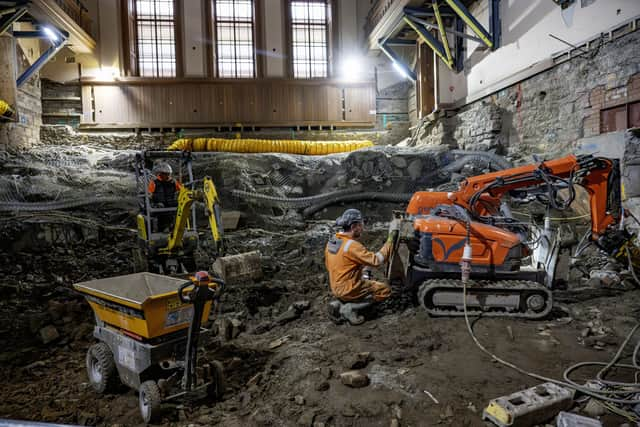

Construction on the major project is now well underway on the site, with the completion date on track for summer 2028.
Diggers have excavated the area under the main hall where a new corridor is to be created, linking the two symmetrical wings of the original building.
“My favourite part of showing people around the site is seeing their faces,” says Kate Smith, chief executive of the Royal High School Preservation Trust, which was formed a decade ago to conserve Thomas Hamilton’s architectural masterpiece. “I think there was always a feeling that it would never happen and now we’ve broken ground, they can see it will.”
The west wing, closest to the main Regent Road entrance of the site, is to house the commercial side of the operation, including conference facilities and a public cafe-bar area which opens out at the lower ground level onto the west gardens.
The gardens, designed by architect Tom Stuart-Smith and Edinburgh based landscape architects, OPEN, will be the first major new city centre public garden since Princes Street Gardens opened in 1820. It incorporates the historic Belvedere former bell tower which will be developed to include a piazza which could be used for outdoor concerts.
The near-identical east wing will be home to smaller performance spaces, music practice rooms and offices for NCM staff, as well as green room space and a recording studio, which will also allow concerts to be beamed live into other venues around Scotland and vice versa.
Roof slates have been salvaged where possible and where new ones are needed, they have been sourced from the same quarry in Wales where the originals were found.
Ms Smith admitted there is still a £2 million funding gap on the project, but said 98 per cent of necessary funds had now been found. While the RHSPT will not give a specific figure of the project’s costs, £70 million had been previously hinted at, although the current numbers suggest it has potentially risen above that.
The project has been almost entirely funded by individual philanthropists, largely the Dunard Fund, with the exception of an additional £4.5 million in funding from the National Lottery Heritage Fund unveiled in October and funding of £3m from the City of Edinburgh Council’s new visitor levy.

Earlier this year it was announced the opening date of the building had been delayed from next year until mid 2028 after an excavation of the site forced changes to the plans.
“We still do have a bit of a funding gap,” Ms Smith said. “We’re in pretty good shape for a project of this scale, but we do have £2m left to find. There’s still work to do, but I feel comfortable that at the end of the project we’ll be in a position to complete it out.
“It’s almost all been from philanthropic sources, which is almost unique for a project of this scale and size.”
She said the RHSPT was “in conversation” with public sector funders, but was not hopeful.
“The prospect of those materialising feel fairly thin because of limited budgets,” she said. “But we are doing everything we can to close the gap.”
The building was earmarked in the early 1970s as the potential home of a devolved Scottish Assembly and was decked out accordingly, complete with speaker’s desk and expanded viewing galleries. However, a 1979 referendum did not garner enough support for devolution. The building was abandoned for decades and the devolved Scottish administration eventually located in the purpose-built Scottish Parliament in Holyrood, which opened in 2004.
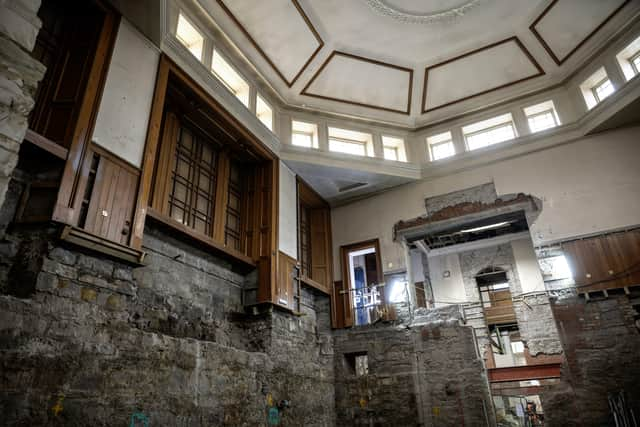
In the two octagonal rooms situated on either side of the main hall - one previously a headmaster’s study, the other a former library - wooden panelling dating back to the time of the Scottish assembly renovations is listed and will be retained.
In the main hall, the original 1820s wooden balconies will be also be kept, along with other original features, including a Latin inscription above a door which scholars were only allowed to pass through on their final day at school. The never-used speaker’s chair from the room’s days as a would-be debating chamber was passed to National Museums Scotland during the works, where it is on display to the public.
Seating up to 310, the hall will feature a moveable floor modelled on the one in the Laidlaw Centre in St Andrews, which can reconfigure the space to have a theatre set up at either end, or in the round.
The centre is in talks with both the Edinburgh International Festival and the Edinburgh Festival Fringe over its use as a potential festival venue in the future.
“We’re very much looking to fill a strategic gap,” says Ms Smith. “We’re looking to support a bit of decongesting of the city centre in festival season and we really want to become a real home for music in that time.”
Jenny Jamison, creative director and chief executive of NCM. said the organisation was currently finalising a different name for the centre, which will be revealed in September.
“One of the things we learned from the brand engagement work we’ve done was that the nature of the stunning, grand architecture we have here, plus the name of the National Centre for Music, might feel intimidating for some audiences,” she said.
“So we have chosen a different name, something shorter and snappier that has resonance with the existing name, so people can say, ‘we’re going to a gig at X’, rather than abbreviating it.”
As part of the National Lottery Heritage Fund grant, research assistants have been recruited to look into the full history of the building, from famous pupils of the former school - known to include actor Ronnie Corbett, author Sir Walter Scott and Alexander Graham Bell, inventor of the telephone - to verifying legends surrounding the building’s construction, including the use of dynamite to blow a hole in the side of Calton Hill.
Comments
Want to join the conversation? Please or to comment on this article.