
Wicked: For Good review: This Wizard of Oz origins story starring Ariana Grande is devoid of magic
Wicked: For Good doesn’t have the courage of its progressive convictions, writes Alistair Harkness
Concluding last year’s serviceable origins story of the Wizard of Oz’s hitherto deliciously depraved villain, Wicked: For Good continues the mission to reverse-engineer unnecessary backstory from its original source material, to nullifying effect.
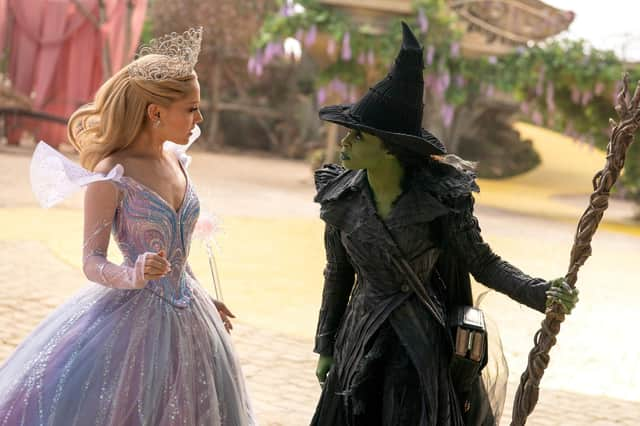

Getting thoroughly lost in the minutiae of the story, returning director Jon M Chu reveals the whole endeavour to be a stretched-thin, creatively confused epic that’s part feeble-minded fable about fascism, part corporate brand expansion of the hit Broadway musical, the limitations of which are much more obvious now that the film has to incorporate the plot of its superior inspiration into the mix.
With the green-skinned Elphaba (Cynthia Erivo) fully ostracised as the Wicked Witch of the West, this instalment kicks off with her futile efforts to expose the demagoguery of the Wizard of Oz (Jeff Goldblum), whose vainglorious campaign to make Oz great again with the unnecessary construction of yellow brick roads and the mass incarceration of talking animals is being lapped up by a public who don’t care that every word out of his mouth is a lie (“these people will believe anything” trills one character early on).
Opting to go into hiding instead, she’s coaxed out by a cabal of Oz sycophants, among them her bubble-dwelling frenemy Glinda (Ariana Grande), who also knows the way to get to Elphaba is through her disabled sister, Nessarose (Marissa Bode), whom we see being furnished with a pair of magic slippers that apparently give her the power to float through the air, but not dodge falling houses.

The latter event is the most egregious example of the film’s use of The Wizard of Oz.
The death of Nessarose (no one ever refers to her as the Wicked Witch of the East) is here re-imagined as a political assassination in which Dorothy Gale – whose face we never see – is a patsy, used by Oz, Madame Morrible (Michelle Yeoh) and Glinda to capture Elphaba, who doesn’t, in truth, seem all that bothered about the death of her sister, just the loss of the slippers.
There are other detrimental additions, such as the Munchkin origins of the Tin Man (huh?) and the revelation that the Cowardly Lion (Colman Domingo) has a grudge against Elphaba for setting him free from a zoo (what?).
There’s also a baffling origins story for the Scarecrow that’s too much of a spoiler to get into and, in fact, the character is kept mostly off screen anyway, appearing only at the end as part of a nonsensical twist designed to re-emphasise a beauty-is-in-the-eye-of-the-beholder message that the film is half-heartedly peddling.
But even here the film doesn’t have the courage of its progressive convictions, relegating its queer-coded characters to the margins and giving Elphaba a hunky hetero love interest (Jonathan Bailey’s Fiyero) that further undermines the supposed tragedy of her own misunderstood nature.
Wicked: For Good may thoroughly deconstruct the rich lore of The Wizard of Oz, but like the characters left behind at the end, what it builds in its place is devoid of magic.
Comments
Want to join the conversation? Please or to comment on this article.