
Film Reviews: How to Make a Killing | Everybody to Kenmure Street | The Bride!
Glen Powell and Margaret Qualley can’t help but be watchable in an otherwise dull remake of Kind Hearts and Coronets, writes Alistair Harkness
How to Make a Killing (15) ★★
Everybody to Kenmure Street (12A) ★★★★
The Bride! (15) ★★
Remaking black-hearted Ealing comedy Kind Hearts and Coronets for our current age of billionaire schmucks is a fun idea on paper, but not so much in practice if How to Make a Killing is anything to go by. Starring Glen Powell as the son of a disinherited socialite who decides to murder his way into a fortune by “pruning a few branches” of his illustrious family tree, the film takes the original’s gleefully macabre premise and makes it weirdly boring, starting with the tedious decision to begin with Powell’s character, Becket, recounting his story to a priest during his final few hours on death row.


Dated narrative device established, we’re subjected to lots of snarky voice-over as Becket lays out the events that have led him here while we get to watch the ever-charismatic Powell test the waters of Becket’s sociopathy after realising grit and hard work don’t pay in a world fuelled by nepotism and family connections.
The film sees no irony here in casting Margaret Qualley — excellent though she always is — as its femme fatale, a former childhood crush of Becket’s who plants the murderous succession plan in his head for nefarious reasons of her own. Then again, Powell and Qualley can’t help but be watchable and they’re the saving grace of a film that in every other way feels like a step back for writer/director John Patton Ford, whose 2023 debut Emily the Criminal offered a more forceful, streetwise and modern take on similar themes.
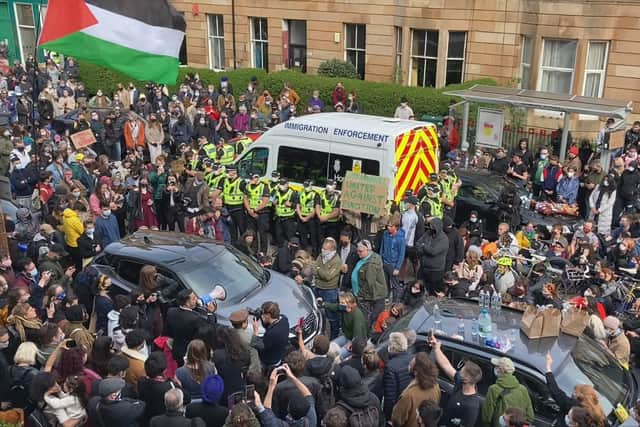
It’s been almost five years since the fast-acting residents of Glasgow’s Kenmure Street helped stop a provocatively timed Home Office dawn raid on the first day of Eid in one of the most culturally diverse parts of the city. Ending with the two men who’d been bundled into the back of a Home Office immigration van being released back into the community following an eight-hour stand-off between demonstrators and Police Scotland, the peaceful and positive outcome has made the events of 13 May 2021 a rarity. But if the shining example it offered of how activism and policing by consent can and should work hasn’t exactly been embraced by those in power in the years since, that’s also what makes Felipe Bustos Sierra’s rousing documentary Everybody to Kenmure Street so valuable.
Mixing together on-the-ground footage with talking-head interviews, historical analysis and dramatic reconstructions, it kicks off with a montage detailing the long history of protest and civil rights activism in Glasgow, before showing how a trickle of curious residents started gathering in the street (some still in their pyjamas) upon learning that two of their neighbours were being taken away. In a playful cameo, the film’s executive producer Emma Thompson provides testimony from “Van Man”, the anonymous activist whose decision to wedge himself under the van made the larger protest possible (Kate Dickie also co-stars as a proxy for the off-duty nurse who attended to his well being). But as the numbers swell and the police respond by drafting in an intimidatingly large number of reinforcements, the film captures not just the heartening, sometimes surreal sense of community that emerged, but also the possible inflection points during which things could have deteriorated were it not for the cool-headed actions of the residents, protestors and community leaders whose collective decency and empathy won out.

“Me too! Me Too!” screams Jessie Buckley’s titular protagonist towards the end of The Bride!, underlining — in case you’ve missed it — the thematic intent behind Maggie Gyllenhaal’s wildly imagined, incoherently executed riff on 1935’s Bride of Frankenstein. Using as a jumping off point that film’s decision to frame proceedings with Frankenstein author Mary Shelley ruminating on her own literary creation, Gyllenhaal transposes the action to 1930s Chicago where Shelley’s restless spirit (also played by Buckley) takes possession of a loose-lipped gangster’s moll called Ida (Buckley). Swiftly murdered for reasons hastily explained later on, she’s just as quickly resurrected by a mad scientist (Annette Benning) at the behest of “Frank” (Christian Bale), the stapled together “son” of Victor Frankenstein, who has been lurking in the shadows for the last hundred years, but now quite fancies a mate.
With no memory of who she was — but still possessed by Mary Shelley — Ida is renamed Penelope by Frank and kind of falls for him as they’re forced on the run by an unsympathetic public. Musical numbers and movie references abound as they go on a cross-country killing spree, inspiring en route a proto-Riot Grrrl revolution as Penelope — with her ink-stained face and Bonnie Parker style — becomes a figurehead for silenced women everywhere.
Alas, despite scratching at interesting ideas, Gyllenhaal’s chaotic, see-what-sticks approach nullifies most of them, leaving us with an untethered heroine barking slogans that the film around her fails to back up in any creatively meaningful way.
How to Make a Killing is in cinemas from 11 March; Everybody to Kenmure Streets is in cinemas from 13 March; The Bride! is in cinemas now.
The Scotsman’s arts newsletter is now sent twice a week - subscribe today
Want the latest Scottish headlines sent directly to your phone? Sign up to our new WhatsApp channel here
Comments
Want to join the conversation? Please or to comment on this article.