
Blink Twice review - 'a horror film puzzle full of gruesome payback'


Zoë Kravitz’s debut feature stars Naomi Ackie as a waitress who is whisked away to a billionaire’s private island, where things might not be quite as perfect as they seem. Review by Alistair Harkness
Blink Twice (15) ★★★★☆
Kneecap (18) ★★☆☆☆
Zoë Kravitz makes the transition from actor to filmmaker in fine style with Blink Twice, an entertainingly slippery social horror movie that takes superficial aim at the super-rich to launch a sharper sneak attack on the sorry/not sorry patriarchal backlash against #MeToo. Like a lot of recent examples of the former – Triangle of Sadness, Infinity Pool, Glass Onion, The Menu – it’s set on a luxurious private island, this one owned by a billionaire tech mogul called Slater King (Channing Tatum), newly emergent from the doghouse following a very public reckoning for an unspecified abuse of his power. As the film opens, Kravitz gives us a montage of the by-now familiar stages of crisis management PR, beginning with Slater’s first insincere hostage-video-style non-apology and ending with him re-integrated into public life as a thoroughly humbled philanthropist, the sort of contrite “work-in-progress” guy who just wants to do good in the world and has his own Met Gala-style fundraising bash to prove it.
It’s here that cash-strapped waitress and Slater obsessive Frida (Naomi Ackie) hopes to meet him. Though instructed by her catering boss to be “invisible”, Frida’s flatmate and fellow waitress Jess (Alia Shawkat) slips a couple of dresses into the event so they can gatecrash the afterparty. Soon enough they’re being whisked off to Slater’s island on a private jet for an impromptu holiday with his inner-circle. Here the film – by way of Jess making a couple of cracks about cults and human sacrifices – openly acknowledges their dumb horror movie behaviour, but amid the free-flowing champagne, hallucinogens and insane gourmet food, neither Frida nor Jess question too deeply why, say, there’s matching white swimwear and chic linen clothing readily available in the correct sizes for all the women on the trip, or why Slater’s tech-bro friends (played by Christian Slater, Simon Rex, Haley Joel Osment and Levon Hawke) seem awfully concerned that they’re are having as good a time as they are. Nor do they seem all that worried about their lives back home – or that this Edenic paradise has an awful lot of venomous snakes.
This isn’t so much a fault in the writing as it is a part of the film’s overall design: Kravitz – who co-wrote the script with ET Feigenbaum – is good at drip-feeding information that turns what we think we know on its head, revealing the full horror of her concept with a rug-pull or two that sends it to some pleasingly outré places.
That said, not everything about it works smoothly: the implicit romantic rivalry between Frida and Sarah, a reality TV star desperate for Slater’s attention (she’s played by Hit Man’s Adria Arjona), is resolved a little too easily to make the direction their subsequent relationship takes feel as earned as it should; and the fate of one character who goes missing is pretty much forgotten about as the film speeds towards its revenge fantasy finale. But the performances – especially Ackie and, latterly Ariona – do a lot to help Kravitz pull off a tricky balancing act, letting her excavate provocative themes about trauma suppression and nostalgia for more regressive times within the bounds of a horror film puzzle full of gruesome payback (there’s a sly supporting role here too for Geena Davis that really helps bring this home).
Of course Jordan Peele’s Get Out – the urtext of all recent high-concept horror – can be lazily invoked as an influence. But like Olivia Wilde’s unfairly maligned Don’t Worry Darling, Kravitz goes back further, to classic Ira Levin novels Rosemary’s Baby and The Stepford Wives (and their original film adaptations), reconfiguring their still depressingly relevant ideas for a world in which “cancellation” is just an inadequate speed-bump on the road to dismantling the status quo.
Disrupting the status quo is also at the heart of Kneecap, an inspired-by-real events comedy tracing the wild origins of the titular Belfast rap trio, whose punky attitude, fondness for coke and ketamine, anti-coloniser stance on British rule, and defiant refusal to let the English language drown out their native tongue has made them social media folk heroes as well as targets for right wing tabloids and the British government. Sadly, the film – co-written by and starring the band – straightjackets their story by turning it into, at best, the sort of annoyingly broad, post-Trainspotting “YOOF culture” comedy epitomised by the clubbing film Human Traffic and, at worst, a kind of weirdly sentimentalised musical coming-of-age story – like Sing Street with swearing and Class A drugs.
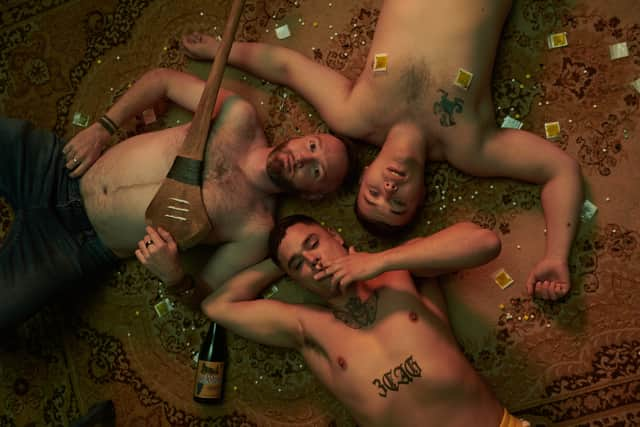
Director and co-writer Rich Peppiatt may set the ironic tone with a middle-finger flip to past cinematic portrayals of the Troubles, but what he presents instead is too cartoonish to be truly edgy – though kudos for casting Michael Fassbender (who broke through playing Bobby Sands in Hunger) as band member Móglaí Bap’s ex-IRA father and having Móglaí nickname him “Bobby Sandals” after he fakes his own death and reinvents himself as a yoga guru. The film, though, mostly squanders the very real charisma and stage presence of the band by pitting them against a series of buffoonish caricatures and enacting cliched scenes like the one where Móglaí’s agoraphobic, salt-of-the-earth mother (Simone Kirby) puts on some make-up and her best shoes and stomps off to stand-up for her boy. When the film plays actual footage of Kneecap’s various gigs and antics over the end credits, it hints at the movie it could have been had it had taken a more artistically daring, 24 Hour Party People-style approach.
Blink Twice and Kneecap are in cinemas from 23 August
Comments
Want to join the conversation? Please or to comment on this article.