
Export ban placed on bust of Scottish politician owned by Highland Council to 'preserve' it for nation

The bust is valued at £3.1 million
An export bar has been placed on an 18th century bust of a Scottish politician by the UK Government in a bid to preserve a “key piece” of history.
The temporary ban on moving the bust - of Sir John Gordon of Invergordon by artist Edmé Bouchardon - out of the UK, aims to give a British museum or gallery the chance to acquire the work.
The 18th century marble sculpture, created in Rome in 1728 and valued at £3.1 million, is owned by Highland Council.
The UK Government, which said the bust “provides a unique insight into Scottish heritage”, on Friday deferred a decision on an application for an export licence to remove the artwork from the country until 8 April. Criteria of the sale state that any new owner would have to create a replica bust to go on display in Invergordon.
The sculpture was last sold off in 1930 for £5 following the sale of Kindeace House in Invergordon, when it was acquired by the Burgh of Invergordon Town Council, which was later absorbed into Highland Council.
Two years ago, the council launched a public consultation over plans to sell off the bust to create an ongoing income stream to invest in the local community. It said the high value of the sculpture meant it could no longer be put on public display, due to the “associated security risks”.
The work represents the only classicising bust of a Scottish aristocrat by Bouchardon from the first half of the 18th century. The sculpture demonstrates the sculptor's innovative approach to portraiture, combining classical typology with naturalism and psychological insight.
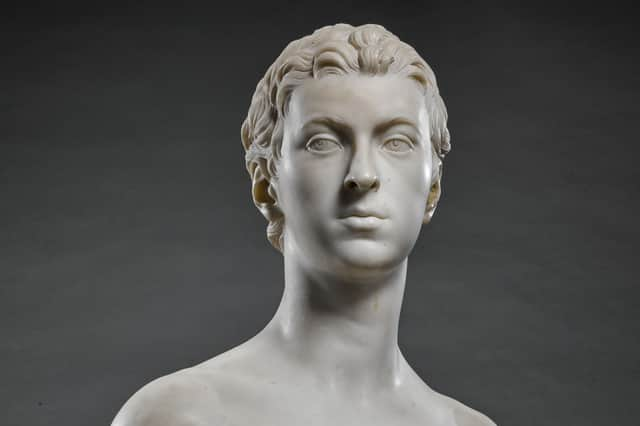

Sir John Gordon of Invergordon was a Scottish politician who served as a Member of Parliament. He succeeded his father as MP for Cromarty and served as Secretary for Scottish Affairs to Frederick, Prince of Wales, in the 1740s.
His family was also well known for their land ownership and development efforts which established the town of Invergordon, a key port on the Cromarty Firth.
It is one of only two classicising marble busts of British male sitters by the French sculptor, with the other not on public display, meaning the work is considered essential to understanding the development of 18th century British portraiture.
UK Government culture minister, Baroness Twycross said: "This bust has an extraordinary history. I hope the temporary export ban will allow a UK institution or gallery to be found to keep this extraordinary sculpture in Britain.”
The Minister’s decision follows the advice of the Reviewing Committee on the Export of Works of Art and Objects of Cultural Interest (RCEWA).
Highland Council’s sale plans for the bust were approved in November 2024 and the item was put on sale with auctioneer Sotheby’s. An application for a UK export licence was submitted on 12 March last year, however, an objection was raised with Sotheby’s, sparking the review by RCEWA.
Stuart Lochhead, member of RCEWA, said: “This remarkable marble bust of John Gordon of Invergordon by Edme Bouchardon tells a unique story about Scotland, Jacobite intrigue, Rome as a cultural crucible at the time of the Grand Tour, and a radical new portrait style.
“Gordon is portrayed bare-chested, evoking some of the classical sculpture Bouchardon studied at the French Academy in Rome. This rare approach reflects the artist’s ambition to merge ancient nobility with eighteenth-century elegance.
“A striking example of Bouchardon’s mastery and Scotland’s participation in the Grand Tour, the sculpture combines historical significance, rarity, and superb quality. This exceptional work of art deserves to be saved for the nation.”
The government said the committee made its recommendation on the basis that the bust met criteria for a bar for its outstanding connection with “UK history and national life, its outstanding aesthetic importance, and its outstanding significance to the study of the history of 18th century sculpture in Britain and Europe and the sculpture and portrayal of aristocrats”.
A spokesperson for Highland Council said; “Arts Council England informed Sotheby’s, who are acting on behalf of the Highland Council, that an objection had been raised regarding the export of the Bouchardon Bust. As a result, the application was considered at a hearing of the Reviewing Committee on the Export of Works of Art and Objects of Cultural Interest in July 2025.”
“We have today, 9 January 2026, received confirmation on the outcome of the hearing.”
Comments
Want to join the conversation? Please or to comment on this article.