
Edinburgh International Book Festival 2025: AL Kennedy, Philip Marsden & Vanessa Taylor
The importance of stories and our relationship with nature are themes in both of these discussions.
AL Kennedy gives one of her enjoyable, amusing and thought provoking performances at EIBF. She talks about her latest novel Alive in the Merciful Country.
Part of the novel takes place at Edinburgh during the Festival, when, she says, ‘the town gets mediaeval’ and ‘young people will hand you flyers for brilliant shows which no one will ever see’ and when it takes a long time to walk down the High Street to Hunter Square, somewhere akin to the promised land (for street performers) but is not, I don’t think, the ‘Merciful Country’ referred to in the title, a heavenly place where all your sins are forgiven.
Though it may have certain similarities, street traders and performers in Hunter Square might question the comparison.

This aside, at EIBF it is clearly a good idea to read passages from her book that describe so well the colourful and packed streets, the people in all kinds of fancy dress, or almost none at all, the fire eaters, jugglers, plate spinners, sword swallowers, clowns and stilt-walkers we are accustomed to seeing perform to large crowds who block the High Street at this time of year.
Kennedy’s novels always have rich descriptions not just of the physical world but also of the states of mind of her protagonists, how people see and experience the world. And her school teacher character tells her pupils the story of Rumpelstiltskin, where a miller’s daughter has to spin straw into gold which impossible task is made possible by an imp-like being with magical powers.
The price of his help is high. She has to give him her first born child. The only way she can be released from this promise is to discover his name, which, with the help of a scout, eventually she does. This knowledge of his name dissolves his power over her and he disappears into the floor. The idea being, that ‘the way to defeat all monsters is to know who they really are’.
Kennedy is passionately for all human beings, particularly the downtrodden, the ignored or scapegoated. She advises people to turn away, whenever possible, from conversations that demonize others, and to ‘look for what makes your heart sing’. This, she says, is the value of the arts, because they ‘get you through’. Rather than focusing on life’s pain and challenges, the arts bring people together, through theatre, song, dance, all the arts, and we experience a celebration of life.
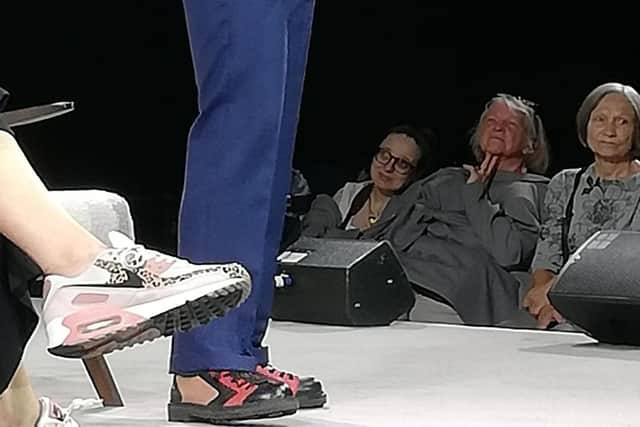
Edinburgh at this time of year is a vivid example of celebration and enjoyment.
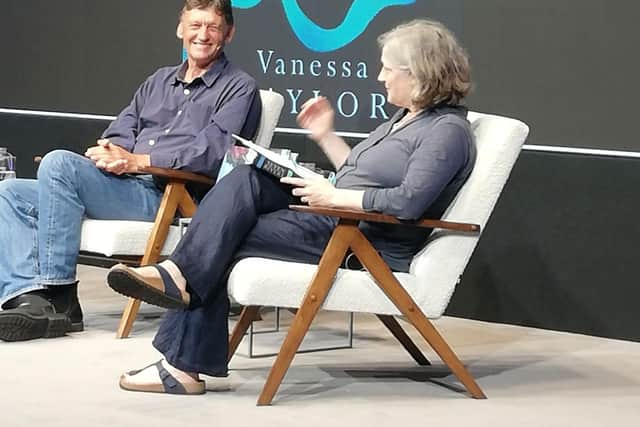
In a talk entitled How we use the Natural World Philip Marsden and Vanessa Taylor discuss their books. Philip Marsden has written several books, mainly travel, and he says of his latest Under a Metal Sky, that this is also a travel book, and he used the journey that he made to various parts of the world as a vehicle for carrying his ideas. These concern our relationships with minerals, ochre for example being used far back in time by the Neanderthals, and later, Homo Sapiens, in cave paintings.
He talks about how humans discovered the metals, how they were mined or extracted, and the conditions of the extractions. He talks about associations of certain metals with certain places and people too, and tells us stories of Mercury’s association with Prague, and how in a market place in Svaneti, Georgia, he meets a man whose nickname was ‘McKenna’ because he loved to pan for gold.
Marsden says that rocks are not dead, that the lithosphere is as much a part of the ecosphere as the biosphere. The way to engage people, he says, is through myths and stories, they help to rekindle respect for nature, and a delight in our relationship with it.
I’ve found with all of Philip Marsden’s books that he invokes a sense of wonder at the world, its huge variety of plants, creatures, land and waterscapes, makes us feel lucky to accompany him to so many off-road destinations.
Vanessa Taylor chose Seven Rivers out of many thousands, to write about. It was she says, difficult to choose between them all but in the end, she went for those which presented the most interesting stories in terms of human history and connections. The Mississippi is a good example of occupying historical as well as geographical space. Like many other rivers, it is the boundary between states (or nations) and it featured in colonial land and power grabs, where the river was crossed, pushing the indigenous people off prime land.
In the big question of – what are rivers for, there are opposing camps, where some see them as resources to be exploited for human use, and others feel they have a spiritual meaning, they are our home, and should be cared for and respected. In ancient times rivers were viewed as gods, and in some cultures they are still seen as sacred.
Today we are faced with such abuse of our rivers, so it is timely to reflect on how we view them and how better to care for them and for the creatures who live in them, rather than exploit and pollute them for our own selfish purposes. Philip Marsden said that no government will commit to huge investments, and he has set up a local initiative in Cornwall, where he lives, looking at different ways to improve water quality.