
Fringe theatre reviews: Pilate: The Lost Gospel | Do Better: A Dramagedy | Louise: The Last Dance | Stand Up If You’re Here Tonight | The Mothman Cometh
Michael Punter’s captivating monologue Pilate: The Lost Gospel takes a fresh perspective on one of the most controversial men in history, while Izzy Salent’s Do Better: A Dramagedy craftily gets inside audience members' heads to conjure a stunning sign-off.
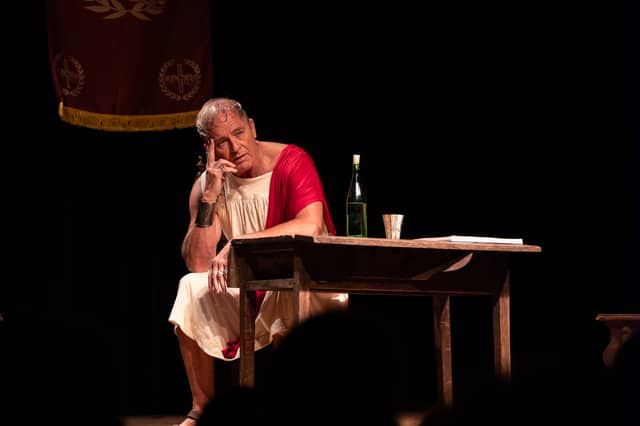

Pilate: The Lost Gospel ★★★★
Pleasance Courtyard (Venue 33) until 30 August
The character of Pontius Pilate is, depending on your point of view, the man who sentenced Jesus Christ to death or the man who tried to get him released. In Michael Punter’s play, Pilate finds himself recalled to Rome to answer certain, unspecified, charges. This monologue is his account of his life given in his defence.
It’s masterfully delivered by British-American actor Maxwell Caulfield, whose impressive CV includes theatre, film and television, and subtly directed by Asaad Kelada. This Pilate has a natural air of gravitas, an authoritative presence and restrained dignity. It’s impossible to imagine him weak and vascillating, as the character is sometimes portrayed.
Punter’s play is particularly strong on his back story. A career soldier, he was assistant procurator of the Rhine when his commanding officer, Quinctilius Varus, led his legions into a bloody ambush in the German forests. Varus, he believed, made “an error of mercy” which led to his downfall; he must not do the same.
Thence to Judea, and “a post no sane man wanted”, a disputatious little province producing several would-be Messiahs every month. But one of them is different from the others, and after Jesus heals Pilate’s beloved wife from a debilitating illness, Pilate becomes convinced he is an embodiment of the Roman god Appollo and vows to rescue him from his fate.
Whatever one might think of the play’s theology, and how well or otherwise it meshes with the more orthodox accounts of Christ’s life and death, Caulfield captivates with this study of character. His Pilate is not so much a politician as a natural leader who carries a burden of guilt for failing to bring about the act of mercy he believed was right. Susan Mansfield
THEATRE
Do Better: A Dramagedy ★★★★
Greenside @ George Street (Venue 236) until 29 August
‘How will you do better?’ It’s an innocuous sounding question that the audience are, at the start, encouraged to write a response to. Jazz music plays to help you feel relaxed. Over the course of an hour of Izzy Salent’s impeccably structured show – that also combines magic and jokes and an affecting story of bereavement strikingly well told – it slowly becomes clear why.
It’s a beautifully deceptive show in which everything on stage and around it is tightly controlled and, like magic, invisibly constructed. A magician and a storyteller at the prized place where the two meet, Salent takes us on a smooth journey from what was going on inside his head as a child who “some people find annoying” to the myriad of ways in which we might approach the voice in our heads that tells us to “Do Better”.
The minimalist script is as sharp as the pens handed around. There is nothing here that hasn’t been whittled down, polished and planned to provide laughs, sadness, surprise and magic in all senses. Salent tricks us as much with words as he does with card tricks – constantly turning one thing into another. It could feel edgy, conformational and extreme if in the hands of another comedian or show – but that’s not the mood he’s going for here. He’s planned something else.
You could probably work out how the magic tricks are done if you thought about it for long enough, but that’s not the point: the real mastery is in the way he weaves magic, storytelling and improvisation around the audience, to create a show in which he honestly and succinctly describes his mental health, while encouraging us to think about our own with similar clarity. It’s a show that knows it’s audience (and reviewer) and adapts itself to create a stunningly well-constructed ending that is as moving as it is masterful. Sally Stott
Enjoying The Scotsman's coverage of the Edinburgh festivals? For just £2 a month you can get unlimited access to scotsman.com plus 2-for-1 Fringe tickets. For details visit www.scotsman.com/subscriptions
THEATRE
Louise: The Last Dance ★★★
Greenside @ George Street (Venue 236) until 29 August
Among the plethora of solo biographical monologues doing the round on this year’s Fringe, Canadian burlesque and performance artist Saint Stella’s Louise: The Last Dance offers up one of the more interesting subjects. The Louise of the title is Louise Weber, who died in poverty living in a caravan in Paris in 1929, at the age of 62. It’s a sad ending which Stella opens on, with the large, late middle-aged Weber baited to perform her signature dance for the media’s voyeuristic cameras.
Yet in her youth Weber had been the toast of the city (or a certain quarter of it, at least) as La Goulue, ‘the Glutton’, a dancer at the famed Moulin Rouge in La Pigalle, so named because she would cheekily swipe and guzzle male patrons’ drinks while they were mesmerised by her dancing. The epitaph on La Goulue’s gravestone at nearby Montmartre cemetery, in fact, describes her as the ‘Créatrice du French Cancan’.
Using her own impressive high-kicking skills, Stella demonstrates how the working class Weber used the martial cancan dance style to mock the upper classes. She outlines a bawdy working girl, muse to sleazy photographers, Pierre-Auguste Renoir and the ‘vile’ Toulouse-Lautrec alike, but also a true rebel original whose rediscovered spirit lives on in everyone from Marilyn Monroe to Yoko Ono and Beyonce. David Pollock
THEATRE
Stand Up If You’re Here Tonight ★★★
Underbelly Bristo Square (Venue 302) until 31 August
Written by award-nominated playwright John Kolvenbach, and performed with charm and precision by the distinguished American film actor Jim Ortlieb, Stand Up If You’re Here Tonight is a short 60-minute show in praise of live theatre, that has had successful runs in cities across the United States since it first appeared in 2021.
Said to be inspired by the social isolation we all experienced during the Covid pandemic, the play uses gently-choreographed audience participation to remind us of the unique joys and occasional perils of being present in the same room with other audience members, and lays great emphasis on the effort people sometimes have to make to get to a live event - journeys, baby-sitters, whatever - as opposed to the insidious comfort of just sitting at home, in ever more inglorious solitude.
Given that it is a live theatre event, though, it’s difficult to avoid the feeling that Kolvenbach’s play is preaching to the choir, in presenting itself to an Edinburgh Fringe audience. It has charm, but very little to say to people who already know that live theatre matters; except, perhaps, that they should congratulate themselves - something they are, of course, always more than happy to do. Joyce McMillan
THEATRE
The Mothman Cometh ★★★
Just the Tonic at The Caves (Venue 88) until 30 August
Performed almost entirely in darkness, lit only by the glow of Mothman’s red-ringed eyes, this show turns fear of the dark into something else entirely: an invitation. What could easily read as horror is, in fact, delightfully warm – Mothman positions the audience as his “minions,” pulling volunteers up to help build the story, teasing throughout that the show’s real subject is nothing like it first appears.
Beneath the theatrics is a sincere argument about connection: noticing the people around you, reaching for support in dark moments, treating loneliness as something to be met the way hunger might. “Okay, that’s enough, this isn’t therapy,” the performer jokes at one point – undercutting the show’s own emotional reach, before circling straight back into it.
The show works best as pure experience – playful, participatory, unexpectedly moving – rather than as tight storytelling; the narrative is thin, and some of the audience-built material may fare better on some nights than others. But that looseness is part of its charm. Sweet, strange, and genuinely heart-warming, it earns its send-off: a closing ritual, candles gathered into a circle, gently marking the end of something you’ll be sorry to leave. Josephine Balfour-Oatts
The Scotsman’s arts newsletter is now sent twice a week - subscribe today
Enjoying the Arts & Culture journalism on scotsman.com? Make it easier to find by selecting us as a preferred Google source
Want the latest Scottish headlines sent directly to your phone? Sign up to our new WhatsApp channel here
Comments
Want to join the conversation? Please or to comment on this article.