
Fringe theatre reviews: Boiler Room Six | Max Olesker | In a Bad Way | Stayin’ Alive + more
In our latest Fringe theatre round-up, our critics are impressed by a new take on the overly familiar Titanic story and a solo show about converting to Judaism to be with the one you love
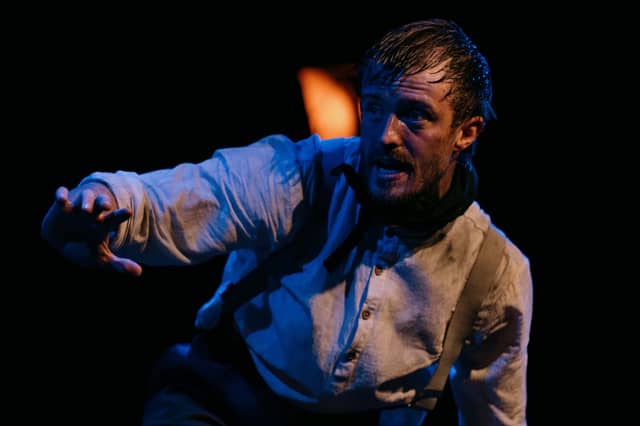

Boiler Room Six: A Titanic Story ★ ★ ★ ★
Pleasance Dome (Venue 23) until 31 August
Judging by the crowbarred-in capacity audience on the morning I saw this production, there still remain few real-life dramas which can pull a crowd like that of the Titanic. The trouble is, especially since James Cameron's thoroughly-researched and still-ubiquitous film was released nearly three decades ago, there's hardly any aspect of the 1912 tragedy, its victims or the manner in which it unfolded which hasn't had dramatic light shone upon it.
Except for, as writer/director Tom Foreman's solo play cannily realises, the darkest corner of the ship; the engine room, briefly glimpsed in Cameron's film as a saturnine firepit packed with hard men caked in coal dust. Charlie Sheepshanks plays Fred Barrett, a sturdy, dependable young stoker whose backbreaking working voyage in Titanic’s Boiler Room Six partly acts as a flight from a sweetheart back home who’s told him she’s pregnant.
Enjoying The Scotsman's coverage of the Edinburgh festivals? For just £2 a month you can get unlimited access to scotsman.com plus 2-for-1 Fringe tickets. For details visit www.scotsman.com/subscriptions
The actual mechanics and sequence of the Titanic’s downfall aren’t news when it comes time to relate them, but shown from this perspective – below decks, amid the heat and dark, and a group of working-class men whose fates mean little even to the lowliest passenger above them – they feel new. Foreman introduces a rag-tag band of mannerless, often damaged brothers, most poignantly the fearful 17-year-old orphan Albert, and then sets them up against high jeopardy as the bulkhead buckles and the water comes flooding in.
While Foreman’s text is effective, fast-paced and rich in just the right blend of excitement, fear and human feeling for this tale, it must be said that a large amount of the production’s success is down to Sheepshanks’ brilliant performance. As Fred he’s muscular and determined, with a physical stature and gravelly growl which commands the room and all those in his charge, yet we feel every inch of this rugged man’s existential fear as well as his desperate bravery. It’s an old tale, but here it’s retold to near-perfection. David Pollock
Max Olesker: Making the Cut ★ ★ ★ ★
Pleasance Dome (Venue 23) until 30 August
Max Olesker’s solo show, adapted from his memoir Making the Cut: An Unorthodox Love Story, tells the true story of falling for Eliana, an Orthodox Jewish woman, and the process of converting to Orthodox Judaism to be with her.
The show opens with their Fringe romance: nursing jägerbombs in the small hours, attending each other’s shows, the hours together beginning to outnumber those apart. Eliana, he says, “exists more vividly than other people.” Olesker sketches his own background with fondness – bohemian parents, an artist mother and a playwright-puppeteer father, and a conviction that “a freewheeling creative life is one well spent.”
He lays out the mechanics of Jewish denominations, from his own Progressive upbringing to Eliana’s Orthodoxy, which does not recognise him as Jewish without a Jewish mother. What follows is a gruelling, often absurd conversion process – described as the hardest of any religion – that tests his patience and his sense of self in ways both humorous and devastating.
A sharper, sadder thread runs alongside: his father’s declining health, and an unresolved memory of playing Fagin in a Year 6 school play, both handled with nuance. The couple were not permitted any physical contact during the conversion process, and one memorable image late in the show captures how they learned to endure it together.
Olesker has the rare comic skill of never letting a joke defuse a hard truth, or a hard truth drain a joke, and the two registers inform one another throughout. Making the Cut is a lovely, funny, moving piece of work, and Eliana, once again, “exists more vividly than other people” – this time for a live audience too. Josephine Balfour-Oatts
In a Bad Way ★ ★ ★
Gilded Balloon Patter House (Venue 24) until 31 August
Isolde Fenton’s one-woman show, set in the sparse corner of a Dublin GP surgery, follows Grá through a fifth appointment this month, this time convinced she has “bum cancer.” What could be a straightforwardly comic premise is elevated by Fenton’s poetic writing – rhythm and meter woven through the prose, sensation rendered vividly, from coffee “flooding her body” to a nightmare of a spider in her ear.
Beneath the hypochondria is grief: Grá's mother died of breast cancer, and her fear of illness is shown to be rooted in experience rather than irrational excess. A university friendship with her former roommate Jenny, and its unravelling, adds a second emotional throughline – loneliness and disconnection running parallel to the physical panic. Fenton performs with skill and commitment, inhabiting Grá's anxiety when it spirals.
The density of the writing is both the show’s strength and its limitation: individual images are radiant and well-observed, but taken together the piece can feel crowded, moving so fast that one vivid detail dulls the next. Even so, it’s a thoughtful, well-crafted exploration of a condition often dismissed or misunderstood, and it makes a strong case for taking it seriously. Josephine Balfour-Oatts
Stayin’ Alive ★ ★ ★
Glided Balloon Patter House (Venue 24) until 31 August
Victoria Oxley’s solo show, multi-roling as Maggie, her sister Anne-Marie, her mother, her late nan, and her therapist Rob, makes for an intense, visceral hour. Maggie is still living in her nan’s house months after her death, unable to part with her belongings, spiralling through OCD rituals – counting to nine, hugging herself for grounding – and childhood trauma that surfaces in fragments throughout.
The show’s rare moments of levity come via a string of disturbingly off-kilter tribute acts at the Blue Anchor pub, glimpsed beneath a glittering “Stayin’ Alive” sign – a knowing, uneasy juxtaposition against the darkness beneath it. But even these interludes carry an edge, and the show rarely lets up: this is an hour built to disorient and wear down, not soothe.
Oxley is unflinching, and the writing is sharp – particularly in Maggie’s fraught, boundary-testing relationship with her therapist, and in a late, audience-confronting moment that briefly and deliberately breaks the performer-audience contract set out at the start. It’s a bold choice, and an effective one, though it leaves little space for release. Brutally honest and technically assured, but a show that could use more care for its audience on the way out. Josephine Balfour-Oatts
Spider Witches of Appalachia ★ ★ ★
PBH’s Free Fringe @ The Outhouse Bar (Venue 99) until 30 August
Jenna Baer traces five generations of Appalachian women – healers, midwives, rebels – through Spider Witches of Appalachia, a solo show rooted in oral storytelling tradition, shifting between characters with simple, effective changes of shoes, coat, and apron.
Baer is a skilled storyteller, and the show is rich with regional folklore: the orb weaver spider, common to Appalachia; the Spider Witch who reads signs in its webs; spider silk used as a coagulant for wounds; the belief that a spell, once unwound, must be undone three times. An estimated 3,000 witches, Baer notes, still live in Georgia today.
Witchcraft here is reframed away from spectacle and toward attention – “most witches don’t know they are witches,” we’re told, their power lying in noticing, “hearing everything around everything,” in living in the in-between spaces, the porch eaves and kitchen corners, like spiders. The show distinguishes between different kinds of witches – dreaming witches, kitchen witches – while insisting there’s no single correct way to hold the title.
The individual stories are, at times, less clearly defined than they might be, and how they nest inside one another isn’t always easy to follow. But their cumulative effect, passed hand to hand down a line of mothers, proves hypnotic, even enchanting. Josephine Balfour-Oatts
The Scotsman’s arts newsletter is now sent twice a week - subscribe today
Enjoying the Arts & Culture journalism on scotsman.com? Make it easier to find by selecting us as a preferred Google source
Want the latest Scottish headlines sent directly to your phone? Sign up to our new WhatsApp channel here
Comments
Want to join the conversation? Please or to comment on this article.