
Fringe Firsts week one: we reveal the first five winners of the Scotsman's prestigious theatre prizes
Edinburgh festivals editor Andrew Eaton-Lewis explains the importance of the Scotsman’s Fringe First awards - and announces our first five winners of 2025
These days there is a long list of theatre prizes that can be won at the Edinburgh Fringe, with more being added each year. But not one of these is anywhere near as established, prestigious, or internationally renowned as the Scotsman’s Fringe Firsts, which have been running continuously at the festival since 1973.
The Fringe Firsts were set up at a time when there was very little new theatre work being premiered in Edinburgh in August. Allen Wright, the Scotsman’s arts editor at the time, wanted to encourage more companies to bring new work to the festival, and so he founded an award that would recognise and encourage outstanding new writing. Since then, the Fringe Firsts have helped to launch countless numbers of careers. Notable past winners range from Rowan Atkinson, Stephen Fry, and Billy Connolly to Phoebe Waller-Bridge (with the original stage version of Fleabag) and Richard Gadd (for Baby Reindeer).


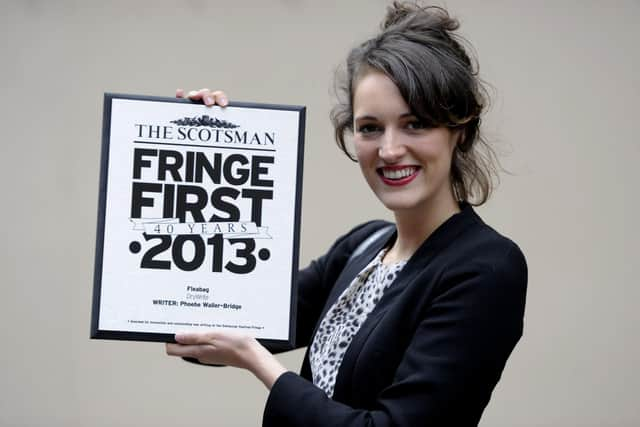
This year the awards are sponsored by Queen Margaret University Edinburgh and Stagecoach, and we are very grateful to them for supporting us to continue seeing the hundreds of eligible shows premiering across the Fringe’s many venues. We are also very grateful to the Pleasance for hosting our three weekly award ceremonies - the third of which, on Friday 22 August, is a public event at the Pleasance Grand with special guest presenter Miriam Margolyes, when you can also find out the winners of other prizes presented by the Brighton Fringe, the Adelaide Fringe, the Mental Health Foundation and more.
HOW IT WORKS
The Fringe Firsts recognise outstanding new writing premiered at the Edinburgh Fringe. Shows in the theatre, dance & physical theatre, and musicals & opera sections are eligible, and winners are announced on each Friday of the Fringe.
There is no set number of winners each week. Shows are nominated by The Scotsman’s team of critics, and winners are then decided on by a highly experienced judging panel consisting of, this year, our chief theatre critic Joyce McMillan (as chair) plus writers Susan Mansfield, Mark Fisher, Jackie McGlone, Sally Stott, David Pollock, Fiona Shepherd and Fergus Morgan.
This week we are delighted to announce our first five winners of 2025.

Eat The Rich (but maybe not me mates x)
Pleasance Courtyard, 2.15pm, until 25 August
What we said: “Before studying English Literature at Cambridge, (writer-performer) Jade Franks worked at a call centre in her home city of Liverpool. Having always worked, she takes up a position as a cleaner at the beginning of her undergraduate degree, which is – she soon learns – against college rules. Certainly, working and studying simultaneously is an alien concept for her classmates, since they have never wanted for a job or been inclined to earn their own money, but they also treat her as she were from a different planet... The true conflict lies in the overt and covert classism purported by the Cambridge student elite. If you’re not in, you’re out, and in this, Eat the Rich shows that the price of fitting in moves swiftly from fantasy to become a socio-economic and moral quandary.”

Monstering the Rocketman
Pleasance Dome, 4.10pm, until 24 August
What we said: “Henry Naylor’s latest play is brilliantly entertaining and rivetingly well-told monologue about The Sun newspaper of the early 1980’s,and its vicious campaign of vilification against gay rock star Elton John, whom it accused - on very slender evidence - of a series of hideously exploitative relationships with young boys. It’s an ugly story, but one that, exhilaratingly, ends on a far more hopeful note than many at the time expected; and that stands as both a vital historical record and a warning, as new waves of intolerance begin to target groups even more vulnerable than gay men were, back in those days of Section 28, and the early years of the AIDS epidemic.”

Red Like Fruit
Traverse Theatre, various times, until 24 August
What we said: “Hannah Moscovitch’s superb Canadian two-hander offers a precise and brilliantly focussed exploration of the current post- #metoo moment in gender politics. Written as a monologue, but fascinatingly read on stage by a male actor while the female central character - who has written the story - listens, reacts and occasionally comments, it tells the story of a happily married Toronto journalist who nonetheless finds herself increasingly depressed and mentally uneasy, haunted by a frightening sense of anger, and of dissociation from her everyday life... It leaves behind a profound uncertainty about how far we can protect women from exploitation while leaving space in our culture, for the daft, anarchic energy of real sexual desire.”

She’s Behind You
Traverse Theatre, various times, until 24 August
What we said: “With handfuls of glitter, music, callbacks and wordplay-based gags, what starts off feeling like pure panto is actually a panto-about-panto, in particular its ability to capture and, at its best, critique the ever-changing politics, attitudes and topics of its time. From playing “sexless” Silly Billys to becoming a dame at the ancient age of 26 to a playwright determined to do things differently, Johnny McKnight is open about having written lines in the “toxic 2000s” that he wouldn’t now... With 18 dames behind him, it’s a reminder that we’re all made up of past versions of ourselves, their successes and flaws, but also the power of shows (and reviews) to reflect, amplify and shape reality and turn it into whatever we want it to be.”

Kanpur: 1857
Pleasance Courtyard, various times, until 24 August
What we said: “Niall Moorjani’s play is beautifully written, full of a lyrical sense of the beauty of India and its culture, and of those moments when Indian and British cultures can share their poetry and music; both Moorjani and co-director Jonathan Oldfield deliver richly complicated performances. And when, in the end, the prisoner asks “How many Indian lives can one British life be worth?”, the question echoes down the ages to the present tragedy in Gaza; in what seems like one of the most important political dramas on this year’s Edinburgh Fringe, and one with strong and challenging Scottish resonances.
Comments
Want to join the conversation? Please or to comment on this article.