
Can a play about a high school shooting be funny?


As two festival shows from America bring darkly comic perspectives to tragic events, Mark Fisher explores how gallows humour can be used to confront everyday horror
If you are sensitive about bad taste, probably best not to hang around with teenagers. Gallows humour comes with the territory. Certainly, that’s what Alice Stanley found out when she worked as a public school teacher in Chicago. “It was around 2018 when a school shooting happened in Parkland, Florida,” she says. “That’s when I realised my students were making the worst jokes ever.”
How dark is too dark? Now she has reinvented herself as a playwright, it is a pertinent question. Like fellow playwright Zora Howard, whose Hang Time treats the lynching of Black men with both weight and humour (more of that below), Stanley dares to see the funny side of a tragedy. In her case, the fraught subject of high school massacres.
The premise of her Fringe show, The Second Best School Shooting, is darkly funny. It is about two best friends who should be traumatised by a shooting at their school but are instead outraged that an even worse attack has taken place. Instead of revelling in the melodrama, they are jealous of a school on the other side of town that has claimed the number-one slot.
“It’s true of a lot of American youth that they want attention for the bad things that have happened to them but they also have a lot of guilt for knowing that it could be worse,” says Stanley. “I talked to a survivor who had witnessed a shooting when she was 14 and she said, ‘Ours wasn’t even that bad, only two kids died.’ It just breaks my heart.”
Humour is one way of processing the trauma. “Hearing my students tell the jokes, I would laugh and I realised there is a huge divide between inside school and outside school,” she says. “We’ve never fixed the problem and now we’re putting Band-Aids on it and all of the Band-Aids are stupid. When they say, ‘Hmm, should we arm teachers?’ that’s wrong – and it’s funny.”
In the UK, the mass murders of children in Dunblane and Southport hang heavy in the memory, in part because they were out of the ordinary. In the US, the picture is very different, although no less tragic. “There’s too many shootings for them to be interesting any more,” says Stanley.
According to the Washington Post, since April 1999 when 13 pupils and one teacher were murdered at Columbine High School, the number of students who have experienced gun violence at school exceeds 390,000. That figure is in addition to mass shootings in other locations. In a country where guns outnumber people, firearms kill more than 50 a day. The playwright is shocked by how unshocked her compatriots have become.
“There’s a secret cultural context for Americans which is we’re all terrified all of the time,” says Stanley, who promotes the March For Our Lives' advocacy group in the US and will be distributing resources from the UK’s Gun Control Network. “You can make a million rules, but there’s one problem: it’s guns.”
She also worries that constant vigilance is damaging children psychologically. As a teacher, she was trained to instruct her pupils how to respond to an armed intrusion. Since she left the profession, the level of alert has only intensified. Students today know nothing else. “If you are under 30, you will have trauma,” she says. “It sounds dramatic, but they were trained every day about getting killed. At six years old, you might learn how to cry quietly in case the shooter’s in your room. That’s wrong.”
Her urge to remind audiences of the horror of violence is something she shares with Zora Howard, whose play Hang Time, appearing in the Edinburgh International Festival, features three men caught in mid-air as if frozen at the point of being lynched.
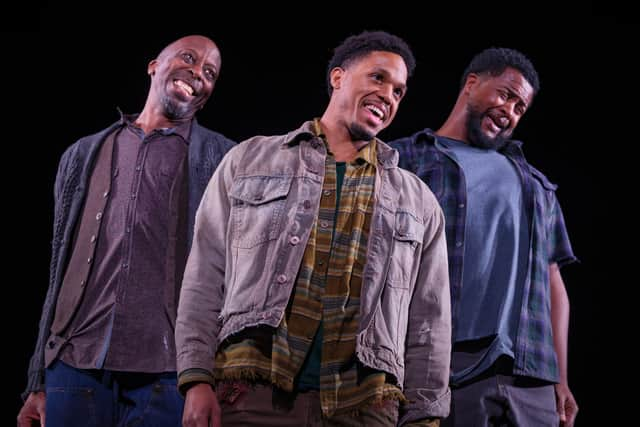
It could be an image from the pre-civil rights era, but Howard keeps the period abstract, not least because she was inspired by two modern-day cases. In 2020, Robert Fuller and Malcolm Harsch were found hanging from trees at two locations in southern California. The official verdict was suicide but, given the history of racialised violence, many were concerned by the implications. “It is an image you would hope not to see again in a public place,” she says. “There’s still the symbol.”
There is nothing funny about this and yet Howard’s play makes audiences laugh – often to their own consternation. That is because the three men, who do not know they are being lynched, talk with the everyday humour of people living life to the full. The context is grim but the life within is not.
“The three characters are, in their own ways, funny,” says Howard. “They are just being themselves and sometimes that inspires a laugh. We’re looking at them in a devastating circumstance, but we are looking at the men, we are not looking at the circumstance. The hope is we consider these men in their fullness.”
The juxtaposition can be unsettling. “People don’t expect to laugh and I’ve seen them grapple with their own laughter and the laughter of those around them,” she says. “They try to be still or look down. The men are constantly hanging, so it’s not trying to make you forget, it’s not ironic, it’s the men that are funny.”
Curiously, Hang Time grew from an image. Howard had a vision of three men suspended in the air and started drawing on paper. Next, she named them – Slim, Blood and Bird – and only then did their voices appear. Because of this organic growth and the strength of the central image, it was natural for her to direct the play, learning from her actors and their male speech patterns as she went.
“I could see so clearly what the focus would be, which was the Black body,” she says. “The body is the design. There’s nothing else to look at. For the actors, it is not easy from a psychological or emotional standpoint and it takes physical endurance to maintain the position that they’re in. It takes a toll on their bodies and their spirit.”
The Second Best School Shooting, Pleasance Courtyard, 5–30 August; Hang Time, Royal Lyceum, 20–23 August
The Scotsman’s arts newsletter is now sent twice a week - subscribe today
Enjoying the Arts & Culture journalism on scotsman.com? Make it easier to find by selecting us as a preferred Google source
Want the latest Scottish headlines sent directly to your phone? Sign up to our new WhatsApp channel here
Comments
Want to join the conversation? Please or to comment on this article.