
Drag kings rule the Fringe: meet the women taking on masculinity at the Edinburgh festival
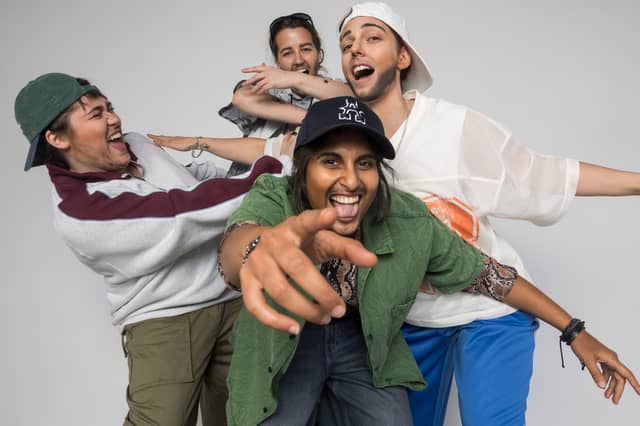

Is this the year drag kings conquer the Edinburgh Fringe? Arusa Qureshi meets the female performers taking on masculinity
For many audiences, drag is synonymous with drama-fuelled lip-syncs, glittering costumery, and all-out glam. While drag queens have become a prominent feature of mainstream pop culture, thanks in part to social media trends and the mammoth success of RuPaul's Drag Race, drag kings, in contrast, have largely remained on the fringes of the drag scene itself.
With its ever-growing offering of cabaret and queer culture, the Edinburgh Fringe annually plays host to a plethora of drag queens, plucked from rapidly burgeoning scenes all over the world. But as public awareness of other forms of drag widens and understandings of gender itself continue to evolve, the festival has also seen a gradual increase in the presence of drag kings.
At this year's Fringe, there are a trio of shows that use drag masculinity not simply as parody, but as a way to interrogate power, gender and performance. From a washed-up erotic novelist struggling to survive in the modern world, to a fictional boy band grappling with toxic masculinity, to a stadium-pop satire of dating culture, Sexopolis, MANiFEST and FUCCBOIS demonstrate just how inventive, and politically sharp, the medium can be.
Yet none of the artists behind these productions is interested in delivering lectures. Instead, they use humour, music and absurdity to invite spectators into conversations about masculinity that feel not only entertaining, but highly revealing too.

For Han Whyte, creator of Sexopolis, drag offered the perfect vehicle for Roger Prick, a 1970s Soho Casanova who is hopelessly out of step with contemporary feminism. "He's just sort of an amalgam of many men that I have met in my life," Whyte explains. "His sense of freedom and entitlement is something that I just love to experience and play with."
The result is, in Whyte's words, "very silly, very sleazy, very stupid" – a character comedy filled with cardboard props, drawings and exaggerated machismo. But beneath the comedy lies an exploration of how certain models of masculinity continue to persist.
Enjoying The Scotsman's coverage of the Edinburgh festivals? For just £2 a month you can get unlimited access to scotsman.com plus 2-for-1 Fringe tickets. For details visit www.scotsman.com/subscriptions
Drag, Whyte says, has allowed her to inhabit a self-assurance that would otherwise feel inaccessible. "I'm so much more confident talking to the audience as Roger," she says. "I have, through Roger, such a joyous sense of confidence that allows me to say things I would not normally say. It's so much fun to walk around with the bravado of an old geezer."
That sense of freedom is echoed by the creators of MANiFEST, a drag boy-band musical that uses catchy pop songs to examine toxic masculinity and its wider consequences. Externally, the show is packed with excellent choreography and laugh out loud moments, but writer and performer Maddie Bell insists there is far more beneath the stereotypes.
"It is a comedy on the surface," Bell says, "but it's a much deeper show than that. It's a very reflective piece on toxic masculinity and the effects that that has on not only young boys, but on young women."

The company's drag personas emerged from asking a deceptively simple question: what would they be like if they were boys? "If we really pushed our personalities to an extreme as a boy, what would that be?" Bell asks. Rather than creating caricatures from scratch, the performers inflated aspects of themselves until fully formed characters emerged.
For co-composer and lyricist Emily Benucci, the transformation feels almost instinctive. "He just comes out," she laughs. "As soon as I get on stage, it comes bounding out of you."
Bell admits that becoming these characters also reveals uncomfortable truths about everyday gender dynamics. "There's real permission to be a bit of an asshole when you're dressed up as a boy," she says. "It really gives you a level of confidence to be a boy that I think, unfortunately, as women you don't necessarily have walking around every day."
Across all three shows, it’s evident that for the performers, drag becomes more than costume. It is a way of physically experiencing social power – and exposing how constructed that power really is.
For Vidya Makan, one of the performers in FUCCBOIS, stepping into the role of a swaggering heartbreaker proved unexpectedly transformative. "I didn't realise how much I shut down until you have to play a dude – and a f*** boy, no less," she says. "The ability to take up space as that character was really weirdly hard at the beginning."
The show's creator, Bridie Connell, began developing FUCCBOIS after a string of disappointing encounters with men in her personal life. Initially conceived as satire, it gradually evolved into a full-blown pop concert performed in drag. "I realised that I could go much darker and say a lot more if the performers themselves were not men," Connell explains.
That distance gives the show permission to push tough ideas while remaining playful. Rather than presenting audiences with a lesson on patriarchy, Connell says she prefers to "hide all the messages like vegetables, chop them up really finely and sneak them into the audience, so that hopefully it's just sugary fun."
The desire to entertain first runs through each show. Despite tackling misogyny, coercive relationships and performative masculinity, none of the companies wants audiences to feel preached at. It’s a balancing act, but one that may also explain why drag kings remain less visible than their queen counterparts.
Whyte believes mainstream audiences simply haven't discovered the breadth of king performance yet. "People just don't know about drag kings," she says. "I see drag kings consistently doing the weirdest, most creative, most bizarre acts." She rejects the assumption that drag kings are simply women dressed as men. "Playing with gender is definitely one part of drag," she says, "but there's also so many other aspects of it, and the culture is so exciting and creative."
Esther Dracott, co-producer and performer in MANiFEST, believes deeper cultural attitudes are also at play. Reflecting on conversations with established drag kings, she points to how audiences have historically responded differently to performances of femininity and masculinity. "When a man dresses up as a woman and performs femininity, femininity is often presented as something to be laughed at," she says. "When someone dresses up as a man, what's funny about masculinity?"
Similarly, Clara Harrison, who performs in FUCCBOIS, argues that audiences often find women performing masculinity more challenging than men performing femininity. "I think women dressing as men, people find it confronting," she says. "They find that it makes them possibly uncomfortable.”
Ironically, that discomfort is exactly what gives drag kings their unique artistic potential. By exaggerating masculinity rather than simply mocking it, these performers reveal its contradictions and absurdities while remaining empathetic towards the people caught within its expectations.
Bell insists that although the band's members begin as over-the-top stereotypes in MANiFEST, they ultimately become fully realised characters. "It is drag," she says, "but there is also a point where you watch the show and you are just watching four boys in a band trying to survive." The company hopes audiences will leave laughing, but also questioning why. "We want them to come in laughing and leave feeling a bit gut punched," she continues.
READ MORE: Sons of Susan on their apocalyptic black comedy BIRDS: 'We're applying latex for hours every day'
Co-composer and lyricist Hollie Jameson-Clarke hopes attendees find themselves humming the show's infectious songs before realising exactly what they're singing about. "Should I really be enjoying the fact that I'm singing about a coercive relationship?" she asks.
Likewise, Connell hopes FUCCBOIS leaves audiences better equipped to recognise unhealthy behaviour without sacrificing any of the joy. "I don't think the show will change the world," she says, "but if it can just help you spot a few red flags, I think that's a really great thing."
Whyte's ambitions are equally inclusive. She hopes Roger Prick can bring together "the girls, gays, and theys, as well as the sleazy pub men, in a way that is fun for everyone."
Taken together, these Fringe shows reveal drag kings as artists doing far more than gender-swapping for comic effect. They use masculinity to ask difficult questions through a form of entertainment that feels impossible to resist. As drag continues to advance beyond the expectations shaped by mainstream television, these performers are proving that some of the most exciting work isn't happening under a spotlight; it’s there on the periphery, just waiting to be unearthed.
Roger Prick: Sexopolis, Underbelly, Cowgate, 5-30 August; MAN!FEST: The Drag Boyband Musical, Pleasance Courtyard, 5-31 August; FUCCBOIS: LIVE IN CONCERT, Assembly George Square Studios, 5-31 August
The Scotsman’s arts newsletter is now sent twice a week - subscribe today
Enjoying the Arts & Culture journalism on scotsman.com? Make it easier to find by selecting us as a preferred Google source
Want the latest Scottish headlines sent directly to your phone? Sign up to our new WhatsApp channel here
Comments
Want to join the conversation? Please or to comment on this article.