
Canvas of Sound with Tazeen Qayyum at EIF: 'There's something special about seeing an artist working live'
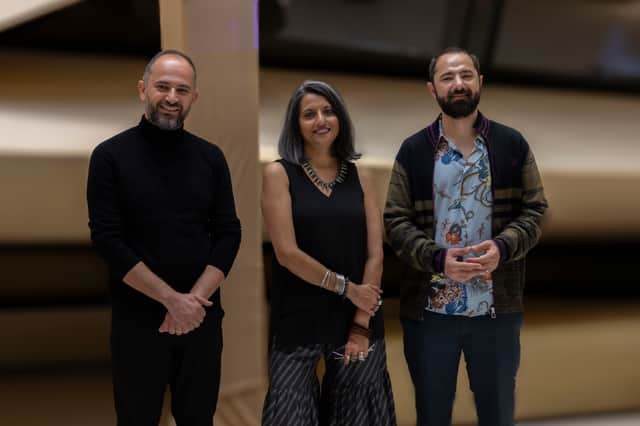
In her Edinburgh International Festival collaboration with musicians Basel Rajoub and Feras Charestan, conceptual artist Tazeen Qayyum hopes to ‘touch some souls’. Interview by Jim Gilchrist
Just four words – hope, justice, kindness and peace – may seem utterly at odds with a present world that appears to be hell-bent on ripping itself to pieces. Yet as written and shaped into beguiling patterns by artist Tazeen Qayyum, to the accompaniment of two virtuosic Middle Eastern musicians, they are designed as an immersive counterblast against our deeply troubled times.
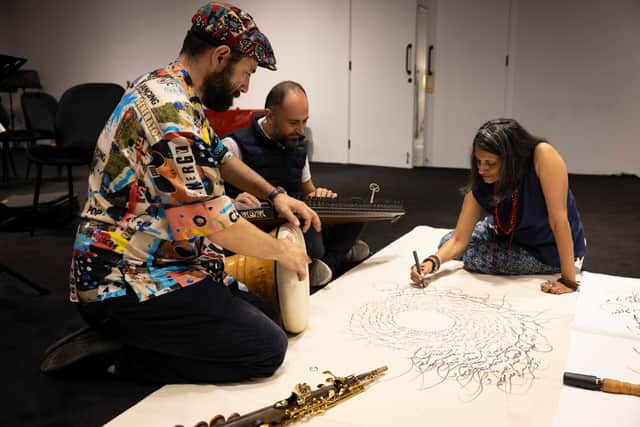

Qayyum, a Pakistani-born Canadian conceptual artist, will collaborate with the musicians in the Edinburgh International Festival’s programme at The Hub, creating her art in real time, as they play, projecting it simultaneously on to a large screen, and inviting their audience to seek a state of harmony and mindfulness.
Qayyum’s two accompanists are soprano saxophonist and percussionist Basel Rajoub, who also plays the duclar – a hauntingly human-toned Middle-Eastern clarinet, and Feras Charestan on qanun – a Syrian zither. Their blend of reed and wire sound is a potent one, as demonstrated when the pair appeared at the Festival two years ago with the Aga Khan Master Musicians, and Qayyum is enthusiastic about their collaboration.
“They’re brilliant and I’m grateful that we’re working together,” she says, speaking from her home in Oakfield, a suburb of Toronto. “The first time was last year at the National Museum of Qatar and that experience was new and so fulfilling for all of us that we decided to continue it.”
READ MORE: Sissoko, Segal, Parisien & Peirani at EIF: the unlikely quartet where egos are 'out of the window'
Their collaboration, Canvas of Sound, has been described as “an immersive presentation drawing on calligraphy, improvised music, trance and movement,” although Qayyum tends not to regard her art as calligraphy. “Calligraphy is a very sophisticated art form in itself,” she says. “Mine is more like spontaneous drawing, working with text.”
Creating “live” visual art to music isn’t an entirely novel concept; indeed Edinburgh has its own exponent, Russian-born painter Maria Rud, who was creating large-scale paintings in real time and projecting them on to the interior of St Giles' Cathedral to a live accompaniment of Bach earlier this month. “There is something really special about seeing an artist working live,” Qayyum agrees, “because you experience paintings and drawings as finished products normally.”
Asked whether creating her art in front of an audience brings pressure, she laughs: “To be honest, before the performance I’m very nervous. I’m a quiet person by nature and don’t like to be where people are looking at me, so that aspect is a little nerve-racking.”
Once started, however, she becomes completely detached: “I go into that zone where it’s just me, the pen, the sounds and the words. I lose any sense of time. Somebody has to, like, tap me on the shoulder to say that everybody’s gone. Or in a time-specific performance like Edinburgh, somebody would have to give me a cue, I get so immersed in that experience.”
For her Edinburgh International Festival appearance, she has anchored her performance in four words with a multiplicity of meanings. The root words, in Arabic, are “amal”, which means hope; “adl”, justice; “karam”, kindness; and “silm”, peace. Coming from a Pakistani background, Qayyum’s language is Urdu – “but Urdu borrows from Arabic and Farsi, so I understand these words”.
Under her black pen, the script for these words will spiral outwards, shaping itself into beautiful, intricately whorling patterns.

“In my drawing practice and outside these live performances, I work with words a lot and spend a lot of time thinking about what words I want to contemplate on … what ideas I want to think about,” she says. “I specifically look for words that are poetic in nature, multi-layered in meaning, with a depth of essence, then an act of continual repetition allows me to focus on the ideas these words carry – and most of them are ideas of care, peace, calm. In a way it becomes self-reflective for me, but at the same time it allows the viewer to connect.”
In many ways, she agrees, the process becomes almost meditative, mantra-like. “And if it touches some souls, that’s all we can hope for.”
Asked to what extent she is reacting to the music or the musicians in what she is drawing, she replies: “I think there is a very interesting connection, because the rhythm, the sound, anchors my thought and my movement. I’m focusing on the words, saying them in my mind and writing them, so my thoughts are driven by the words, but my body is responding to the sounds around me and I feel that energy transcends not just for me but for the musicians and they make certain choices spontaneously.” She regards it as a three way process, “because I feel that energy carries to the audience and the way the room reacts comes back to us.”
Qayyum’s word choice of hope, justice, kindness and peace reflects her concern at the times in which live. “It’s very depressing, but I feel it is extremely important for us not to give up hope and to know how we can live through these times as well as take lessons from them. I believe it is so important to think of these words, these ideas, and say them to ourselves – to really understand each other without the prejudices of where we’re from, or what our identity or belief system is.”
And that, she adds, echoing this year’s Festival slogan, “is the truth we should be seeking”.
Canvas of Sound with Tazeen Qayyum, Basel Rajoub and Feras Charestan is at The Hub, Edinburgh, on 21 August. This feature was produced in association with the Aga Khan Music Programme
Comments
Want to join the conversation? Please or to comment on this article.