
Karine Polwart on her Fringe tribute to a beloved Royal Botanic Garden tree: ‘It had two centuries’ worth of story to tell’
How did an acclaimed folk musician end up imagining the story of what was once the oldest tree in the Royal Botanic Gardens? Susan Mansfield hears from an artist getting back to her roots
“FIZZLE” is how Karine Polwart describes it, the feeling she gets when she knows she’s found a story she wants to tell. That’s how she felt when she walked in to the Tropical Palm House in Edinburgh’s Royal Botanic Garden and was introduced to its oldest, tallest occupant, the sabal palm.
“The Head of Living Collections, David Knott, just put his hand on the trunk of the tree and said: ‘This is our old sabal, and it’s for the axe’,” she remembers. “And I think I knew in that moment this might be the story.”
Polwart and her collaborator, composer and sound designer Pippa Murphy, were invited in 2019 to make a work to mark the Garden’s 350th anniversary. The Biome Project, which includes refurbishing and modernising the glasshouses, was already underway. Thousands of plants were being moved out but the 200-year-old sabal was too big and too unstable.
“There was this tremendous sadness among the garden staff about the loss of this heritage plant. One of the palm house horticulturalists, Simon Allen, talked about it as a quiet, sentient presence. He said it was like being in a room with an elephant. The palm mattered to the people there. That made me think it had two centuries’ worth of story to tell.”
That story became Windblown, which premieres this week at the Queen’s Hall, part of the Made in Scotland showcase at the Fringe. Polwart describes it as “half spoddy TED talk and memoir – that’s me – and then the palm itself tells its own imagined story through music and spoken word”. She’s thrilled to lead a creative team which includes designer Neil Haynes, Jamie Wardrop on video, Lizzie Powell on lighting and movement director Janice Parker.
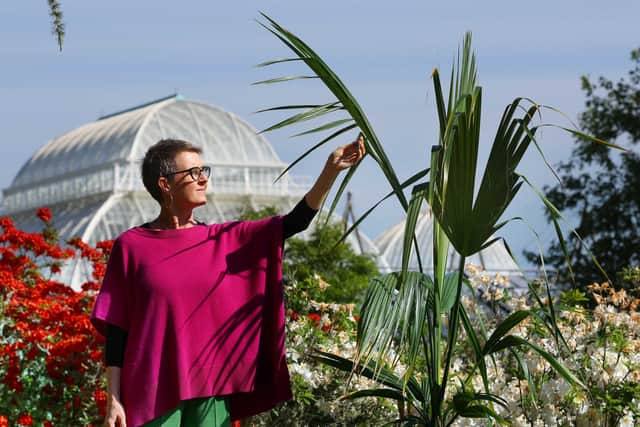

Inspired by a “living wake” which she and Murphy took part in in 2020 for a friend who was dying of cancer, they decided to stage one for the palm just before it was felled in September 2021, with songs, pipe tunes and a farewell address in the imagined voice of the tree. “Both folk music and the piping tradition are bound up with lamentation and dignifying and grieving,” Polwart says. “I’ve sung at countless funerals. Our music gets used to birth babies. I’m aware of the job that music does around those big life cycle events.
“By its nature this story is about dignity at the end of life, not necessarily human dignity, but I think it would be hard not to see the parallels. The loss of dignity during the pandemic was also part of it, the idea that people’s lives ended and that couldn’t be marked properly. I don’t this piece could have been written before the Covid era.”
The sabal palm began its life in the West Indies and was brought to Scotland as a botanical specimen. Until it was felled it was oldest plant in the garden. Having crossed the Atlantic in an era of colonialism, one which fetishised the collecting of exotic plants, it lived to see a very different time in which institutions like the Royal Botanic Gardens are contending with post-colonialism and climate change.
“It’s an immigrant plant, and that has altered the course of its life and its journey,” Polwart says. “The palms have evolved to withstand hurricanes, but if you’re in a glass house in Edinburgh, you don’t have to withstand anything, so you don’t develop resilience. Although it was very tall, it was very weak.”
As a self-confessed “research geek”, she relished the deep-dive into botany, ethno-botany and the history of the gardens. “The thing that fuels everything that I do is curiosity. Learning stuff about how the world works is pivotal to everything. Understanding what that means emotionally is the work that I can bring to it as a musician and storyteller.”
She has said that everything she does now as an artist “happens through the lens of climate change”, and adds that the voice of the palm gave her a new perspective through which to address this theme. “There’s a kind of magic provocation about adopting a non-human voice that I really enjoy. You can say things you can’t say as a human, you don’t have to deliver a lecture.”
In her 25 years as a professional musician, Polwart has won multiple awards, and has racked up a long and diverse list of interesting projects and collaborations from working with writer James Robertson on a Scots version of Joni Mitchell’s album Hejira, to writing a science documentary for Radio 4 and making an album with Julie Fowlis and Mary Chapin Carpenter.
Make sure you keep up to date with Arts and Culture news from across Scotland by signing up to our free newsletter here.
It was playwright David Greig who encouraged her to make her first piece of work for theatre, Wind Resistance, a meditation on motherhood, nature, healthcare and a specific peat bog near her Midlothian home. It premiered at the Edinburgh International Festival in 2016 to widespread acclaim. She says it felt like a “natural evolution” of her work. “I had always thought that theatre was about writing plays, and this was a kind of poetic essay with songs, but once I was given permission to make a thing that wasn’t a play, it was great! I love the way it enables me to collaborate with a bigger team.”
Looking back from a distance of 25 years to the day she quit her job to “take a punt” on music, she’s profoundly glad she trusted the hunch, the fizzle. “It was a massive leap of faith. I sold my house and used the money to underwrite my musical career for the first five years. There were several moments when I could have jacked it in, and it didn’t make any financial sense for a long time, but I had this strong sense of intuition that something positive might come of it.”
Having marked the anniversary with two special gigs, she’s planning a year away from gigging, a decision which happily coincided with her being named as the inaugural recipient of the year-long Dr Gavin Wallace Fellowship in association with Creative Scotland and the Fruitmarket Gallery. She will work on a project called Attached to Land, about place, land and ecology on a stretch of coastline from Grangemouth to Dunbar, which she hopes will become a book.
“I need to embrace my inner librarian and archivist, which is strong,” she says. “This is the first time I’ve ever been recognised as a writer, which feels like a big deal. I’m aware that I’m a little bit greedy in terms of the number of art forms I work in. I mean, musician, composer, theatre-maker, storyteller, writer, come on, Karine, calm yourself! But, really, they feel like they’re just expressions of the same thing.”
Windblown, Queen's Hall, 9-13 August
Comments
Want to join the conversation? Please or to comment on this article.