
Henry Naylor on the dark 1980s inspirations behind his new play Monstering the Rocketman


The playwright reflects upon the horrific tabloid homophobia of the 1980s in his latest work, which involves Elton John, Princess Diana and a pair of ‘devil dogs’.
It’s human to remember the best bits of the past, and edit out the worst. Currently there’s a lot of nostalgia for the 1980s. But beneath the gaudy clothes, the big hair and even bigger shoulder pads was a darker, more scary, more violent country.
There was football hooliganism, race riots, IRA bombs, the Poll Tax revolts, lengthy dole queues and crippling, brutal strikes. It was a time of massive social upheaval, as Britain strove to define itself.
I’ve been wanting to write a series of plays about the decade for a while, if nothing else, to contradict the demagogues selling us a romanticised view of the past. For research, I spent four months in the British library reading back issues of the tabloids, to revisit and understand the mindset of the 1980s. This was a golden era for the tabloids and The Sun was the backdrop of our lives. As the biggest selling daily newspaper in the English-speaking world, it sold nearly five million copies a day, with a readership of 12 million. It was seen on every train carriage, on every bus, and it was impossible to avoid its bold, provocative, sometimes hilarious, often offensive headlines.
Reading those papers today is alarming. We often lambast the society of today for being intolerant but we’ve come a long way. Intolerance and hate speech were mainstream in the 1980s and racist terms were commonplace. The French were ‘Frogs,’ the Germans ‘Krauts’ and the Japanese ‘Japs.’ Black faces rarely appeared on the front pages and when they did, they were usually those of criminals.
But the greatest invective was reserved for the gay community. When the Chief Constable of Greater Manchester, James Anderton, an evangelical Christian, spoke to a national conference about how the police should deal with AIDS, he said: “Everywhere I go I see evidence of people swirling around in the cesspool of their own making. Why do homosexuals freely engage in sodomy and other obnoxious sexual practices knowing the dangers involved?”
He was dismissed as a crank by the broadsheets. Not so by The Sun. In an editorial it declared, that it “hopes Mr Anderton will treat these perverts with the contempt they deserve.” Coverage was relentless and overwhelmingly negative, with headlines that are shocking to modern eyes: ‘Gays are Plague In Our Midst’, ‘MI6 Boss was Poof’, etc. Furthermore, it seemed the tabloids thought it a moral duty to ‘out’ gay celebrities and portray them as sexual deviants. There was a particular fascination with celebrity/rent-boy stories. Russell Harty had his career destroyed in such a way, and Harvey Proctor too.
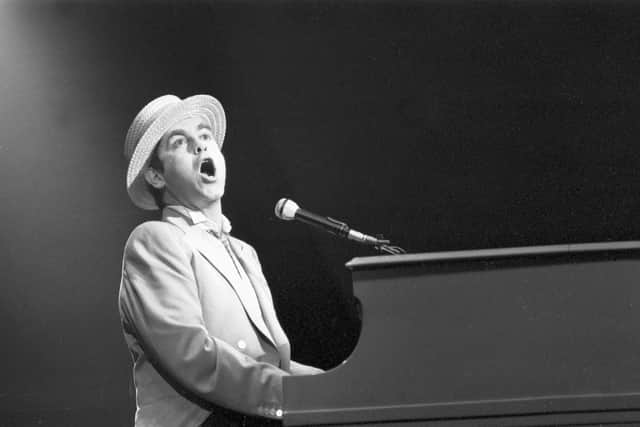
And then came Elton John. You could almost smell the glee of Sun editor Kelvin MacKenzie when he was offered the ‘confessions’ of a male prostitute known as ‘American Barry’. Mackenzie has admitted some stories were “too good to check”, and this was one of them. He published.
Disastrously, he was to discover that ‘Barry’ was a liar. He was neither American, nor called ‘Barry’. He was called ‘Stephen’ and worked in a dry-cleaners in Twyford, and had made the whole thing up. Elton was understandably incensed. He wasn’t in Britain when the alleged orgies took place. He was in the States having a costume fitting, and he had the taxi receipts to prove it.
As a member of The Sunday Times 100 Rich List, Elton had the money and the resources to fight. He also had the time, as he was taking a yearly sabbatical to rest his damaged vocal chords. But when Elton sued, Mackenzie refused to back down. Instead of admitting his mistake, he doubled down on the lie, and launched a massive campaign of media harassment against the star.
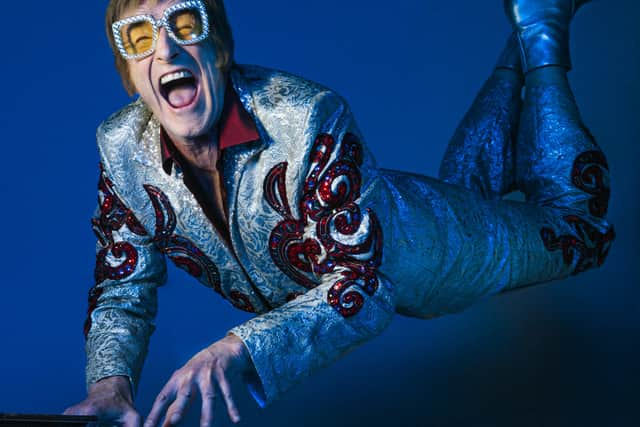
An extraordinary tale ensued which forms the subject of my latest play, Monstering the Rocketman. It involves Ferraris, punch-ups, gangsters, bugged phone calls, a £10 million divorce suit, Princess Diana, the Vice Squad and a pair of ‘devil dogs’. It resulted in Elton settling for a whopping £1 million damages, still the greatest libel payout in British history.
In an era when the tabloids were all about making money, this was a salutary lesson.
I believe it was a turning point in British history, for good and bad. On the positive side, I believe the Press had to become more sensitive to minorities, which paved the way for our more diverse and tolerant Britain. On the negative side was the damage to the reputation of the media.
Elton’s was one of a series of high-profile legal cases and payouts by the tabloids. In 1987-88 alone, the Queen was paid £100k by The Sun; Koo Stark sued The Mail on Sunday for £300k; Jeffrey Archer by The Star for £500k. By the end of the decade, the credibility of the print media was in shreds. In 1990 a survey concluded that only 14% of the British public had confidence in the British press.
It’s easy to criticise the tabloids. But we, the public, played our part. We were willing to pay for thrilling stories, regardless of whether they were true or not. How else to explain the phenomenon of the Sunday Sport, known for headlines like ‘World War II Bomber Found on the Moon’. Its readers surely knew they were being lied to, but they didn’t seem to mind just so long as the storylines were compelling. So who would blame the 1980s popular press editors for ‘hyping up’ and even ‘making up’ stories? That was what we, the public, seemed to be demanding.
In a time of screaming TikTok influencers, vacuous OnlyFans narcissists and demagogues with orange faces, we need a strong, trustworthy source of truth. If nothing else, to dismiss the ‘alternative facts’ and ‘firehose of falsehoods’ corroding our democracy, and to stop us from retweeting the B.S. fed to us by bots.
The Free Press is surely the answer. It needs to be powerful, have free rein, but above all be responsible. Above all, trust has to be rebuilt. That can only be achieved by acknowledging the mistakes of the past, and by examining where the trust was lost: in the mid-1980ss, when profits were placed before truth. It can be done, but as Elton has said, sorry seems to be the hardest word.
Monstering the Rocketman, Pleasance Dome, 4.10pm, until 24 August. www.pleasance.co.uk
Comments
Want to join the conversation? Please or to comment on this article.