
Edinburgh Fringe theatre reviews: The Horse of Jenin | Ordinary Decent Criminal | Consumed
Joyce McMillan looks at three plays dealing with war, from a five-star production celebrating Palestine to an intense solo show from political comedian and storyteller Mark Thomas

The Horse of Jenin
Pleasance Dome (Venue 23) until 25 August
★★★★★
Ordinary Decent Criminal
Summerhall (Venue 26) until 25 August
★★★★☆
Consumed
Traverse Theatre (Venue 15) until 24 August
★★★☆☆
WAR, CONFLICT, and the violence that often simmers beneath the surface, even in the most outwardly peaceful societies. There are dozens of shows on these themes on the 2025 Fringe, some brilliant, others struggling to find the right tone for a play about the worst that human beings can do to one another.
One show that hits exactly the right balance of life-enhancing comedy and utter tragedy, though, is Alaa Shehada’s The Horse of Jenin, produced by Troupe Courage for the Pleasance and the Palestine Comedy Club. In 70 minutes of theatre, storytelling and wild, hilarious comedy, he confronts the current crisis in the Israel-Palestine conflict not directly, but through the story of his youth and childhood in the West Bank city of Jenin, home to generations of displaced Palestinians.


At the centre of that story is the image of the Horse of Jenin, a 15-foot sculpture created out of war debris in 2003, after a previous Israeli Defence Force (IDF) incursion into the West Bank. Designed by German artist Thomas Kilpper, and assembled with a team of Palestinian teenagers, the horse reflected both the conflict and the Arabic tradition of the horse as a symbol of freedom. It eventually took its place at the centre of as mayor Jenin traffic roundabout, until it was bulldozed and removed by the IDF in 2023.
For Shehada, born in Jenin in the early 1990s, the horse was therefore a vital part of his boyhood; and his aim in this show is somehow to rebuild it, with the support of the audience, out of fragments of memory and feeling that can be passed on, even when people and cities are destroyed.
The sheer exuberance of Shehada’s performance is a joy to behold, drawing the audience into the spirit of the show within seconds. All wide-eyed wonder at the crazy beauty of the world despite all the pain it can inflict, and full of hilarious thumbnail sketches of his family and friends, the Horse of Jenin is a terrific tale of Palestinian life, laughter and tragedy under unimaginable pressure, and of human lives given a moment of shape and meaning by a fine piece of art. It deserves to be celebrated as one of the key contributions to this year’s Fringe, bringing life, humanity and even joy to a story shaped by one of the grimmest conflicts of our time.
The great British comedian and storyteller Mark Thomas is a past master at combining comedy with serious and violent subject matter; and in his new solo show Ordinary Decent Criminal – written, like last year’s England And Son, by playwright Ed Edwards – he confronts the complexities of life in a northern English prison in the 1990s, as all the cross-currents of a troubled society wash up in the criminal justice system.
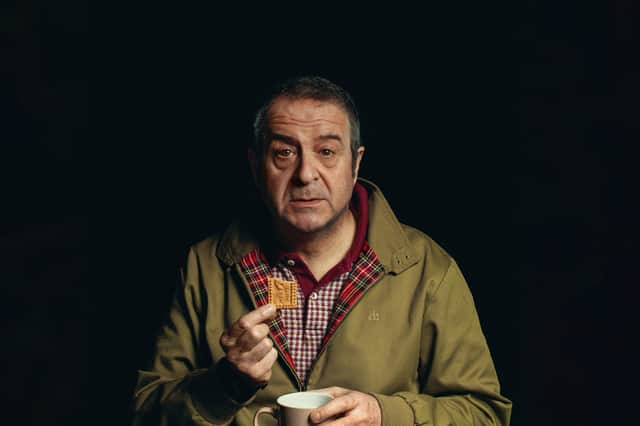
The shaping forces in the prison are the legacy of the Northern Irish troubles on one hand – there is one particularly terrifying character known as Belfast Tony – and the pervasive drug culture on the other. Our hero and narrator Frankie is inside for importing and dealing drugs, although he has been clean for some years, and dreams of becoming a writer. His survival in prison involves some spectacular ducking and diving, and a few strokes of pure luck, as all around him hard men fight for dominance and control, exploiting and abusing the weak.
Frankie’s backstory, though, involves something else; a history in left-wing student politics, including support for the republican cause in Ireland, that comes crashing down on the night in 1989 when the Berlin Wall falls. Frankie cannot join in the general celebration, seeing the collapse of communism as a disaster opening the way to fascism, and sinking into depression and addiction, reinforced by a relationship with beautiful heroin addict Josie. But in prison, his forgotten political activism proves to have its uses, as he navigates the tangled web of influence around Belfast Tony.
Thomas’s evocation of this whole complex scenario, and of all the characters involved, is typically brilliant. And it offers a strikingly vivid portrait of the UK as it was around the turn of the millennium, as seen from its dark and revealing underbelly; a portrait powerful both in itself, and in the extent to which it captures the forces that still shape our society today, for better and for worse.
At the Traverse, Karis Kelly’s Consumed assembles all the right elements for a cutting-edge play about the legacy of conflict – extreme comedy, sudden violence, a lurch into surrealism – but somehow, in Katie Posner’s production, fails to make them cohere into a convincing story about Northern Ireland today, in the long backwash of conflict.
Make sure you keep up to date with Arts and Culture news from across Scotland by signing up to our free newsletter here.
Co-produced by the Traverse, Paines Plough, and a consortium of major English theatres, the play begins as four female generations of a Northern Irish Protestant family gather to celebrate the 90th birthday of great grandmother Eileen, brilliantly played by Julia Dearden. The other attendees are her downtrodden daughter Gilly (a hoarding housewife with OCD), her raging granddaughter Jenny, now living and working in London, and Jenny’s teenage daughter Muireann, a London kid stuck with an Irish name.
Menfolk are strangely absent, for reasons that become more sensationally or chillingly obvious as the 90-minute play unfolds. There’s a final plunge from hard-hitting family comedy into shambolic rage and then dark, surreal tragedy, as great grandmother and great granddaughter scrabble together in the black earth for the bones of a buried past; but the bold shifts in mood are too sudden and capricious to convince, leaving behind a sense of confusion, and of a huge opportunity missed.
JOYCE McMILLAN
Comments
Want to join the conversation? Please or to comment on this article.