
Edinburgh Book Festival round-up: Mark Haddon | Chimamanda Ngozi Adichie
Our latest round-up from the Book Festival features insightful commentary from a pair of literary A-listers on the pleasures of reworking stories and how books can inform, embolden and empower
The Book Festival has so many facets that it’s possible to forget one of the finest pleasures it offers: the chance to listen to great writers talking beautifully and insightfully about writing and about life. One who does this very well is Mark Haddon, still best known for his 2003 novel The Curious Incident of the Dog in the Night-Time, but a writer of many parts: poetry, drama, novels for adults and children and, of course, short stories.
Interviewer Chris Power decided to go through his latest book, Dogs and Monsters, story by story, creating a rich and interesting framework for a conversation. Many of the tales in the book have their inspiration in other stories, from Greek myths to HG Wells and Virginia Woolf. Some simply nod to the original while others are more detailed reworkings. But Haddon always find the twist which makes the story his own.


Take the first in the collection which reworks the story of the minotaur: the child born in shame who must be kept secret is no monster, just severely disabled. It took Haddon a long time to find this twist, he said, but when he did the elements of the story clicked into place in a new way. It felt “psychologically real, not just antique”.
The stories range in their settings from Elizabethan England to Haddon’s old school to a nuclear bunker in York. And dogs weave their way through many of them, notably in a retelling of the myth of Actaeon, the warrior who is turned into a stag by the goddess Diana, only to savaged by his own hunting dogs. When Haddon realised Ovid names 33 dogs in his version but very few of the human characters, he had a moment of clarity: we have more in common with our forebears than we think.
He cheerfully dismissed the idea that “writers know what they’re doing” describing his own creative process as “thrashing around putting things into this big grab-bag on my back”. But he works every day, either in writing or visual art (he began his career as an illustrator). “If I haven’t made anything, either with words or physically, it’s been a wasted day.”
Chimamanda Ngozi Adichie, appearing at the McEwan Hall on Tuesday at lunchtime, looked far too chic to have a “grab bag”. Just off a flight from Lagos, she was greeted by cheers from the crowd like the literary celebrity she is. In a free-flowing conversation with writer and journalist Afua Hirsch, she talked about race, Scottish taxi drivers and the characters in her new novel, Dream Count.
She reflected on her own much quoted line – “I did not know I was Black until I came to America” – explaining that when she gave that experience to one of her characters, an African woman in the USA becoming aware of her own Blackness, her publisher asked her to remove it because “no-one thinks like that”.
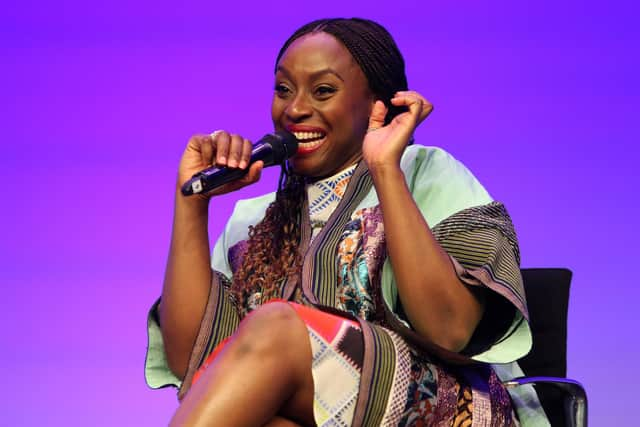
One of the four women whose journeys she maps in Dream Count is based on the true story of New York chamber maid Nafissatou Diallo who, in 2011, accused Dominique Strauss-Kahn, then head of the IMF, of sexual assault and attempted rape (the case was eventually settled out of court). Adichie followed the story avidly, and wanted to draw attention to how Diallo was treated and “the assumptions made about women who are poor, Black, African and immigrants”.
The conversation flowed so smoothly there was time for just a single audience question (from a Black speaker): how to you find the courage to do what you do? After talking about the power of books to “inform, embolden and empower”, Adichie questioned the need for courage at all: “Start with the right you have to be where you are. You are not on the periphery, you are in the centre.”
Comments
Want to join the conversation? Please or to comment on this article.