
Scots Makar Peter Mackay at the Edinburgh Book Festival – 'I want to celebrate all the languages of Scotland'
Be it English, Gaelic or any of the other countless languages spoken in the country today, Peter Mackay tells Susan Mansfield that he wants to platform them all during his three years as Scotland's national poet
IT’S UNUSUAL for a poet to find themselves in the spotlight, but when Peter Mackay was named as the new Scots makar last December - the youngest writer to take up the role, and the first who writes primarily in Gaelic - he found himself being interviewed by people from all over the world.
For the champions of minoritised languages, the appointment was big news, happening at the same time as the Scottish Languages Bill - proposing to recognise Gaelic and Scots officially for the first time as languages of Scotland - was being prepared (it was passed by the Scottish Parliament in June). Mild and unassuming, Mackay - who is also a senior lecturer in Literature at the University of St Andrews - took the attention in his stride. “It’s good to have the opportunity to gab about poetry and to gab about Gaelic on a wider scale,” he says.
He describes the three-year makar post as “somewhere between an honour, a responsibility and a job”. “The things that are asked of me are largely to celebrate literature and literacy, and to encourage people - especially young people - to engage with poetry. One of the ways I want to do this in particular is to celebrate all the languages of Scotland, not just English, Scots and Gaelic but all the languages that are spoken here.”
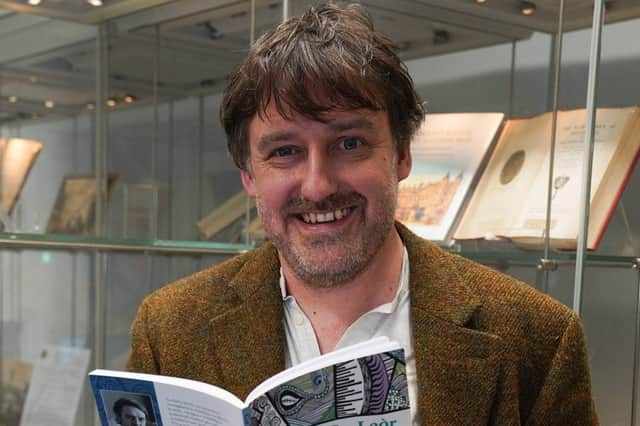

Our conversation keeps circling back to the subject of language. Most poets are obsessed with language, but Mackay is also a linguist, fluent in English, Gaelic and Spanish and able to read and speak “to some extent” in Irish, French, Italian, Danish and Catalan. “I used to play computer games in Swedish. I've translated out of Occitan, but that was through Catalan and French, with dictionaries. I'm interested in languages and their fluidity, and passing between them, as much as anything.”
One of his first projects as makar is Our Many-Voiced Country, which brought together six poets living in Scotland, each working in a different language (or languages), and invited them to translate and respond to each other’s work. They will feature in an event hosted by Mackay at the Book Festival, and further readings and an anthology are planned.
READ MORE: First Gaelic Makar Peter Mackay on his plans to use poetry to tell a new story of Scotland
Working between languages is also central to his own writing (he has two published poetry collections, with a third on the way next year, and is working on a book of literary non-fiction). He grew up on Lewis, speaking Gaelic and English, and, while working on his PhD in Dublin, he made a conscious decision to write his own poetry in Gaelic: “I felt if I didn’t actively work at Gaelic it might become rusty to the point of inoperability, those hinges just wouldn’t open if I didn’t oil them at that point.”
His work is usually published in parallel English and Gaelic versions (though neither is a direct translation of the other) and when reading his work he reads both, the Gaelic first, regardless of whether the audience is Gaelic-speaking. “There’s an obstinacy there as well. The very first reading I did was in Ireland and somebody came up to me afterwards and said: ‘Why have you read in Gaelic and in English when nobody else in the room can understand the Gaelic?’ I said: ‘The English was for all of you, the Gaelic was for me’, partly because I wanted to and partly because it was important.”
Early drafts of poems are usually in Gaelic, but they might go through several journeys between Gaelic and English in subsequent drafts. “I quite often like to see if a poem works in another language. That allows me to ask questions of the original poem as well. What does it means if I have to do different things in English than I could in Gaelic? Or, if they map on to each other very easily, is that a good thing or a bad thing? The two might end up going in different directions.”
Translation is an important part of his creative practice. “I’ve often used translation as a way of getting over writer’s block, or to give myself new poetic forms, phrases, images, ideas. Not as a form of appropriation, but to find ways of using my own voice in different forms, tenors and timbres. Translation tends to open something up inside you, rather than simply allowing you to speak in different languages to other parts of the world.”
READ MORE: The 25 past Booker Prize nominees at this year's event - including Ian McEwan and Samantha Harvey
Historically, it’s being a monoglot nation that’s unusual. “Most of human existence has been bi- or trilingual. The minute that you have to trade between different peoples, different nations, people have this fluidity of speech. I honestly quite like being in a place where I don’t understand everything going on around me, I find that energising rather than terrifying.” He speaks with enthusiasm of a primary school he visited in Fife where the pupils, between them, speak upwards of 20 languages.
Currently, he’s enjoying “taking Gaelic into every room I’m in”, whether that’s a classroom, a cross parliamentary working group, or a conference on rewilding. “I think you have to be a little bit obstinate with this kind of thing and say, ‘Okay, here’s a few words of Gaelic, this is an entirely legitimate form of discourse and communication, let’s see what that adds to questions of environmental diversity, or business development or economics.’”
While the number of Gaelic learners in Scotland has significantly increased, the language is continuing to decline in traditional Gaelic-speaking communities. I ask if he’s concerned. “It’s to be celebrated hugely that so many people are choosing to educate themselves or their children in the language. But we also need to try and find ways to maintain Gaelic as a vernacular or community language.” He suggests there are factors at play which have little to do with language, such as affordable housing and professional jobs, to encourage more young families to stay in the Highlands and Islands.
Mackay says he currently “grounds himself” amid his various roles by translating the poetry of Alasdair mac Mhaighstir Alasdair (Alexander MacDonald), the greatest Gaelic poet of the 18th century, a captain in Bonnie Prince Charlie’s army, and the writer of the first Gaelic dictionary. “There has never been a full version of his poems because they were too Jacobite, or too rude, for different tastes in different centuries. But I think we’re now in a position where we can publish all of his work and have honest conversations about it.
“He had a European-wide sensibility and ambition. He was measuring Gaelic against Latin and Greek as ancient languages, and he was very fluent and very skilled in English too. For him, Gaelic was a fully functioning vibrant European language, and there was no limit to what you could do with it. He allows you to think broadly, to expand your horizons in what you want to do in the language.”
Peter Mackay is at the Edinburgh International Book Festival on 12 August at 6pm in Meeting One’s Makar. The Our Many-Voiced Country project will be presented in Our Mother Tongues on 11 August at 6pm, and he will lead a workshop on translating poetry on 12 August at 1.30pm. www.edbookfest.co.uk
Make sure you keep up to date with Arts and Culture news from across Scotland by signing up to our free newsletter here.
Comments
Want to join the conversation? Please or to comment on this article.