
Creative Scotland committed to 're-emergence' of arts centre on site of defunct CCA

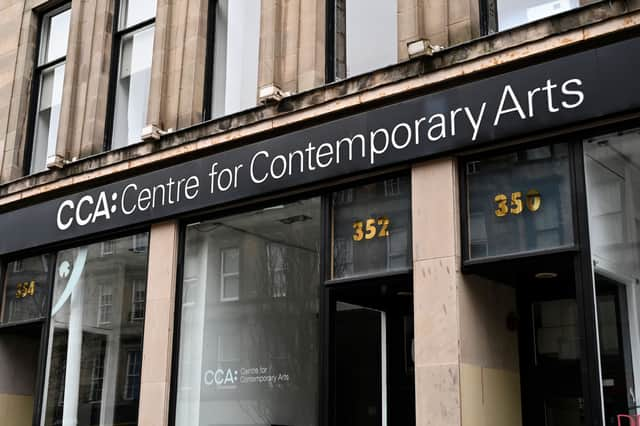
Creative Scotland owns the building formerly occupied by the CCA
Creative Scotland has pledged it is committed to enabling the "re-emergence" of an arts centre on the site of the defunct Centre for Contemporary Arts.
Speaking to MSPs at Holyrood's culture committee, Creative Scotland's chief executive Iain Munro said the non-departmental public body - which owns the building on Glasgow's Sauchiehall Street - had had a lot of interest from third parties over the future of the building since the CCA was announced to have gone into liquidation on Friday.
However, he said it could not "rush into" a reopening and reiterated that the CCA as an existing organisation could not continue due to liquidation.
Creative Scotland has historically charged a peppercorn rent of £1 a year to the CCA.
He said: “We do own the building and it is our intention to ensure we work appropriately through this complex situation to work with others to find a pathway which enables the building at 350 Sauchiehall Street to reopen.
“What we’re committed to is finding a way with others to enable the re-emergence of the building at Sauchiehall Street to come back into use as a cultural asset. It is key for the city but for Scotland too and that’s what we’re going to be focusing our attentions on to enable that to happen.”
Mr Munro said Creative Scotland, which announced £3.4 million in funding for the CCA over three years in January 2025, had been supporting the organisation to reform amid financial and governance challenges.

He said: “Unfortunately, over the course of the past year that hasn’t been successful. It increasingly became apparent that the financial fragilities, the governance fragilities and the leadership fragilities of the organisation, combined with external factors, have all coalesced and the organisation realised itself it was insolvent and notified us of that.”
He said that as “guardians of public funds”, Creative Scotland had to acknowledge that the CCA in its current form “was not viable”. The board of Creative Scotland was due to meet on Thursday afternoon to consider next steps for the building.
He added: “We’re committed to to ‘what next’. We’ve had a lot of interest come forward in terms of the building, its re-opening and ideas around that and we need to engage with that at an appropriate time. We won’t be able to rush into anything, because we need to be able to get something with solid foundations confidently in the position to reopen for the long term.”
No liquidator has yet been announced, however, the CCA’s financial dissolution was reported on Friday by board member Louise Norris, a solicitor at Lindsay’s law firm in Edinburgh.
It emerged earlier this week that Glasgow City Council had loaned £300,000 to the CCA on an emergency basis in August 2024.
Separately, Mr Munro was also asked about the geographic spread of its multi-year funding, after a Scottish Parliament Information Centre (SPICe) briefing document prepared ahead of the meeting showed that per capita funding through its main grants programme ranged from £52.47 in England to just 17p in North Lanarkshire.
Committee convenor Clare Adamson pointed to the SPICe document, saying there was “quite a disparity in provision”.
In January 2025, Creative Scotland announced multi-year funding for more than 250 arts venues and organisations across Scotland.
She said: “Do you think there’s a problem with equity across Scotland? Notwithstanding the fact the cities have most of the cultural activity, is Creative Scotland concerned that there are patches in the country which don’t seem to have the opportunity to secure multi-year funding because of a lack of cultural activity?”
Mr Munro said the funding was “borne from demand within the area” but said Creative Scotland does recognise there are “some areas which are underserved”.
He said the Spice briefing for today acknowledged the per capita measure was “an imperfect one”.
“But it is symbolic of something and we recognise that,” he said.
Comments
Want to join the conversation? Please or to comment on this article.