
Two new books marking Edinburgh's 900th anniversary celebrate the centre but snub the schemes


From the Porteous Riots to Miss Jean Brodie, two new books about Scotland’s capital city cover much of the same, familiar ground. What’s missing from both, though, writes Stuart Kelly, is the Edinburgh outside the routes of the open-top tourist buses
Do we need another book about the Athens of the North – or the Reykjavik of the South as it was wittily dubbed in Tom Stoppard’s Jumpers – let alone two? Both are part of the “Edinburgh 900” campaign, which has entirely passed me by, not least because the anniversary is somewhat arbitrary: the best one can say is that Edinburgh was made a royal burgh by David I at some point before 1127 when it is mentioned in the Dunfermline Abbey charter. Given “Edinburgh” or strictly speaking Eidyn is – as Alan Taylor’s volume points out – mentioned in the c. 7th century Welsh poem Y Gododdin, the whole thing is a bit makey-uppy. But the Council Worthies have deemed it worthy for commemoration, so worthy it must be.
The nature of these books means there is an understandable amount of overlap. It would be remarkable if John Amyatt claiming he could “take fifty men of genius by the hand” just by standing at the crossroads were not mentioned. Predictably enough, there are also fur coats with nae knickers and coal delivered in “sex”. Both include General Joe Smith, the Porteous Riots and the greatest Edinburgh novel, The Heart of Midlothian, and is seems as if the current atmosphere is perhaps more sensitised to riot and rabble rather than the dignified dissent of the Great Disruption.
Alistair Moffat’s book audaciously refers to itself as a “new” history, although almost all of it is already familiar. It is perfectly adequate, although a passable AI might come up with roughly the same text, especially as the bibliography is made up solely of other books on Edinburgh (including, remarkably, Alan Taylor’s anthology, which was published on the same day as Moffat’s own book).
So it is a perfunctory trudge through the highlights – Burke and Hare and Brodies Deacon and Jean. Moffat begins and ends with the same statement rephrased: in terms of skylines “others will argue with passion for their own hometowns but objective observers know that Edinburgh is without rival” and “The fact that Edinburgh is the most beautiful city in the world is not only a matter of subjective judgement; it is also demonstrable”. That kind of balderdash might go down well in some after-dinner speech, but in the city of the Enlightenment it is, to use the word Thomas Carlyle (unmentioned in this book) ruefully applied to Walter Scott, “kleinstadtisch”, “small town-ly”. It is perilously close to Jack McConnell’s cringe-inducing “best wee country in the world”.
Moffat, like Taylor, mentions the ill-fated ring-road scheme and continues the 60-year harrumphing at the modernist buildings in George Square, but the Edinburgh outside the routes of the open-top tourist buses remains terra incognita: Wester Hailes and Craigmillar might as well be Zembla or Xanadu. This is not a book for surprises.
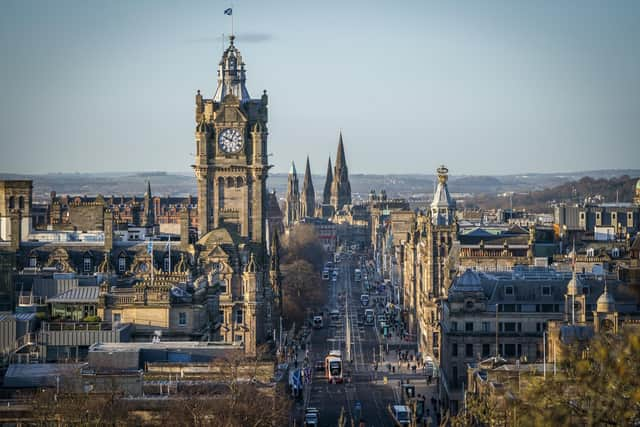
Alan Taylor’s anthology of writing about Edinburgh is by far the better book. The form means that the reader is presented with a range of voices, and it seems to me necessary that a book about a city is a clamjamfry. It also means that stories such as Jenny Geddes throwing her stool in opposition of William Laud’s liturgy are put into context; namely, that the story is of a much later date. Taylor opts for light modernisation in terms of historical texts, and does so sensitively (Moffat does “translate” four lines of Ramsay, although there is only one word – “gash” – that might be unfamiliar, and smart seems to me a better option than wise).
The familiar sits pleasingly here alongside pieces such as Samuel Johnson on the school for the deaf and “Ranger’s Impartial List of the Ladies of Pleasure in Edinburgh”. Particularly when it comes to contentious matters – most notably the Independence Referendum but also the legacy of slavery, especially around the Henry Dundas statue – the passages are judiciously selected. There are always personal favourites - such as the description of children’s games James Bone’s 1911 Edinburgh Revisited – that merit a twinge for being overlooked. It was to be expected that Muriel Spark would feature a great deal, but given how good she was that can hardly be considered a flaw.
Perhaps the greatest surprise in the book is the inclusion of Tom Nairn’s claim that poetry was a substitute for prose culture. It is true that there is nothing comparable to Joyce’s Ulysses (is anything comparable to that novel?); and perhaps the problem is a rictus at modernism itself. That said, finishing with an article on New Town door paint colours from the nigh samizdat community publication Spurtle shows the potential for an almost post-modern Edinburgh. Neither writer, for some reason, mentions Edinburgh Zoo, despite William McIlvanney once meeting Sean Connery there to avoid publicity.
Narrating any city is an endless task, and it does surprise me that there is no psychogeography, no Iain Sinclair, for Edinburgh. We have no books that encompass Gilmerton Cove, the Craigentinny Marbles, the Ballardian interzone of Platinum Point, the talismanically rubbed toe of Stoddart’s David Hume, the Gormleys in the Water of Leith, the Phoebe Traquair murals. These books are not quite the equivalent of Statler and Waldorf, but they did leave me melancholy. In fact, they reminded me of the crushing line from Rita’s mother in Educating Rita: “there must be better songs to sing than this”.
Alistair Moffat, Edinburgh: A New History, Birlinn, £14.99; Alan Taylor, Edinburgh: The Autobiography, Birlinn, £20
Comments
Want to join the conversation? Please or to comment on this article.