
The essential guide to being a good camper in Scotland
Scotland isn’t there to be trashed by careless campervanners, says Martin Dorey. The author of The Green Camping Book shows how to sleep under the stars without it costing the earth.
Things went a little awry in 2020, didn’t they? For a moment there, while all hell was breaking loose in our cities and hospitals, we cared about nothing but our freedom. When the lockdowns ended we all went mad for camping, and especially camping in Scotland. Campsites were the first places to open up, but with restrictions. If you were self-contained (you had your own loo and shower) you could get away from the cloying, suffocating lockdowns in search of your own sweet green glen of heavenly delights. Camper vans and porta pottis were the things to have. North was the place to go. Never mind the consequences.
Scotland’s Right to Roam is huge privilege at any time. For someone who lives in England who has open access to (checks notes) just seven per cent of the land, it is heartbreaking to see it abused. When it’s done right, wild camping is a wonderful freedom. To be able to walk into the wilderness and spend a few nights under canvas? What could be more perfect to help a cooped up population soothe away their worries?
Sadly though, on some mornings after the wild nights before, we occasionally wake to a horror show of wanton carelessness. When freedom-drunk, giddy excitement leads to disrespect and littering, lighting fires where they shouldn’t be lit, driving on the machair, leaving camping equipment in the wilderness (what we now call fly camping) and generally acting with little regard for the Scottish Outdoor Access Code, we risk losing those precious, hard won freedoms. From south of the border this looks like madness. Why would anyone treat the countryside with such disdain, and especially at a time when it needs us more than ever?
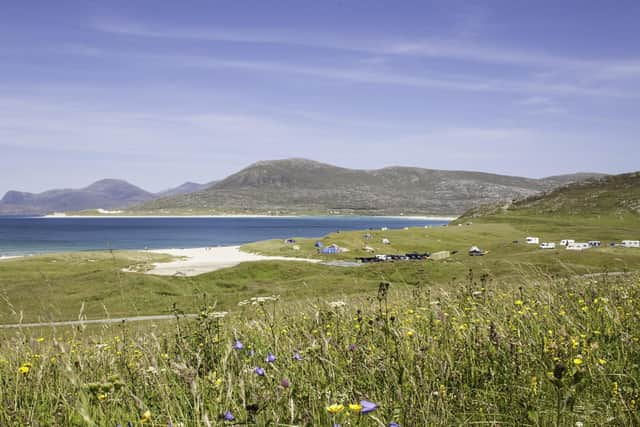

Four years later and, thankfully, we are still in love with camping. We love our festivals. We love the outdoors. We love our camper vans. We love getting off the sofa. We love meeting up with friends. We love life in the wilds. It gives us something that we can’t get anywhere else. Call it blue health or green health or whatever you like. Getting outside is good for us. Simple.
During the summer and autumn of 2023, while slap bang in the middle of writing The Green Camping Book, a book about camping ethically, sustainably and responsibly, I travelled to Scotland to update another book, ‘Take the Slow Road: Scotland’ a guide book for people travelling by motorhome and campervan. Scotland was, as always, absolutely beautiful in every way. We kayaked on Loch Ness (nothing to report), biked down the Blue Doon in the Nevis Range (amazing buzz), spent far too much on local ale in Applecross (ouch my head), watched the most beautiful dawn on the Moray Firth (so beautiful), watched the Northern Lights in the Cairngorms (incredible) and stayed on a fabulous campsite, Solway View, in Dumfries and Galloway (wonderful rewilding – go visit).
Sadly we also turned up on the morning after the night before when we followed the South West Coast 300, a route to rival the NC500, through the beautiful Mennock Pass. We picked up a number of broken camping chairs, about 20 bags of litter and were aghast at the patches of grass that had been scorched by fires and disposable BBQs. It made me more than a little sad. It also served to make me even more determined to make The Green Camping Book as good as it could be and to ensure that everyone who goes camping knows how to do it without trashing the places they go to enjoy. It might be subtle, like saving money (and landfill) by renting a tent from Tentshare, staying on a campsite with brilliant eco credentials or just learning a few basic rules about wild camping. Small, positive actions can add up to make a big difference. At the other end of the scale it means buying kit from people who care about the planet, making your voice heard when it comes to environmental issues, making everyone feel welcome in the countryside and understanding that nature needs all of us to fight for it if we are to turn things around.
I have always felt that people who camp should also be environmentalists, by virtue of the fact that they go camping to enjoy the outdoors and appreciate all that nature has to offer. You are in such close contact with nature that it must be impossible to ignore: you hear the birds sing, taste the salt on the wind and see beauty all around. You sleep under the stars. You play in nature, remembering all those things you learned as a child: how to flick a plantain or make a blade of grass screech between your fingers like a barn owl. As you lie awake, just before dawn, you listen for the sounds of the birds, the rushing stream, the wind in the trees, the knock of the woodpecker. You lie on granite that is millions of years old, with just a sleeping mat to keep the cold away, or park so you can wake and throw open the van’s doors to a vista that’s been shaped by natural forces beyond your imagination. The sun warms your face as you peel back the awning and stare out into the new day. How could you not be an environmentalist?
And yet some of us trash the place. I don’t get it.
When I got up to the NC500 it soon became clear that we (campervanners, motorhomers, bikers and hoons in fast cars) still need to learn a few rules, and also some manners when it comes to the communities through which we pass. We need to learn that there is more to Scotland than the NC500 and Skye, and most of it is absolutely stunning. There is plenty to go around. New routes, which include the SWC300 and the NE250, have just as much to offer and less traffic.
Green camping, of course, is about more than just choosing kit from people who care as much about the environment as you do. It’s about changing attitudes to the places we stay. Scotland isn’t there to be exploited and used up like some exotic food on a bucket list. It should be savoured, of course, but slowly and delicately. You can’t ever hope to understand a place by shooting through it. Its layers need to be peeled back carefully so you can see what’s inside. Getting out of the campervan or the car is just the start. Staying longer in one place, buying food locally, supporting attractions, eating out, taking trips with independent tour operators and – dare I say it – getting involved in community and understanding local stories can all make a huge difference. Whizzing around the NC500 in four days isn’t that.
Making memories is easy. Having a great time is a possibility. Taking your litter home is mandatory.
The Green Camping Book How to camp sustainably, ethically and responsibly by Martin Dorey is out now, published by Bloomsbury Publishing at £23