
The end of an era: Allan Massie reflects on 50 years as literary critic for The Scotsman
After 50 years and thousands of reviews, Allan Massie, The Scotsman’s chief literary critic, is calling time on a love affair with the paper that began in 1976. Now 87 and suffering from ‘wretched cancer’, it is the end of an era. David Robinson visits his friend and reflects on a prolific career as both an acclaimed novelist and critic
The dogs are barking outside the living room. They want to see the stranger who has come to visit Allan Massie, who is propped up by cushions on a couch next to a roaring fire in his daughter Claudia’s house in Doune. A bookcase next to him is full of works by authors he has reviewed and admires – Alistair Moffat, Javier Cercas, Helen Dunmore – but the chances are he won’t be re-reading them.
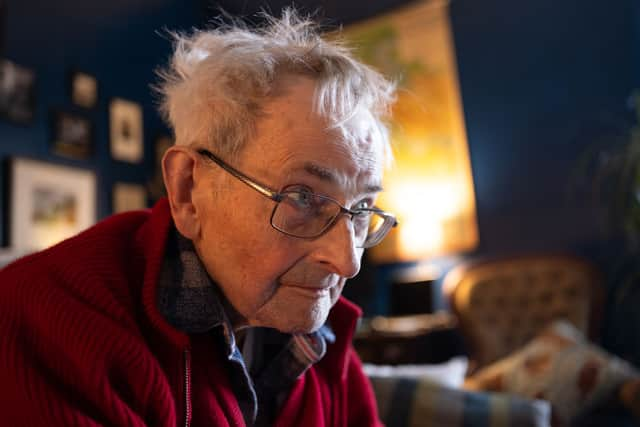

“I’m not reading much these days,” he says. “My eyesight isn’t what it was, so for the last few months I’ve been spending my days sitting here, thinking, reflecting and remembering. If this wretched cancer wasn’t involved, it would all be quite agreeable.”
The “wretched cancer” is the main reason Massie is stepping down from his role as The Scotsman’s chief literary critic. He started reviewing books for this paper 50 years ago. Perhaps there are other freelance book reviewers who have worked on a national newspaper for five full decades, but if there are, I have never heard of them. To do all of that, on top of writing 40 books, including novels that at least two Man Booker judges thought should have won Britain’s top literary prize and non-fiction of the highest quality, seems superhuman.
Let’s have some more numbers. In the 15 years I was The Scotsman’s books editor, Allan reviewed 760 books for our pages, one for each Weekend Scotsman; my predecessor (Catherine Lockerbie) and successor (Roger Cox) have each held the job for 10 years, so that makes another 1,000 books. For the 15 remaining years of Massie’s Scotsman half-century, we can add another 1,500, which brings the total up to 3,260 – or about 300 times more books than the average British home contains. To be completely fair, we must add the ones that Allan has reviewed for the Telegraph, the Spectator and the Herald and various other publications, which must surely take the total soaring far above 5,000. However you look at it, this is an extraordinarily well-read man.
Because the breadth and depth of Massie’s fiction, non-fiction and criticism makes him almost a de facto definition of what a writer should be, it seems almost perverse that for well over a decade of his adult life he wasn’t anything of the kind. The turning point, he tells me, was his friendship with Robert Nye, the poet and novelist who was also reviewing for The Scotsman in the 1970s.
“Robert had written a piece about F Scott Fitzgerald and I’d written to him saying that I liked it but disagreed about something or other. And I got a letter back saying ‘Are you a writer?'” He smiles at the memory.
“Back then I wasn’t. It was 1975 and I was teaching English as a foreign language in Rome. I had written a piece on Italian politics for The Scotsman, and had some reviews published, but The Scotsman connection, in terms of books, started in 1976 with Robert and rolled on from there.”
That year, he and his wife Alison moved back to Edinburgh. He was 38, and after winning scholarships to both school (Glenalmond) and university (Trinity, Cambridge) he had been teaching at the Drumtochty school in Kincardineshire run by Alison’s parents until it closed down in the early 1970s. In 1976 he started both reviewing books for The Scotsman and writing novels – the twin-track career of that now almost extinct species, the man of letters.

“In the 1980s people were more interested in literary fiction than they are now, and I reviewed many of the top novelists. Sometimes I was fairly rude about them, even the successful ones like Iris Murdoch. I remember getting a stern rebuke from [Scotsman music critic] Conrad Wilson because I had given a pretty damning review to one of her novels, which I thought was terribly overwritten.”
These days, he points out, not only are people reading less, what they do read is increasingly dominated by crime. So is the long-heralded death of the novel finally happening?
“No,” he says. “Even if there’s only a small demand, people will go on writing novels, and we can still find some very good ones even from people I hadn’t come across before, like Alexander Starritt’s Drayton and Mackenzie, which I reviewed last year. The first half of that, particularly, was brilliant.”
In his review, Massie singled out the accuracy of Starritt’s portrait of Aberdeen, a salutary reminder that, no matter how clearly I can see him in my mind’s eye at Abbotsford or the Borders Book Festival, or imagine him smoking a Gitane while watching Selkirk play at Philiphaugh, Massie hasn’t always been a Borderer, but grew up in Kintore and Inverurie, Aberdeenshire. His relatives there – all farming folk – are due to visit him at his daughter Claudia’s Stirlingshire home this weekAs in: the week starting Monday 19 January.
I ask him which decade he looks back on with the greatest fondness and at first he says the 1980s, because life got a bit easier for the hard-pressed book reviewer then, when commissioning editors stopped asking critics to round up a number of books in the same review.
Back then, he says, The Scotsman was an unforgettable place. “I can still remember going up the steps at Fleshmarket Close, in at the back door, and along to the old arts room. There were fine people there and in the features room: Allen Wright, Conrad Wilson, Arnold Kemp, Jim Seaton.” Even those whom he would have disagreed with politically – Ian Bell or Colin Bell, say – shine on in his memory.
Then he changes his mind. “No, maybe it was the Nineties. Around then, I had more of my books published in France, starting off with A Question of Loyalties [published here in 1989 and the first in his acclaimed Vichy trilogy], which was followed by The Sins of the Father (1991) and Shadows of Empire (1997). I think they’re among my best.”
That is probably the critical consensus too, although many will make the case for his Roman Emperor series (especially 1986’s Augustus) or wonder why his Bordeaux Quartet has never made it to at least the small screen. I lack the space to discuss his 18 non-fiction books, but anyone praised by both Muriel Spark (for his third book, a study of her work) and Irvine Welsh (for The Thistle and the Rose) must surely be doing something right.
As for me, I’m not going to single out any one of his books, though I do wonder why I haven’t yet read The Ragged Lion, his fictional autobiography of Sir Walter Scott. None of them matter half as much as their author – charming, softly-spoken, witty, wise and so knowledgeable that one always felt he never really needed Google. I have already been talking to him for twice as long as Claudia initially suggested and we have covered everything from what he would like to re-read if he could (Anthony Powell, Graham Greene), French publishers, mentoring, Argentinian rugby, English cricket, devolution, PD James, judging the Booker, and smoking cigars (he still does: a Toscano cut in half will last him a day).
I don’t want to tire him out. Time to head down the road and let the dogs – a long-haired pointer called Otto and a Dandie Dinmont puppy called Tibbie, who both adore him – back in.
The Scotsman’s arts newsletter is now sent twice a week - subscribe today
Want the latest Scottish headlines sent directly to your phone? Sign up to our new WhatsApp channel here
Comments
Want to join the conversation? Please or to comment on this article.