
Poetry reviews: Poetic Responses to Robert Fergusson | Karen Solie | Vicki Husband
On the evidence of these three books the poetry ecosystem is thriving, writes Stuart Kelly
Even compared to non-fiction, which can range from thousand page biographies of minor historical figures to fatuous “Pray Yourself Thin!” self-help, and even fiction, which encompasses subtle explorations of the mystery of being human alongside the downright schlock and pulp of multiple forms – and worse yet the “celebrity novel” – the most diverse, expansive, wide-ranging form is still poetry. I have pondered far too long on if there is anything all poems have in common, or whether just calling something a poem is sufficient to class it as such.
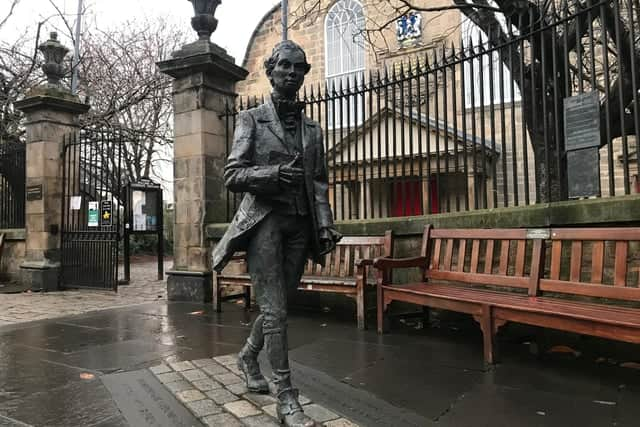

The anthology O’er a’ my labours sey your skill is a reflection of this. It is the result of an invitation to contemporary Scottish writers to reflect on the life and work of Robert Fergusson, the poet whom Burns memorably lamented as “my elder brother in Misfortune, / By far my elder Brother in the muse”; so the idea of poets creating their tributes has a decent precedent. Including a foreword by Andrew O’Hagan, there are 70 works. Fergusson was a curiously heterogenous writer, veering between registers and idiolects, so again it seems unfortunately appropriate that the quality of the work here is, ahem, variable.
In the cacophony, the clamjamfrie, there are some kenspeckle characters, the likes of Tom Pow, Robert Crawford and Sheena Blackhall; although there seems a conspicuous absence in terms of female writers like Jackie Kay, Kathleen Jamie or Jen Hadfield. The fact that there is Gaelic representation is worth commending. Among names I didn’t know, Britta Benson stood out for a sense of slyness and wit; and Calum Esler pleasingly resurrects Edwin Morgan’s “emergent poetry”. As one might expect, many writers take on the traditional forms – especially Standard Habbie – which is easy to do and very difficult to do well: WN Herbert is perhaps the master of its modern form. It was also pleasing to see glances where Scots is more expansive. For example, James Robertson’s poem has the glorious “read his most heronious rhymes – and jings”, a lexical capaciousness.
Jock Stein’s contribution similarly rhymes “psyche” with “crikey” which would tickle RD Laing as much as Fergusson. But on the downside, works like Kate Tough’s finger-wagging (“We’re not here celebrating Roberta”) or a rather first year art-school meditation from Rodge Glass and Ellen Nash seem against the spirit of the festschrift. I do find it passing strange that that there is such as air of inferiority - “His popular legacy pales in comparison to his Ayrshire-born namesake” - since this is the second such book of creative responses to Fergusson. I will not hold my breath for a similar volume on Byron or Scott.

Almost all the poems in the anthology can be “got” on a first reading. The work of Karen Solie, however, who was recently named joint winner of this year’s Forward Prize, is a different proposition. It requires re-reading, and meditation, but it more than rewards it. It is very difficult to quote, but these lines from “That Which Was Learned In Youth Is Always Most Familiar” I think capture her unique style: “But he said Auntie, I think there are two kinds of shapes. / Replaceable and irreplaceable shapes. / Triangles, circles, squares, we can make them. But this / - he held a clot of earth - / is an accident. Will never happen again. / He threw it to the ground / where it shattered in a rhetorical flourish / of one example made various // and each, he promised, singular. / He’s five / And not even I, / who would sooner be right than happy / could argue.”
Most of her work is more oblique but not opaque, and it variously reminded me of the ghostliness of Weldon Kees, the precision of Wallace Stevens and the environmental insight of John Burnside. Solie has a predilection for lists (“wild licorice, clover, corn mint, bergamot”) but brings them into creative juxtaposition with other terms (in that poem, sylvatic, and MotoMaster, and GPS, and moraine). There is a tension between the desire for accuracy and the sense that to grasp something totally is impossible and elusive. I will re-read and re-read these poems. They have the aura of imminent epiphany about them.

Vicki Husband’s collection is also daring. An occupational therapist in the NHS, her book collects prose poems of encounters, all about various forms of illness and estrangement. It is tightly structured, with a double cycle of anonymised alphabetic names. There are catalogue poems dealing with the prefixes and suffixes that are used in diagnoses. Many of the poems reminded me of the “Informationist” works from late 20th century Scotland, in how they deploy technical vocabularies to find new kinds of poetics.
“The Nervous System” is a bravura piece, where the journey of the narrator across Glasgow is intercut and undercut with pre-recorded telephone messages, a blizzard of psychogeographical data, all of it conjuring panic. Overall though, it is a steely presentation of small kindnesses.
Of course, not every collection of poems can be everyone’s cup of tea, and I freely admit to being more a lapsang souchong man than a PG Tips guy. At least the ecosystem of poetry, on the evidence here, is thriving.
O’er a’ my labours sey your skill: Poetic Responses to Robert Fergusson, Rhona Brown and Amy Wilkinson (eds), Taproot Press, £12.99
Wellwater, by Karen Solie, Picador, £12.99
Glasgoscopy, by Vicki Husband, Vagabond Voices, £11.95
The Scotsman’s arts newsletter is now sent twice a week - subscribe today
Want the latest Scottish headlines sent directly to your phone? Sign up to our new WhatsApp channel here.
Comments
Want to join the conversation? Please or to comment on this article.