
Maggie O'Farrell on how family history informed her new novel: 'These are my people'


Maggie O’Farrell tells David Robinson why her latest novel, Land, is so close to her heart
On 16 March, just after 8:30am, I switched on Radio 4’s Today programme and there, live from Los Angeles, waiting for a limo to take her to the post-Oscars Vanity Fair party, was Maggie O’Farrell. I can’t say I know her very well, but I know her somewhat better than I do Jane Fonda, Nicole Kidman, Mick Jagger, Timothée Chalamet, Sam Altman, Larry David, Javier Bardem and all the rest of the A-listers she would soon be moving amongst.
She and director Chloe Zhao hadn’t won the best adapted screenplay award for Hamnet that night, but it didn’t matter. Jessie Buckley had carried off the best actress statuette and O’Farrell’s joy at her friend’s triumph bubbled up over the airwaves from half the world away. Following on from the Today programme’s gloomy headlines (America’s war with Iran, Pakistan’s with Afghanistan, a terror attack in Nigeria) she sounded as though she was trapped in a blissfully surreal dream, the kind where when you think you can hear George Clooney talking behind you and you turn round and he actually is.
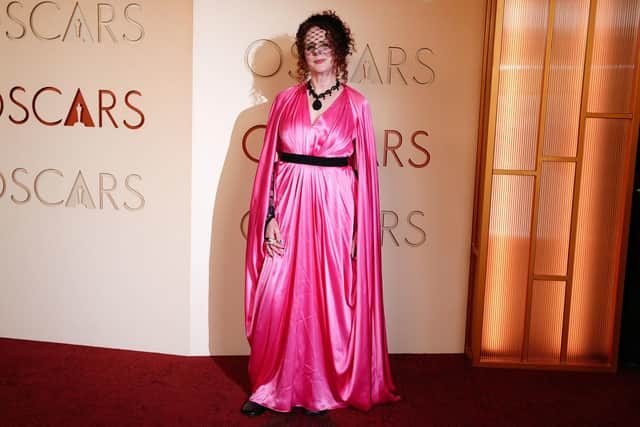
“It’s a very strange day out,” she says of the Oscars, reflecting briefly on the worldwide success (40 languages, 2 million copies) of her novel about how Shakespeare’s family coped with the death of his only son before we talk about her latest, even more ambitious book, Land. “It starts about nine in the morning, when straight after breakfast you get into your evening clothes. There is an awful lot of queuing, and of course when you get there and look around the room there is everyone you’ve seen on screen for the last 40 or even 50 years.
READ MORE: Book review: Hamnet, by Maggie O’Farrell
“But the weirdest thing was when we were waiting in our limos you’d see what looked like huge Transit vans with blacked-out windows. I asked our driver if they were for the catering. ‘No,’ he said. ‘If you’re wearing a really voluminous frock, you can’t sit down, so those vans are specially adapted.’ You stand up and hold onto a pole for hours, like you’re on a crowded bus, just so you don’t crease your dress.”
Most novelists never get to the Oscars because they prefer to hand over their novels to others for adaptation. With Hamnet, O’Farrell opted to write the screenplay – her first – along with Zhao. Why?
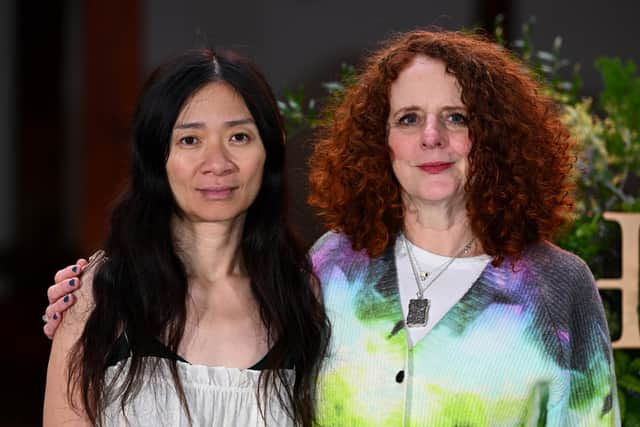
“My first instinct was actually to say no. But I liked Chloe straight away, and she’s a very persuasive person. I’d also just turned 50, and I thought I should stray out of my lane. So I decided to say yes, and I’m glad that I did.”
She has clearly caught the screenwriting bug. Land, an epic novel mainly set in the wake of the Irish Famine, has already been optioned for a film by Hamnet producer Liza Marshall and O’Farrell is going to insist on writing the screenplay: “There are some books I’d be happy to hand over,” she said last month. “But with this one I can’t. These are my people.”
She may have grown up from the age of five in Wales (Bridgend), and from 13 in Scotland (North Berwick) gone to university in England (Cambridge) and brought up her own family in Edinburgh, but O’Farrell was born in Derry and her roots are firmly Irish.
Her new novel is about the land her great-great-grandfather surveyed at the time of the Irish Famine. He was working as an Irish-speaking assistant to the British soldiers working on the Ordnance Survey maps of Ireland. His son trained as a Jesuit priest before following in his father’s footsteps as a map-maker. Hidden from the sunlight in her parents’ home (O’Farrell guards their privacy so fiercely she won’t even say in which country they live), one of the family’s most treasured possessions is a small map the son drew of an imaginary place. In its corner is a medallion-sized picture of his father, holding a measuring chain, standing next to a red-coated soldier looking through a theodolite.
In Land, father and son are fictionalised as Tomás and Liam, and the tensions between them surface as part of a sweeping family story rooted in Tomás’s determination to keep just one hidden, and somewhat mystical, corner of Ireland free from the colonising British and their maps. Yet you could read Land and not find the faintest trace of this thread between fact and fiction. I find that surprising, and I tell her so: if I’d written Land (as if!) I would have certainly mentioned those family connections in an afterword.
“I’m happy to tell that story, but I feel that novels should speak for themselves,” she says. “I’ve taken the few scant details we know about these relatives and woven them into a novel, so it feels like fiction. The novel is one thing, the people are another – and I feel very protective of them. Even though I belong to them, they don’t necessarily belong to me: they had no idea that at one point a great-great-granddaughter was going to come along and write a novel about them. I’m not going to say to readers ‘This is where truth stops and fiction starts’ or vice-versa.”
In any case, she would argue, there are more important truths. The Irish Famine of 1846-52, all but neglected by British writers despite the fact that it left at least a million dead and caused at least the same number to emigrate, is one of them. “I don’t think people in Britain know about it,” O’Farrell says. “Certainly we didn’t learn about it in school. It should be on the curriculum.”
Land does touch on the visceral horrors of starvation in a land of plenty, but its central story is how a family survived and emerged from the shadow of mass death. She had been thinking how to tell it for, she says, “about 15 years”, when one day two years ago, she was on a train from Belfast to Dublin and the novel’s first sentence just came to her. “Suddenly, I could see it all. It was like – appropriately enough – finding a map.”
Land by Maggie O’Farrell is published by Tinder Press, £25. Maggie O’Farrell is at the Edinburgh International Book Festival on 30 August at 6:45pm
The Scotsman’s arts newsletter is now sent twice a week - subscribe today
Want the latest Scottish headlines sent directly to your phone? Sign up to our new WhatsApp channel here
Comments
Want to join the conversation? Please or to comment on this article.