
Looking Down at the Stars by Christina Riley review: 'like an aquatic Nan Shepherd'

In this account of her time as an ‘underwater artist in residence’ in Argyll, Christina Riley’s enthusiasm for the marine environment is contagious, writes Roger Cox
In 2009, in the back room of an Oxford pub, the writers Paul Kingsnorth and Dougald Hine launched the Dark Mountain Project, which they defined as “a network of writers, artists and thinkers who have stopped believing in the stories our civilisation tells itself.” In a document they published at the time, titled Uncivilisation: The Dark Mountain Manifesto, they set out various parameters for a new kind of writing – “Uncivilised Writing” – which they felt would be better suited to addressing the “social, economic and ecological unravelling” of our Anthropocene era than what had gone before.

I’m instinctively suspicious of any attempts to create rules or guidelines in areas of creative endeavour. That said, I’ve returned to the Dark Mountain Manifesto many times since it was first published, and the more the years roll by, the more pertinent it feels. Not only that, I’ve also come to realise that some of the most resonant writing of our age fits like a glove with many of the points in the manifesto. Did Kingsnorth and Hine help make the early 21st century literary weather? Or did they simply come up with an accurate forecast? Either way, their manifesto makes a fascinating lens through which to read some of our best contemporary writing, and that’s certainly the case with Looking Down at the Stars – the new book from Ayrshire-based artist and writer Christina Riley. I have no idea whether Riley has read the Dark Mountain Manifesto or, if she has, whether she agrees with its principles, but there’s no denying that her book ticks some important Dark Mountain boxes.
I first became aware of Riley during the pandemic, when her “The Beach Today” social media posts made her something of an internet sensation. Every day, during her permitted one hour of lockdown exercise, she would go beachcombing on her local beach, then photograph her finds – shells, pebbles, pieces of driftwood, fragments of pottery – and post the results online. The images she produced during this time were subsequently made into a photobook, published in 2021; more importantly though, it was a creative process that fired her love for the ever-changing space between land and sea – or, as she puts it: “I had fallen for this beach completely.”
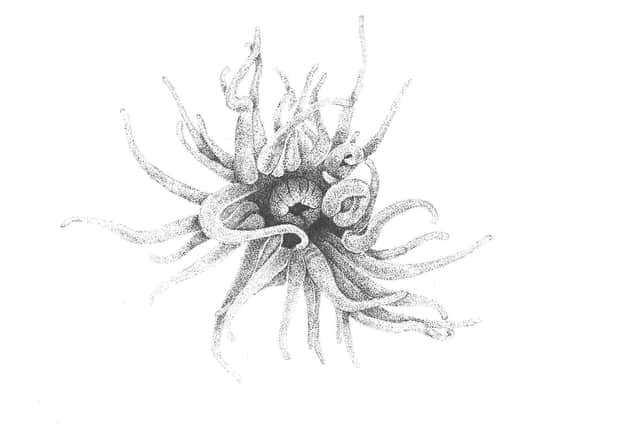
In 2022, Riley became an “underwater artist in residence” at the The Argyll Coast and Islands Hope Spot – Hope Spots being ocean areas identified by the Mission Blue environmental charity as particularly critical to the health of the marine environment – and it’s this experience which she recounts and meditates on in her new, self-illustrated book. As she begins to explore the underwater world in her new role, she increasingly comes across like an aquatic Nan Shepherd, with a desire to “look into the sea, not at it” (shades of walking “into the mountain”). As with Shepherd, her enthusiasm for this new-found world is infectious: “Completely submerged, everything went silent, as though put on mute, while what I saw had the volume turned right up. The colour, the light, how it moved and shapeshifted. I was still on my doorstep... and yet the world as I knew it opened up, unravelling endlessly before me.”
The Argyll Hope Spot begins at a north-south line between the Ardnamurchan peninsula and the north coast of the Isle of Mull, runs south-east from there to Oban, then south until about two-thirds of the way down the Sound of Jura. It is the first Hope Spot in Scotland, in recognition of the huge variety of marine life it supports, from charismatic megafauna like dolphins and minke whales to much smaller organisms like serpulids and sea lemons, not to mention critically endangered flapper skates. On the whole, though, it’s the smaller organisms that interest Riley the most, in particular the ones that experience the world around them in a very different way to us. She is delighted by the idea that brittle stars “see and feel at the same time with their body”, for example, and wonders of sea squirts: “why do they glow when they already bathe in the light of the shallows? Maybe that’s the wrong question. Why only glow if you live in the dark?”
In these leaps of imagination, she is very much aligned with the Dark Mountain Manifesto. The fifth of eight “Principles of Uncivilisation” laid out by Kingsnorth and Hine is as follows: “Humans are not the point and purpose of the planet. Our art will begin with the attempt to step outside the human bubble. By careful attention, we will re-engage with the non-human world” – there could hardly be a more perfect description of Looking Down at the Stars. Riley is similarly in accord with Kingsnorth and Hine’s third principle: “We intend to challenge the stories which underpin our civilisation: the myth of progress, the myth of human centrality, and the myth of our separation from ‘nature’”. Here’s Riley on sea sponges: “Of all the animals on Earth, sponges are one of the simplest, though I’m not sure what this means. The sponge can do a lot of things that I could never do and don’t understand... and no animal that can survive on this planet for 700 million years, through every mass extinction (so far) is simple.” What better antidote to overbearing human arrogance than the idea that we might have something to learn from a sponge?
Looking Down at the Stars: Life Beneath the Waves, by Christina Riley, Saraband, £12.99
The Scotsman’s arts newsletter is now sent twice a week - subscribe today
Want the latest Scottish headlines sent directly to your phone? Sign up to our new WhatsApp channel here
Comments
Want to join the conversation? Please or to comment on this article.