
Debut author Chris Barkley on his Hebridean whodunnit, The Man on the Endless Stair
A stay on the Isle of Eigg gave Chris Barkley the spark of inspiration he needed to complete his debut novel, he tells Malcolm Jack, ahead of his appearance at this month’s St Andrew’s Book Festival in London
Chris Barkley is racking his brain trying to remember exactly when he had an epiphany in a bothy on the Isle of Eigg that led to his extraordinary debut novel, The Man on the Endless Stair. “It’s funny,” he says, “I write a lot about time but I’m really bad with dates.”
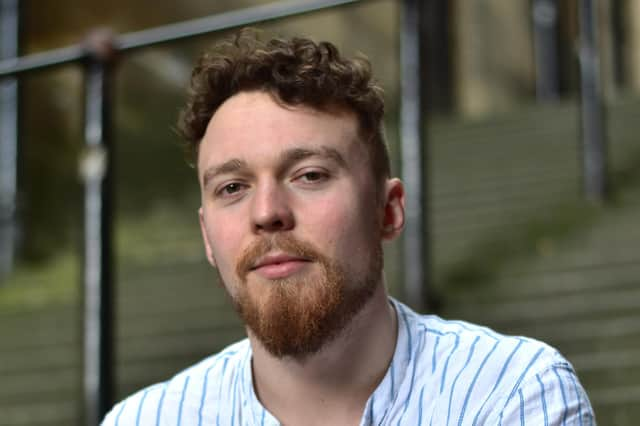

The Swindon-raised, Edinburgh-based 29-year-old author reckons it must have been 2022, not long after finishing his masters in creative writing at Oxford, while he was on a wild camping expedition around Scotland as a break from his day job working in a book packing warehouse. Alone with his thoughts on a Hebridean island, a brainwave suddenly washed over him as to how he could finally make sense of a concept for a story which had been rattling around his head for about four years. “An inward journey” as he describes it, one that “plays with the idea of time”. He had in fact already written an entire novel based upon the concept by this point, but it was scrapped because it lacked the right form.
Barkley’s idea needed new skin, and he found it while staring out to sea among the ferns and the sheep dung on a Hebridean hillside – islands so often being the setting for great murder mysteries. “Something which is quite important about a psychological inward journey,” he reasoned, “is that it cultivates a sense of mystery.”
“It was only on visiting Sweeny’s Bothy on Eigg that I kind of had the place which felt suitable to apply that broad plot structure to.”
Published this summer by Polygon, The Man on the Endless Stair is the tale of a troubled young author and war veteran, Euan, who has been taken under the wing of the decorated novelist Malcolm Furnivall, helping him to get ahead in the rarefied literary scene of the 1950s. When Malcolm suddenly summons his nearest and dearest, Euan included, to his home on a secluded, Eigg-esque Hebridean island, it’s clear that something sinister is brewing. Malcolm is discovered brutally murdered in his study, and it’s up to Euan to venture deep into the labyrinthine Furnivall mansion to figure out the truth about his mentor’s demise - and, more importantly, locate his valuable final manuscript before it falls into the wrong hands.
So far so Cluedo. But rest assured, however you may think this fantastical, page-turning locked room mystery ends, you’ll almost certainly be wrong. The book’s punchy PR pitch - “Agatha Christie meets Italo Calvino” - gives some sense of the weird alchemy Barkley performs in his crisp and exacting writing, which has won him the Oxford University Kellogg Writing Competition and the Bedford International Writing Prize. On which note, let us return to the author’s favourite literary device: time, and its bending.
Growing up, Barkley loved literary deep thinkers who opened his mind to uncertain universes full of strangeness and variety – writers like Ursula K Le Guin, Jorge Luis Borges and Italo Calvino. “I think Emerson said that time is what eternity looks like when experienced by the mind,” says Barkley.
“That’s what I love to talk about. That’s what Borges talks about as well, the idea that time is something which is constructed by the mind and is perhaps malleable. Ideas which are being discussed now in quantum physics.”
Another of the Small Isles, Eigg’s neighbour Rùm, supplied an additional vital ingredient to The Man on the Endless Stair’s rich literary stew in the shape of Kinloch Castle – the ridiculous 20-bedroom red sandstone mansion built by wealthy textile-mill owner John Bullough in 1900 (at a cost of nearly £27 million in today’s money). Left to decay for decades now, the weeds slowly reclaiming it stone by stone, it’s a tragically beautiful monument to Victorian grandeur and excess. It proved fine inspiration for the mad Furnivall manor at the heart of Barkley’s book.
The house is, he says, is “a reflection of Malcolm’s personal unconscious and his sense of individuated self, of ‘Me’ existing separate to the world, of his ambition.”
“It’s not a nice place,” Barkley adds. “What looks grand and awe-inspiring and enigmatic and strange and all that is ultimately a place where lots of bad stuff happens. In the novel, I describe how the land is kind of challenging the manor’s right to be there. That’s a symbolic idea which is playing out in our lived reality with Kinloch Castle.”
Yet more real-world experience shaped the book in the form of Barkley’s very formative spell as Writer in Residence at the Edinburgh Book Festival in 2022. His responsibilities involved working closely with young, disadvantaged people in the North Edinburgh area as a creative writing facilitator. It heavily influenced what he calls “the central dramatic question” of the novel.
“The protagonist is a war veteran,” says Barkley. “Euan has lost his sister, and as a result he’s developed these very reactive behaviours. He’s very rigid in his understanding of reality, and he’s very deterministic. That’s how he’s survived the war, viewing things in that way, which is his trauma response. Throughout the course of the novel he’s presented with challenges to that deterministic way of viewing the world, and towards the end he is given the opportunity to re-examine that worldview and potentially accept that we live in an uncertain universe.”
“I’ve worked with trauma experienced young people for quite a long time,” Barkley continues, “and I’ve seen the effects that trauma has, and cycles which young people find themselves in, completely blamelessly. So, I think that’s maybe the most important question: how does one escape a cycle of trauma?”
The Man on the Endless Stair by Chris Barkley is published by Polygon, price £14.99. Chris Barkley is appearing at the St Andrew’s Book Festival in London on 26 November, see www.standrewsbookfestival.org. The Scotsman is the official media partner of the St Andrew's Book Festival.
The Scotsman’s arts newsletter is now sent twice a week - subscribe today
Want the latest Scottish headlines sent directly to your phone? Sign up to our new WhatsApp channel here.
Comments
Want to join the conversation? Please or to comment on this article.