
Cleare Perspectives by John Cleare review: 'an insider's eye view'


For much of his career John Cleare’s photography put him right at the cutting edge of mountaineering, and now his work and life are celebrated in a new book. Review by Roger Cox
It’s hard to know where to start when talking about Cleare Perspectives, the monumental, 600-page book by the late adventure photographer John Cleare, because it’s a hugely impressive achievement on three different fronts. Even if all you got for the admittedly not insignificant £45 cover price was the lifetime’s worth of jaw-dropping images, taken on everything from Everest expeditions to Colorado whitewater rafting escapades to dramatic ascents of lonely Scottish sea stacks, you’d surely have to consider it money well-spent. The book also succeeds as an autobiography, though, being a series of rattling good yarns, each one more improbable-sounding than the last, and it succeeds as a physical product, too, a triumph of tasteful typography and stylishly understated design, lovingly produced by the team at the Scottish Mountaineering Press.
Cleare primarily made his living as a photographer, however, so it perhaps makes sense to start with the photos. After a brief stint in the Royal Artillery following National Service, the young Englishman had his “eureka moment” in 1956 when he “quite casually” went to see the graduation show of students at the Guildford School of Photography. “There were ethereal landscapes,” he writes, “there were macro shots of insects and the insides of flowers; there were portraits and more. It was unlike anything I had seen before or had even realised could exist... Determined to learn more, I began writing letters and obtained a prospectus.”
Cleare was already a keen climber at this stage, spending his holidays on “Cornish sea cliffs, Welsh crags or Scottish mountains”, and so it wasn’t long before he started combining his passions. Headhunted straight out of college by The Queen magazine, then a competitor of Vogue, he quickly learned to work “under pressure and against deadlines” on a variety of projects. However, it wasn’t long before his climbing photos started gaining attention, initially in the British Mountaineering Council’s magazine, Mountaineering, and as the swinging 60s progressed and climbing and mountain-going began to develop more cultural cachet, he was increasingly able to specialise.
As Cleare is careful to point out, though, every image he produced was built on the foundations provided by his photography course. “Many people possess what is known as an eye,” he writes, “they can recognise a photogenic subject, a scene, a play of shadows perhaps, or a combination of shapes, but are then lost as to what exactly it is that is special. The recognition of this and how to treat it is what we call composition... it can be taught, and we were expected to learn it.”
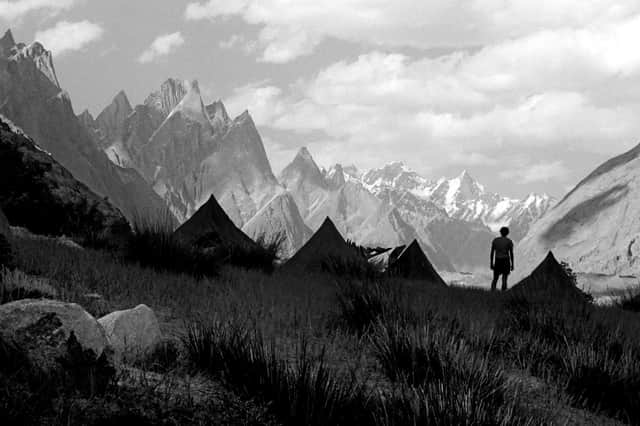
Looking at some of the more memorable images Cleare captured during his extensive career, which, he writes, only really ended “shortly before covid struck”, at which point he was well into his 80s (he died in 2024 at the age of 88), you can see how this carefully cultivated understanding of composition stayed with him throughout his life. It’s there is a memorable image of climber John Evans crossing a crevasse on a makeshift bridge during the ill-fated 1971 International Everest Expedition, shot looking up from deep inside the dark, icy cavern, its steep sides perfectly framing Evans against a deep blue sky; and it’s there in the way he lines up a row of imposing, pyramid-shaped peaks in Pakistan’s Karakorum mountains with a row of similarly pyramid-shaped tents in the foreground. Plenty of adventure photographers put themselves in harm’s way in order to capture moments of extreme human endeavour; Cleare, though, must surely be one of only very few who have been able to frame these moments in a way that both communicates the full dramatic force of the situation and aspires to aesthetic perfection.
As for the text, well, Cleare has so many good stories to tell that, even were he a very average writer, they would still be well worth reading. As luck would have it though, half a lifetime on the lecture circuit presenting his photographs to appreciative audiences all around the world seems to have imbued him with an innate sense of how to grab and hold the attention.

For much of his career, Cleare’s photography put him right at the cutting edge of mountaineering. In addition to his compelling insider’s eye view of the imploding ’71 expedition to Everest, there are tales of his time working as a cameraman on the BBC’s groundbreaking 1967 live broadcast of Sir Chris Bonington and Tom Patey climbing The Old Man of Hoy sea stack; his stint assisting Clint Eastwood with the making of The Eiger Sanction in 1974; and the top-secret promotional work he did on Mont Blanc with Sir Ranulph Feinnes ahead of his 1996 crossing of Antarctica, gatecrashed by a TV reporter who, based on Cleare’s reaction, probably wished he’d stayed at home. The lesser-known adventures often make for even more engrossing reading – for example, a daring escape from armed and angry rangers while climbing on the wrong side of the border between Zaire and Uganda.
Then finally there’s the physical manifestation of the book itself. The images are well-chosen and given space to breathe, the design is elegant and unfussy, and the decision to break up the story with themed portfolios gives a rich, 360-degree view of the artist. So yes, £45 might sound like a lot for a book, but in this case it’s a steal.
Cleare Perspectives: Capturing the Spirit of Adventure, by John Cleare, Scottish Mountaineering Press, £45
The Scotsman’s arts newsletter is now sent twice a week - subscribe today
Enjoying the Arts & Culture journalism on scotsman.com? Make it easier to find by selecting us as a preferred Google source
Want the latest Scottish headlines sent directly to your phone? Sign up to our new WhatsApp channel here
Comments
Want to join the conversation? Please or to comment on this article.