
Book reviews: DM Black: Dante’s Paradiso | Robert Crawford: Old World | Eloise Birtwhistle: Splenectomy
These three Scottish poets deserve to get a lot more attention, writes Stuart Kelly
It is regrettable that DM Black’s poetry is not better known. Black grew up in St Andrews and studied in Edinburgh: I came across his work in Penguin Modern Poets #11, alongside Peter Redgrove and DM Thomas, a selection of oblique rather than opaque avant-garde works. Finding other works by him always had a frisson of esoteric discovery. His translation of Dante’s Purgatorio won the American Literary Translators Association 2022 National Translation Award in Poetry, and now we have the completion, his version of Paradiso, a text that the translator and crime writer Dorothy Sayers referred to as an acquired taste.
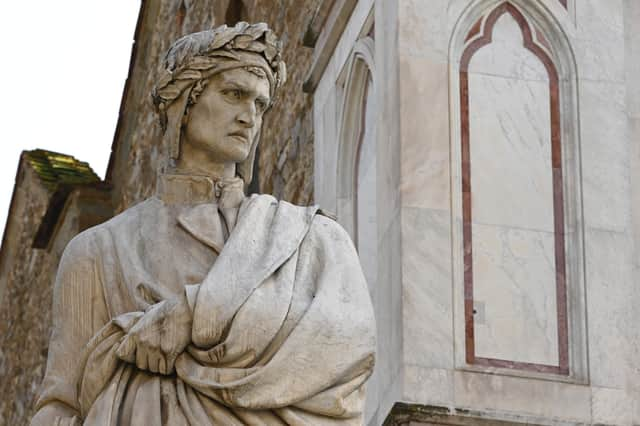

I am, it seems, old enough now to appreciate it, and Black’s lucid translation (with a parallel text) is a version to savour. Black does not imitate the rhyming technicalities, and can justify it with reference to Dante’s own ranking of content higher than form. Things like the acrostic in Canto XIX – LVE, lue meaning plague, rendered as “pox” by Kirkpatrick and “rot” by Palma – are forgone in favour of the clarity of thought. Dante, like Milton later, achieves a crystal sharpness describing heaven, leaving the baroque, knotty and fantastical to the demons. This also has the advantage that some of the chains of imagery are clearer, from the ships at the beginning and end to the frequent images of arrows. It does not stop Black using some neologisms – “in-him’d”, “transhumanising” – which chime exactly with the frequent declarations of language being insufficient to the task.
Black trained as a psychoanalyst, and wryly notes that his opening précis mentions neither psychology nor religion, yet his is the most astute version I have read in terms of both. The translation fulfils and emends lines from an earlier poem, “Subjectivity”, where there is a horror that “but / when to the / worried self I turn I / turn and / wander astray, or / footle about the brim”. For all the theology, it is the awe and the ache that shines through here. Dante is the most patient of writers – you have to mature to appreciate him – and the Paradiso is a patient poem: goodness is acquired gradually. Black deserves alleluias for this work.
Robert Crawford’s Old World is delightfully sprightly, given its awareness of transience. In some ways, it feels as if there is a degree of rewarded license here, a sort of cocked snook at things (almost a grand proving of the lines of Yeats in “Why Should Old Men Not Be Mad?” – “if their neighbours figured plain, / As though upon a lighted screen, / No single story would they find”). Crawford ranges from tight haiku forms that also pay homage to Anglo-Saxon riddles in the titular poem, to more expansive pieces. One of these, an “Essaythalmium”, is truly joyous, ending “& find inside the two words ‘With love’ & underst& them, & the meaning of the library, & life’s one lasting meaning, which is just, after all, one word” (which somehow recalls the end of Dante, “turned / with the Love that moves the sun and all the stars”).
Crawford is the author of an authoritative life of TS Eliot, and it pleasing here to see it transformed in “The West Land”, “A Global Warning”. Although it has a serious theme – a gasping, burning world – this Australian transplantation is full of wit: “April is the crudest month”, shanty instead of Shantih. It is fiddling, a little, at the apocalypse. Unlike much evanescent modern poetry, Crawford can deliver maximum re-readability in the smallest space, as in “God is both the word / And the white paper on which / The word is written” or “The future was not / The Citroën Deux Chevaux. / It was two horses”. It is also encouraging to see the legacy of Edwin Morgan continues with concrete poetry alongside translations. One poem was special for me: an elegy for Roger Lonsdale, who was my tutor at university. I wonder what people will make of it who never knew Roger, but the portrait - “an ever-grey suit, furtively smoking” – conjures him precisely. We could tell how good our essays were by the number of cigarettes he smoked: any more than two and you had lost his interest.
Eloise Birtwhistle’s Splenectomy is a pamphlet that shows a great deal of promise. The imagery here is striking - “the two sides of your scar ridged / like the lips of a cowrie” - and there is a very clever interplay of registers, between the archaic and contemporary medical, diving and marine life. The horseshoe crab becomes both arcane and scientifically accurate (its blood being used for vaccines), the diving images parallel the hazy demi-monde of being anaesthetised. Pamphlets are not embryonic collections, but their own form, as seen here by the use of hand signal line drawings. Baudelaire’s “spleen” was a kind of listlessness and acedia: if its removal leads to such engaged and enlightening work, it’s all to the good.
Scotland does have an engaging poetry scene. Would that these writers got as much attention as over-alliterated unfunny comedy and hyper-caffeinated solipsism.
Dante’s Paradiso, by DM Black, New York Review of Books, £17.99; Old World, by Robert Crawford, Jonathan Cape, £13.00; Splenectomy, by Eloise Birtwhistle, Stewed Rhubarb, £6.00
Comments
Want to join the conversation? Please or to comment on this article.