
Exclusive:Authors should 'hang heads in shame' over 'tremendous damage' to sector, says outgoing book festival chief
Alistair Moffat is to step down as head of the Borders Book Festival after 22 years

Authors including Ali Smith, Zadie Smith and Robert Macfarlane, who backed protesters whose threats resulted in the end of a major corporate sponsorship for Scottish book festivals ought to "hang their heads in shame" because of the "tremendous damage" they did to the sector, the outgoing head of the Borders Book Festival has warned.
Alistair Moffat, who is announcing his departure from the festival he founded 22 years ago, branded protest group Fossil Free Books "brain free books" and said the campaign, which resulted in festivals including his own, as well as the Edinburgh International Book Festival, ending their partnership with financial firm Baillie Gifford was "stupid and ill-thought through".
Mr Moffat, who is to step down after this year's event in June to hand over to long-term director Paula Ogilvie, said the festival was in "good financial shape", after plugging the hole left by Baillie Gifford with high net worth individuals who had donated to the event.
He said he believed private patronage from individuals was the way forward for literary festivals and other events in the future, warning anyone relying on extra public funding would be "disappointed".
In 2024, Borders Book Festival, along with the Edinburgh International Book Festival and Hay Festival in Wales, ended their sponsorship with Edinburgh-based fund manager Baillie Gifford after protests from Fossil Free Books.
At the time, Mr Moffat issued a statement saying the festival took the decision “with great regret”, while Edinburgh International Book Festival chairman Allan Little said the organisation could nor deliver a safe and sustainable festival with the constant threat of disruption from activists.


A protest over Baillie Gifford’s links to fossil fuel investments was backed by climate change campaigner Greta Thunberg, as well as a number of high profile authors including Smith, Macfarlane and Smith.
Mr Moffat said: “I think these idiots did terrible damage, and they ought to be ashamed of themselves, and they have, of course, disappeared, and nobody hears from them.
“But the people like Robert Macfarlane and Ali Smith and Zadie Smith who supported them ought to hang their heads in shame, frankly, because they did tremendous damage to the book festival sector, tremendous damage.
“The whole thing was so stupid and ill thought through. Baillie Gifford had been exemplary sponsors. They are terrific, and we miss them very much. I think many of the the partners were very disappointed, because they wanted to be involved in and help in that sector, particularly with young people. I thought [what happened] was cultural vandalism.”
He said the festival had been unable to find a single corporate sponsor to replace the company and said the view of targeting individual benefactors was one “shared by other organisations”.
He said: “We're in a situation where, with everything that's happening in the Middle East, the economy is not in great shape and that has an impact directly on companies’ willingness to sponsor things. We do well with sponsorship, but not as well as we used to, because Baillie Gifford did contribute a lot of money.

“I took the view that the public funding and indeed commercial sponsorship was not likely to expand significantly. What we have done is to plug the gap with individuals, very generous, high net worth individuals who have become supporters and benefactors of the festival. That's how we've done it. Because if you seek public funding to shore that up, you're going to be disappointed, because there's not much of it around.”
Mr Moffat, who founded the festival in 2004, said his departure had been planned for around 18 months, but that he wanted to ensure funding had been secured before he left.
He said: “This festival will be my last one, which will be 23 festivals, so it's a decent shift. You get to a point of life where you think, ‘there's other things I want to do’, there's no problem or crisis or anything like that.
“We kept very quiet about it, because we wanted there to be a good succession plan and a good transition. I wanted things to be in place, particularly in terms of financial support, for the festival before I left.”
He said the event would be in “very safe hands” with new director Ms Ogilvie, who has been involved with the festival since its inaugural year.
The festival was founded in 2004, when Mr Moffat, then a director of the Wynd Theatre in Melrose, was approached by the artistic director with the opportunity to “do something” to fill a free weekend in its schedule.
“I’d been to book festival in Edinburgh and elsewhere and I thought, ‘Well, why don't we have a festival in the Borders, in Melrose?’.”
He invited four authors: Melvin Bragg; Norman Davies, William Dalrymple and Alan Massie.
“We sold out, which was great, but, but what was more important was that there was a real buzz in the air,” he said. “I thought, ‘Well, why don't we do it again next year?’.”
Director of the Edinburgh Festival Fringe for five years from 1976, Mr Moffat, also a celebrated author, had experience in running festivals.
“I had good contacts, so what I did was just to write to the most famous people I knew who had books out,” he said. “I said, we'll bring you up first class on the train to Berwick, and we will put you in lovely accommodation, wine and dine you like a prince or princess and pay you the miserable fee of £150. How can you resist?
“And Michael Palin and Germaine Greer and Sheila Hancock and Ian Rankin couldn't resist. That's when it really took off.”
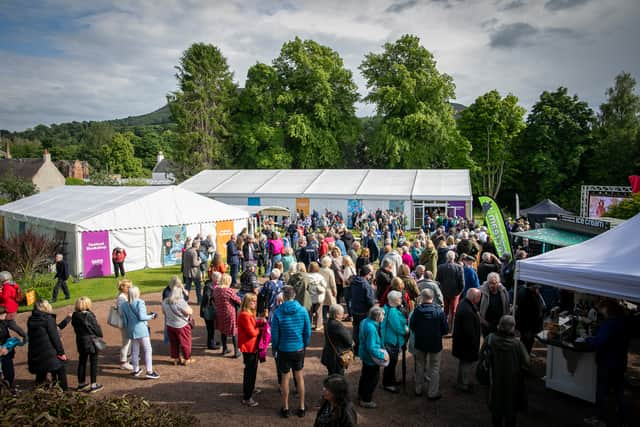
Since then, the festival has expanded massively, initially into the Corn Exchange, then the Melrose Festival Ball Marquee and in 2007, into Harmony Garden.
Footfall over the four-day festival is now around 40,000, while the festival’s economic impact for the Borders is in the region of £3.4 million.
“It's significant. But that wasn’t the point at all. We did it because we thought it was a good thing to do.”
He is looking forward to next year, when he can attend the festival “as a civilian”.
“Everything changes,” he said. “Every event has a character that's often bestowed by whoever runs it and it needs to change and it'll change for the better. Paula Ogilvie, who's taking over from me, has been working alongside me for a long time as a fellow director, so she knows the thing inside out and is extremely good at her job.”
He added: “I’ve got 100 per cent confidence that the festival will go from strength to strength, so I'll be cheering from the touchline next year.
“I'll be in the queue to get into the marquee. I look forward to that and it'll be great to be a civilian. Maybe they’ll even give me a free ticket.”
Ms Smith, Mr Macfarlane and Ms Smith were contacted for comment.
Comments
Want to join the conversation? Please or to comment on this article.